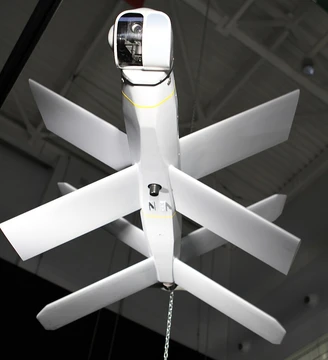
NAI CK-1
China's first indigenously developed drone, derived from the Soviet La-17.

The NAI CK-1 is a target drone, and the first unmanned aerial vehicle built by China. It is based on the Soviet Lavochkin La-17. Work on the drone started in the early 1960s under the People's Liberation Army Air Force, but the Nanjing Aviation Institute took over the project in 1968. The drone entered service around the late 1970s.
Development began after China decided to reverse engineer the Soviet-supplied La-17, which had been used for training since the late 1950s. The Sino-Soviet split cut off further supplies, prompting this effort. The PLAAF’s Weapon Test and Training Base, led by General Zhao Xu, started the work in the early 1960s. The Cultural Revolution halted progress, but it resumed in April 1967 at NAI. The first test launch took place in late 1969, possibly in October or on 6 December. Trials finished in 1976, and the drone entered PLAAF inventory in March 1977, though design certification may not have come until 1979.
The CK-1A radiation reconnaissance variant was created to replace manned aircraft for air sampling during nuclear tests. A March 1977 requirement drove its development. China’s 22nd nuclear test, on 17 September 1977, was the first live use of the drone; it passed through the mushroom cloud twice and landed safely.
The CK-1B low-altitude target drone, meant for surface-to-air missile training, began development in February 1980. It first flew on 18 May 1982 and formally entered PLAAF inventory in February 1983.
The CK-1C enhanced manoeuvrability target drone started development in May 1983. It first flew in September 1984 and underwent certification testing from February to March 1985.
The CK-1 has several changes from the La-17. It uses a domestic autopilot and data link, a reinforced airframe, and revised fuel and electrical systems. The La-17’s RD-900 ramjet could not be reverse engineered, so it was replaced by a non-afterburning version of the WP-6 turbojet, a Chinese copy of the Soviet Tumansky RD-9B. This mirrors the La-17M’s development. Fighter engines near the end of their service lives were converted for drone use. The CK-1 takes off using a trolley for a rolling start. Later variants use a solid-propellant rocket booster to shorten the take-off distance. The La-17, by contrast, launches from a ramp. The CK-1 lands with a parachute recovery system.
The CK-1A carries an air sampling pod under each wing.
Quick Facts
- Aircraft Type
- Target Drone
- National Origin
- People's Republic of China (PRC)
- Manufacturer
- Nanjing Aviation Institute
- Introduction
- 1970s
- Developed From
- Lavochkin La-17
Facts from the source article.
Lore & Background
The PLAAF had used Soviet-supplied La-17s for training since the late-1950s. When the Sino-Soviet split ended further supply, China decided to reverse engineer and produce the UAV as the CK-1. Development began in the early-1960s at the PLAAF's Weapon Test and Training Base under General Zhao Xu, but work was halted by the Cultural Revolution. It resumed in April 1967 at the Nanjing Aviation Institute (NAI). The first test launch occurred in late-1969, possibly in October or on 6 December, with trials completing in 1976. The drone entered the PLAAF's inventory in March 1977 but may not have received design certification until 1979.
The CK-1 features a number of changes to the La-17, including a domestic autopilot and data link, a reinforced airframe, and revised fuel and electrical systems. The La-17's RD-900 ramjet could not be reverse engineered and was replaced by a non-afterburning variant of the WP-6 turbojet, the Chinese version of the Soviet Tumansky RD-9B used by PLAAF aircraft. Fighter engines nearing the end of their lives were converted for drone use. The CK-1 makes rolling take-offs using a trolley, and later variants reduced the long take-off distance with a solid-propellant rocket booster. It uses a parachute recovery system.
Several variants were developed. The CK-1A radiation reconnaissance drone was developed in response to a March 1977 requirement to replace manned aircraft in nuclear weapons testing air sampling. China's 22nd nuclear test on 17 September 1977 was the first live test to use the drone; it passed through the mushroom cloud twice and landed safely. The CK-1B low-altitude target drone began development in February 1980, first flew on 18 May 1982, and entered the PLAAF's inventory in February 1983. The CK-1C enhanced manoeuvrability target drone began development in May 1983, first flew in September 1984, and underwent certification testing in February-March 1985.
Reader's Guide
The NAI CK-1 holds significance as China's first domestically developed drone, marking the country's entry into unmanned aerial vehicle technology. Its development overcame the disruption of the Cultural Revolution and the technical challenge of reverse engineering the Soviet La-17 without access to its ramjet engine, instead adapting a turbojet from fighter aircraft. The CK-1A variant demonstrated a unique operational role by replacing manned aircraft in nuclear test air sampling, passing through a mushroom cloud twice during China's 22nd nuclear test. The subsequent CK-1B and CK-1C variants expanded the drone's utility for surface-to-air missile training and enhanced manoeuvrability testing, while the CK-1E ultra-low-altitude variant simulated terrain-following cruise missiles. The drone's legacy lies in establishing a foundation for Chinese UAV development, with its design influencing later target drones and reconnaissance platforms. Its use of converted fighter engines and parachute recovery system reflected practical engineering solutions that persisted in later Chinese drone programs.
Did You Know?
- The CK-1 was derived from the Soviet Lavochkin La-17 unmanned aerial vehicle.
- General Zhao Xu is known as 'the father of the Chinese UAV'.
- The CK-1C demonstrated 4 g turns during testing.
More in Loitering Munitions and Target Drones 1-24
Spotted an error? Know more?
Reader corrections go straight into our review queue. Suggest an edit · How this site is sourced