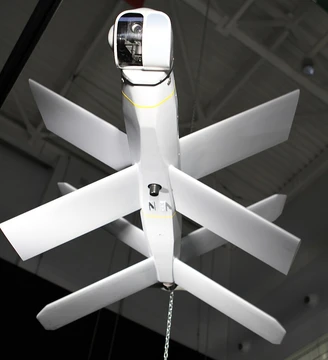
McDonnell TD2D Katydid
Pulsejet-powered target drone for U.S. Navy gunnery practice.

The McDonnell TD2D Katydid (company designation McDonnell Model 31) is a pulsejet-powered target drone produced by McDonnell Aircraft for the United States Navy. It entered service in 1942 and was used for anti-aircraft and aerial gunnery practice, continuing in use until the late 1940s.
Quick Facts
- Aircraft Type
- Target drone
- National Origin
- United States
- Manufacturer
- McDonnell Aircraft
- Primary User
- United States Navy
- First Flight
- 1942
Facts from the source article.
Lore & Background
In March 1941, the U.S. Navy awarded McDonnell Aircraft a contract for a radio-controlled target drone under the designation XTD2D-1. The aircraft featured a mid-mounted wing, V-tail, and a McDonnell XPJ40-MD-2 pulsejet engine mounted atop the rear fuselage. It could be launched by catapult from the ground or from underwing racks on Consolidated PBY Catalina flying boats. The drone was gyro-stabilized and controlled by radio command; at the end of its mission it could be recovered by parachute.
The Katydid entered service in 1942, with testing conducted at the Naval Air Missile Test Center in Point Mugu, California. Production models were originally designated TD2D-1, but the Navy changed its designation system in 1946, redesignating the XTD2D-1 and TD2D-1 as XKDD-1 and KDD-1, respectively. Later that year, the Navy changed McDonnell's manufacturer code letter from 'D' to 'H', resulting in the KDD-1 being redesignated as KDH-1.
Reader's Guide
The McDonnell TD2D Katydid served as a dedicated target drone for the United States Navy from 1942 into the late 1940s, providing realistic training for anti-aircraft and aerial gunnery crews. Its pulsejet powerplant, while noisy and inefficient for manned aircraft, was well-suited for a disposable or recoverable drone, offering simplicity and high speed. The drone's ability to be launched from both ground catapults and PBY Catalina flying boats increased its operational flexibility. The Katydid's design incorporated gyro-stabilization and radio control, allowing it to simulate enemy aircraft maneuvers. Its recovery by parachute enabled reuse, reducing costs. The multiple redesignations—from TD2D-1 to KDD-1 to KDH-1—reflect the Navy's evolving aircraft designation system and the need to distinguish McDonnell from Douglas Aircraft. A surviving KDH-1 is displayed at the Steven F. Udvar-Hazy Center of the National Air and Space Museum, donated by the U.S. Navy in 1966, preserving the legacy of this early pulsejet drone.
More in Loitering Munitions and Target Drones 1-24
Spotted an error? Know more?
Reader corrections go straight into our review queue. Suggest an edit · How this site is sourced