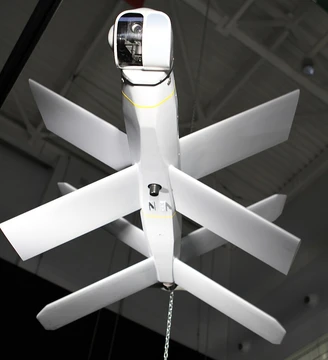
KSR-5
Soviet long-range air-launched cruise missile and anti-ship missile.

The KSR-5, also designated as the Kh-26 (NATO reporting name AS-6 Kingfish), was a long-range, air-launched cruise missile and anti-ship missile developed by the Soviet Union. It was essentially a scaled-down version of the Kh-22 'Kitchen', primarily carried by the Tupolev Tu-16 bomber. The missile was notable for its Mach 3 speed and nuclear or conventional warhead options, serving as a key standoff weapon for Soviet strategic bombers.
Quick Facts
- Origin
- Soviet Union
- Is Ranged
- yes
- Service
- 1969−1994
- Designer
- Tupolev and Mikoyan Missile Design Bureau
- Mass
- 4500 kg
- Length
- 10.56 m
- Diameter
- 920 mm
- Max Range
- 400 km
- Filling
- High-explosive, HE semi-armour-piercing, nuclear
- Filling Weight
- 930-1000 kg
- Yield
- 350 kT (Nuclear)
Facts from the source article.
Lore & Background
Developed in the late 1960s, the KSR-5 was an improved version of the Kh-22 missile, designed to be smaller, lighter, and with a smaller radar signature. According to Janes, it was designed jointly by the Tupolev and Mikoyan Design Bureaus. Originally designed to be carried on the Tu-22 'Blinder', it was primarily mounted on the Tu-16 'Badger', but could also be mounted on Tu-22M 'Backfire' and Tu-95M 'Bear' aircraft. The missile entered service in 1969, with later versions for the Tu-95 and Tu-95M introduced in 1973 and 1976 respectively.
Reader's Guide
The KSR-5 represented a significant evolution in Soviet cruise missile design, offering a more compact and stealthier alternative to the Kh-22 while retaining high supersonic performance. Its development reflected the Soviet shift in the early 1960s away from nuclear free-fall bombs toward standoff missiles, driven by advances in jet fighters and surface-to-air missiles. The missile's variants included nuclear, anti-ship, and anti-radiation versions, giving it flexibility against both naval and ground targets. By June 1991, an estimated 300 missiles were carried on Badger-G bombers. Following the dissolution of the Soviet Union, remaining missiles were used by Russia and possibly Ukraine until 1994. With the retirement of the Tu-16, nuclear versions of the KSR-2 and KSR-5 were retired by 1993. Most of the remaining Russian inventory was converted into supersonic target drones, with target variants such as the KSR-5NM and KSR-5MV offered for export in 1993. This conversion extended the missile's service life and provided a cost-effective supersonic target for training and testing.
Did You Know?
- It could carry a 350 kiloton nuclear warhead or a 930 kg conventional HE SAP warhead.
- The missile had a maximum range of 400 km when launched from high altitude.
- Target variants KSR-5NM and KSR-5MV were offered for export in 1993.
More in Loitering Munitions and Target Drones 1-24
Spotted an error? Know more?
Reader corrections go straight into our review queue. Suggest an edit · How this site is sourced