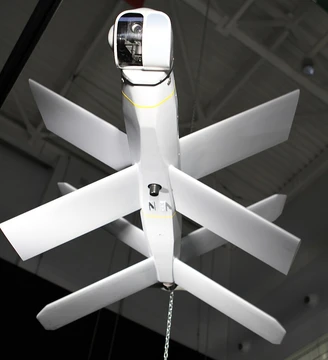
Globe KD2G Firefly
Pulsejet-powered target drone operated by the U.S. Navy from 1947.

The Globe KD2G Firefly is a pulsejet-powered target drone developed by the Globe Aircraft Corporation for the United States Navy. It first flew as the XKD2G-1 prototype in 1946 and entered service in 1947, becoming the first successful jet-powered target drone after World War II.
Quick Facts
- Aircraft Type
- Target drone
- National Origin
- United States
- Manufacturer
- Globe Aircraft Corporation
- Primary User
- United States Navy
- Retired
- ~1954
- First Flight
- 1946
- Developed From
- Globe KDG Snipe
- Developed Into
- Globe KD6G Firefly
Facts from the source article.
Lore & Background
The KD2G Firefly was a mid-wing, twin-tailed aircraft similar in design to the earlier KDG Snipe. Its fuselage was constructed of steel tubing with a duralumin monocoque covering, and dural was also used for the flying surfaces. A single pulsejet engine was mounted atop the rear of the fuselage: the McDonnell PJ42 in the KD2G-1 and the Solar PJ32 in the KD2G-2. The drone was equipped with radio control with an effective range of 6,000 yards. It could be launched via catapult or aerially from JD-1 or F7F-2D aircraft. Recovery, if the drone survived its mission, was by a 32-foot-diameter parachute; the Firefly was designed to float for up to 15 minutes in the event of a water landing. The improved KD2G-2 began production in 1950. The KD2G remained in service through the mid-1950s, being replaced by the KD6G.
Reader's Guide
The Globe KD2G Firefly holds significance as the first successful jet-powered target drone developed after World War II, entering U.S. Navy service in 1947. Its pulsejet propulsion and radio control system, with a range of 6,000 yards, allowed it to simulate enemy aircraft for gunnery and missile training. The drone's design, derived from the KDG Snipe, featured a steel-tube and duralumin construction, and it could be launched by catapult or from carrier aircraft. Recovery via parachute and its ability to float for up to 15 minutes on water reduced losses. The KD2G-2 variant, powered by a Solar PJ32 engine, began production in 1950 and represented an incremental improvement. The Firefly's operational use into the mid-1950s, when it was succeeded by the KD6G, underscores its role in the early Cold War development of unmanned aerial targets. A surviving KD2G-2 is displayed at the Aircraft Pavilion of Battleship Memorial Park in Mobile, Alabama.
Did You Know?
- The KD2G Firefly was powered by a pulsejet engine mounted atop the rear fuselage.
- Recovery was by a 32-foot-diameter parachute, and it could float for up to 15 minutes.
- A KD2G-2 is displayed at Battleship Memorial Park in Mobile, Alabama.
More in Loitering Munitions and Target Drones 1-24
Spotted an error? Know more?
Reader corrections go straight into our review queue. Suggest an edit · How this site is sourced