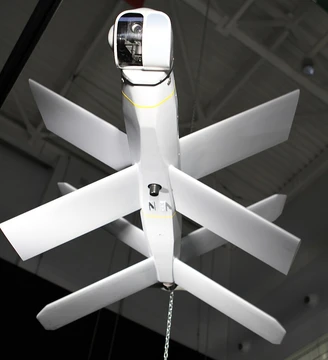
Fire Shadow
Surface-launched loitering munition with six-hour endurance.

Fire Shadow is a loitering munition built by MBDA for the British Army. It can stay above a battlefield for up to six hours before striking stationary or moving targets. The weapon weighs under 200 kilograms and is considered inexpensive. It launches from the ground and has a range of roughly 100 kilometres, flying to a target zone and then circling until it attacks with precision. Test launches have been carried out from a trailer on land.
A 2009 Royal Navy brochure indicated that Fire Shadow could fit within the SYLVER vertical launch system of the Type 45 destroyer, but that possibility was not mentioned again after the 2010 Strategic Defence and Security Review. MBDA has continued developing a Maritime Fire Shadow version as a private venture, with no buyers so far. At the DSEi exhibition in September 2011, marketing materials showed a launcher similar to the land-based one, strapped to the helicopter deck of a frigate or helicopter carrier.
The first complete test firing, checking flight, navigation, and control systems, occurred on 21 November 2010 in Vidsel, Sweden. A second test followed on 13 May 2011. Operator training began in 2011, and the first production systems were delivered in March 2012. The 39th Regiment Royal Artillery was planned to be the first unit to receive the system and deploy it in Afghanistan by 2012, but that never happened.
In 2013, the National Audit Office reported that after spending £207 million, the Ministry of Defence had not decided on the project’s future. However, the 2014 NAO Major Projects Report listed Fire Shadow among the eleven largest equipment projects where the MoD had taken the main investment decision. After a period in limbo, the UK cancelled Fire Shadow in the 2017–2018 defence budget. Phase 1 of the programme—covering concept, assessment, demonstration, and initial manufacture—was forecast to cost around £200 million in 2011.
- Weight
- Less than 200 kg
- Range
- Approximately 100 km
- Loiter time
- Approximately six hours
- Launch method
- Surface-launched
- First complete test firing
- 21 November 2010 at Vidsel, Sweden
- Second test firing
- 13 May 2011
- Programme cost (phase 1 forecast, 2011)
- Around £200 million
Lore & Background
Fire Shadow was designed by MBDA for the British Army. It weighs less than 200 kg and is relatively cheap. The munition is surface-launched and has a range of approximately 100 km; it can fly to a target area and then loiter for approximately six hours before precision attack on a specific target. Test launches have been performed from a trailer on land.
A Royal Navy brochure released in January 2009 revealed that Fire Shadow was compatible with the space envelope of the SYLVER vertical launch system of the Type 45 destroyer, but this option has not been mentioned since the Strategic Defence and Security Review of 2010. MBDA pursued Maritime Fire Shadow as a private venture, with no customers as yet. Their marketing materials at DSEi in September 2011 showed what appeared to be a similar launcher to that used on land, lashed to the helicopter deck of a frigate or helicopter carrier.
The first complete test firing (a test of flight, navigation and control systems) took place on 21 November 2010 at Vidsel, Sweden, followed by a second on 13 May 2011. Operator training started in 2011, with the first deliveries of production systems in March 2012. It was planned that 39th Regiment Royal Artillery would be the first unit to receive the system and would deploy it operationally in Afghanistan by 2012. This plan, however, never materialised.
Reader's Guide
Fire Shadow's significance lies in its role as an early British attempt to field a loitering munition, a class of weapon that combines drone endurance with missile precision. The programme reached production deliveries in March 2012 and operator training began in 2011, with plans for operational deployment in Afghanistan by 2012 that never materialised. After spending £207 million, the Ministry of Defence had yet to decide on a future for the project as of the 2013 National Audit Office report. However, Fire Shadow was listed in the National Audit Office's 2014 Major Projects Report as among the eleven largest equipment projects where the Ministry of Defence had taken the main decision to invest. After a period in 'limbo', Fire Shadow was cancelled in the UK's 2017-2018 defence budget. Its legacy is that of a promising but ultimately cancelled project, with a maritime variant pursued privately by MBDA but attracting no customers.
Did You Know?
- Fire Shadow can loiter for approximately six hours before attacking a target.
- The first complete test firing took place on 21 November 2010 at Vidsel, Sweden.
- The programme cost forecast for Phase 1 was around £200 million in 2011.
More in Loitering Munitions and Target Drones 1-24
Spotted an error? Know more?
Reader corrections go straight into our review queue. Suggest an edit · How this site is sourced