Feilong (loitering munition)
A Chinese loitering munition series with anti-radiation and multi-role variants.

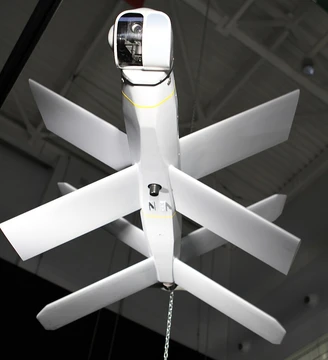
The Feilong (FL), also called the Cruise Dragon or Loitering Dragon, is a family of loitering munitions made by Norinco. The series includes multiple variants that differ in size, endurance, and launch method. The Feilong-5A is a small quadcopter-style munition. The Feilong-10A, or Loitering Dragon 10A, uses a mortar-like launcher. The Feilong-30 can be fired from trucks, armored vehicles, or naval ships. The Feilong-60A and Feilong-60B (Loitering Dragon 60A and 60B) are launched from the SR-5 multiple rocket launch system. The Feilong-60A has a cruise-missile profile, with a rocket motor, rectangular body, panel wings, and four cruciform trailing edges. The Feilong-60B is a more typical loitering munition design, with an electro-optical seeker for reconnaissance, four folding wings, and propellers. The Feilong-300A is an anti-radiation loitering munition with a 300 km range. Also known as the ASN-301, it is a low-cost weapon for Suppression of Enemy Air Defenses (SEAD). Its delta-wing design copies the IAI Harpy drone, which China bought in the 1990s. Israel planned to upgrade China’s Harpies in 2004, but the United States blocked the deal, leading China to reverse-engineer the drone. The ASN-301 carries an anti-radiation seeker for hunting radars and a laser proximity fuse that disperses 7,000 preformed fragments. It weighs 135–200 kg, has a range of 280–300 km, and can loiter for four hours. It was first shown publicly in 2017. Another variant, the Feilong-300D, reportedly has a range of 1,000 km.
- Developer
- China North Industries Group Corporation (Norinco)
- Variants
- Feilong-5A, Feilong-10A, Feilong-30, Feilong-60A, Feilong-60B, Feilong-300A, Feilong-300D
- Feilong-300a weight
- 135–200 kg
- Feilong-300a range
- 280–300 km
- Feilong-300a loiter duration
- 4 hours
- Feilong-300d range
- 1000 km (reported)
Lore & Background
The Feilong series includes a range of loitering munitions for different roles. The Feilong-5A is a small quadcopter configuration. The Feilong-10A is launched from a mortar-like launcher. The Feilong-30 can be launched from trucks, armored vehicles, and naval ships. The Feilong-60A and Feilong-60B are launched from the SR-5 multiple rocket launch system; the Feilong-60A resembles a cruise missile with a rocket motor, rectangular body, panel wings, and four cruciform trailing edges, while the Feilong-60B has an electro-optical seeker, four folding wings, and propellers.
The Feilong-300A, also called ASN-301, is a low-cost anti-radiation loitering munition designed for Suppression of Enemy Air Defenses (SEAD) missions. It features a delta-wing configuration modeled after the IAI Harpy drone, which China purchased in the 1990s. Originally, Israel planned to upgrade the Harpy bought by China in 2004, but the deal was canceled after the United States' intervention, eventually leading to China reverse-engineering the drone. It is fitted with an anti-radiation seeker for hunting radars and a laser proximity fuse for dispensing 7,000 preformed fragments. The ASN-301 was publicly unveiled in 2017. Another variant, called Feilong-300D, reportedly has a range of 1000 km.
Reader's Guide
The Feilong series represents a significant Chinese development in loitering munitions, offering a range of platforms from small quadcopters to truck- and ship-launched systems. The Feilong-300A (ASN-301) is notable as a reverse-engineered derivative of the Israeli IAI Harpy, following the cancellation of an upgrade deal due to U.S. intervention. This anti-radiation variant is designed for SEAD missions, carrying an anti-radiation seeker and a warhead of 7,000 preformed fragments triggered by a laser proximity fuse. The series also includes the Feilong-60A and Feilong-60B, which are launched from the SR-5 multiple rocket launch system, and the Feilong-300D with a reported extended range of 1000 km. The Feilong-5A and Feilong-10A provide smaller, portable options. The public unveiling of the ASN-301 in 2017 highlighted China's growing capability in loitering munitions for electronic warfare and radar suppression.
Did You Know?
- The Feilong-300A is also designated ASN-301.
- The Feilong-300A carries 7,000 preformed fragments and uses a laser proximity fuse.
More in Loitering Munitions and Target Drones 1-24
Spotted an error? Know more?
Reader corrections go straight into our review queue. Suggest an edit · How this site is sourced