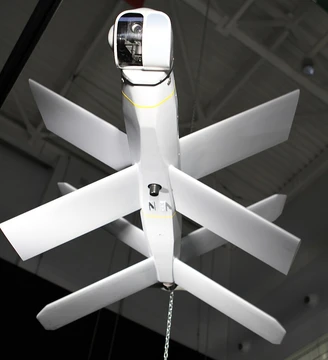
Curtiss KD2C Skeet
American target drone cancelled after unsatisfactory pulsejet performance.

The Curtiss KD2C Skeet is an American target drone developed by Curtiss-Wright for the United States Navy. It was intended for air-launch and use in fleet gunnery training, powered by a pulsejet engine. The program began in 1945 but was cancelled in 1949 after the design proved unsatisfactory.
Quick Facts
- Aircraft Type
- Target drone
- National Origin
- United States
- Manufacturer
- Curtiss-Wright
- First Flight
- 1947
Facts from the source article.
Lore & Background
The KD2C Skeet was developed by Curtiss-Wright for the United States Navy beginning in August 1945. The first prototype flew in 1947. The drone was powered by a pulsejet engine mounted internally, with control provided by a radio command system assisted by a gyrostabilizer. Two variants were produced: the KD2C-1 with a Continental pulsejet engine, and the KD2C-2 with a McDonnell J-9 or J-11 pulsejet of the same diameter.
During wind tunnel and flight tests at the Navy's Missile Test Center at Point Mugu, California, the internally mounted pulsejet produced low speed and high fuel consumption. These deficiencies led to the cancellation of the program in 1949, and the last of the produced aircraft were out of service by 1951. A surviving KD2C-2 was donated to the National Air and Space Museum in 1971 and is on display at the Steven F. Udvar-Hazy Center.
Reader's Guide
The Curtiss KD2C Skeet represents a post-World War II attempt by the United States Navy to develop a pulsejet-powered target drone for fleet gunnery training. Its development from 1945 to 1949 reflects the transitional period in aviation technology, where pulsejet engines were explored for unmanned applications. The Skeet's failure due to low speed and high fuel consumption highlighted the limitations of internally mounted pulsejets in this role. The program's cancellation and the removal of the last aircraft from service by 1951 underscore the rapid pace of technological change in the late 1940s. The donation of a surviving KD2C-2 to the National Air and Space Museum in 1971 preserved a physical record of this short-lived program. The Skeet's legacy is primarily as a footnote in the history of target drones, illustrating the challenges of achieving satisfactory performance with early pulsejet designs.
Did You Know?
- The KD2C Skeet was powered by a pulsejet engine and intended for air-launch.
- The program began in August 1945 and was cancelled in 1949.
- The KD2C-2 used a McDonnell J-9 or J-11 pulsejet engine.
More in Loitering Munitions and Target Drones 1-24
Spotted an error? Know more?
Reader corrections go straight into our review queue. Suggest an edit · How this site is sourced