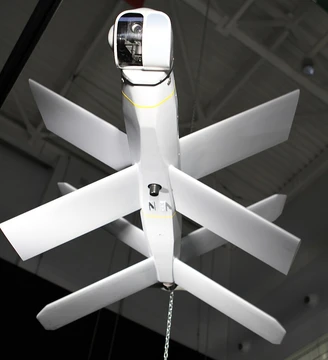
CTV-N-2 Gorgon IIC
Experimental drone for guided missile control and homing tests.

The U.S. Navy began developing the Gorgon IIC late in World War II as a pulsejet-powered bombardment missile for ship-to-shore attacks. Plans for the invasion of Japan in April 1945 called for several hundred of these missiles, with an initial batch of 20 prototypes from the Naval Aircraft Modification Unit in Pennsylvania and an order for 100 placed with the Singer Manufacturing Company in August 1945. The war’s end canceled production, but development continued, and in October 1945 the missile was designated KGN-1.
The Gorgon IIC shared a canard layout with the Gorgon IIA air-to-air missile, featuring a high-mounted monoplane wing, plus vertical and ventral stabilizing fins. Its 14-inch-diameter pulsejet, developed at the Naval Engineering Experiment Station, sat above the rear fuselage. Launch methods included a ground catapult or sled with a 900-pound-force rocket booster, or from a carrier aircraft. In its original bombardment role, it was meant to use active radar homing similar to the Bat guided bomb.
Testing began in 1946. Later that year it was redesignated KUN-1 to reflect a non-combat role, then CTV-2 in September 1947, and finally CTV-N-2 in 1948. The drone tested guidance and control systems for guided missile development. In 1950, an active radar guidance system was trialed on a CTV-N-2, successfully homing from 9 nautical miles. The Navy considered the trials generally satisfactory.
Eight target drone versions were produced, originally called TD3N-1 but redesignated KD2N-1 in March 1946. The KD2N was used in parachute-recovery trials around 1950.
The RTV-N-15 Pollux derived from the Gorgon IIC airframe, with the pulsejet moved to an internal mounting and a mix of radar and infrared guidance intended. First flown in 1948, it had only three flights by 1951, when the program was canceled.
A single RTV-N-15 was donated by the U.S. Navy to the National Air and Space Museum in 1971 and is displayed at the Steven F. Udvar-Hazy Center.
Quick Facts
- Origin
- United States
- Is Missile
- yes
- Service
- 1947–1951
- Used By
- United States Navy
- Designer
- Naval Aircraft Modification Unit
- Design Date
- 1945
- Manufacturer
- Singer Manufacturing Company
- Weight
- 1950 lb
- Length
- 19 ft
- Engine
- one Naval Engineering Experiment Station 14" pulsejet
- Engine Power
- 330 lbf thrust
- Vehicle Range
- 80 mi
Facts from the source article.
Lore & Background
Late in World War II, the U.S. Navy began development of a pulsejet-powered bombardment missile intended for ship-to-shore use. In April 1945, plans for the invasion of Japan called for production of several hundred missiles named Gorgon IIC. Initially, 20 prototype missiles were to be produced by the Naval Aircraft Modification Unit in Pennsylvania, while an order for 100 was placed with the Singer Manufacturing Company in August 1945. The end of the war saw cancellation of production plans, but development continued, and in October 1945 the Gorgon IIC received the designation KGN-1.
The Gorgon IIC was very similar in design to the Gorgon IIA air-to-air missile, being of canard configuration with a high-mounted monoplane wing and vertical and ventral stabilizing fins. The pulsejet was mounted above the rear fuselage. In its original bombardment configuration, it was intended to use active radar homing similar to that used on the Bat guided bomb. Testing began in 1946; late that year it was redesignated KUN-1 to reflect its non-combat role, in September 1947 it became CTV-2, and in 1948 received its definitive designation CTV-N-2.
Eight target drone versions, originally designated TD3N-1 but redesignated KD2N-1 in March 1946, were also produced. The KD2N was used in parachute-recovery trials around 1950. The RTV-N-15 Pollux was derived from the Gorgon IIC airframe, with the pulsejet moved to an internal mounting, and was intended to use a mixture of radar and infrared guidance; it first flew in 1948 but was cancelled after only three flights by 1951.
Reader's Guide
The CTV-N-2 Gorgon IIC served primarily as a testbed for guidance and control devices during the early post-war period of guided missile development. In 1950, an active radar guidance system was trialled using a CTV-N-2, successfully homing from a distance of 9 nautical miles. Trials of the Gorgon IIC were considered generally satisfactory by the Navy. The drone also contributed to parachute-recovery techniques through its KD2N target drone variant. Its airframe was adapted for the RTV-N-15 Pollux program, which explored combined radar and infrared guidance but was cancelled after limited flight testing. A single example of the RTV-N-15 survives on display at the Steven F. Udvar-Hazy Center, donated by the U.S. Navy in 1971, preserving the lineage of the Gorgon IIC design.
Did You Know?
- The Gorgon IIC was originally intended as a surface-to-surface bombardment missile for the invasion of Japan.
- An order for 100 Gorgon IIC missiles was placed with the Singer Manufacturing Company, a sewing machine manufacturer.
- The Gorgon IIC successfully homed on a target from 9 nautical miles using active radar guidance in 1950.
More in Loitering Munitions and Target Drones 1-24
Spotted an error? Know more?
Reader corrections go straight into our review queue. Suggest an edit · How this site is sourced