
Atacamatitan
Titanosaurian sauropod from the Late Cretaceous of Chile.

Levi bernardo · CC BY-SA 3.0
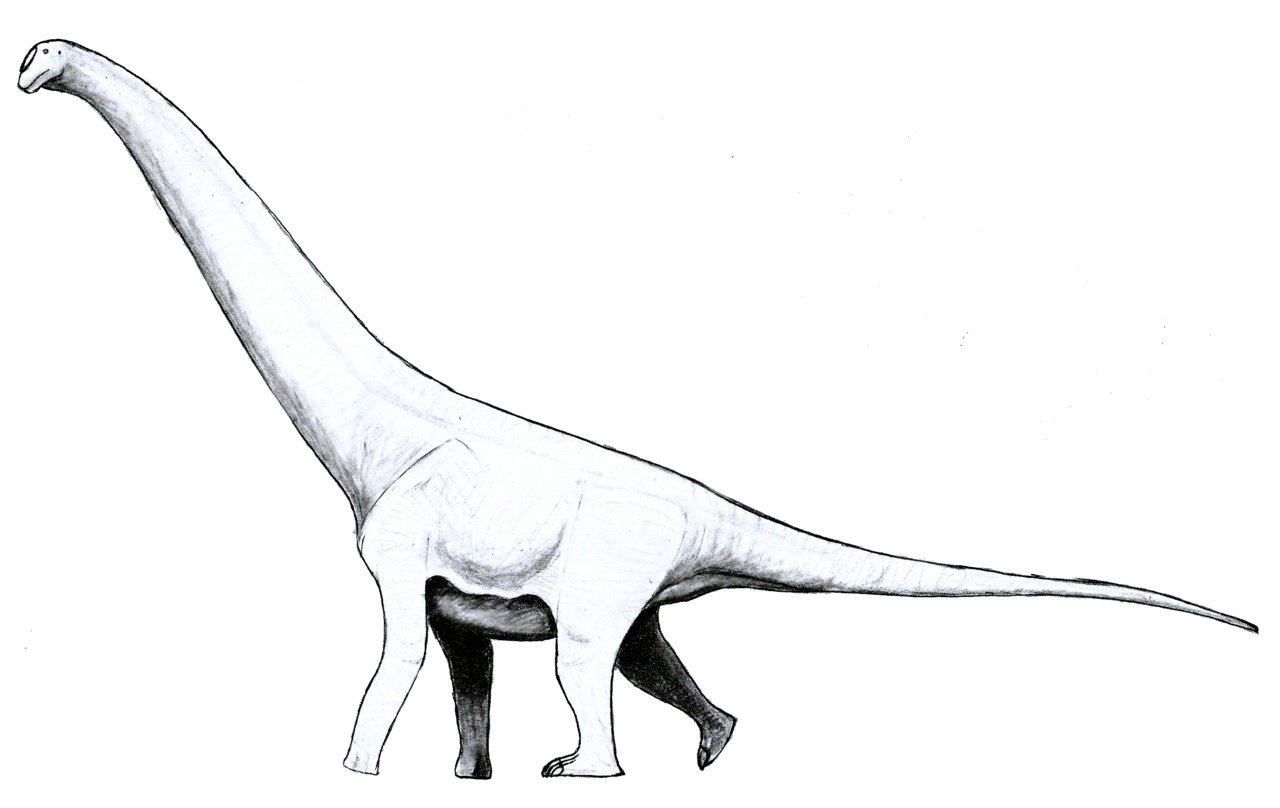
Atacamatitan, whose name means "titan of the Atacama Desert," is a genus of titanosaurian sauropod dinosaur. Its fossils come from the Late Cretaceous Tolar Formation in Chile.
The first expedition to the area, a joint Chilean-Brazilian effort in February 2000, was organized by the Chilean National Museum of Natural History and the National Museum of Brazil. The team explored the Antofagasta Region for Mesozoic fossils and discovered the Tolar Formation deposits, about 150 kilometers north of Calama and 50 kilometers east of the El Abra copper mine. These deposits are a well-stratified red sequence of breccias, conglomerates, and sandstones. A second expedition in July 2001 excavated the formation and uncovered the holotype, specimen SGO-PV-961. The bones were found on a two-square-meter outcrop near Conchi Viejo in the Atacama Desert, Antofagasta Region, and belonged to a single individual. The formation's age is uncertain, ranging from the Late Cretaceous to the Paleocene, but the discovery of Atacamatitan supports a Cretaceous date. The genus was named and described by Alexander Kellner and colleagues in 2011, becoming one of the most complete titanosaurs known from Chile. The generic name refers to the Atacama Desert, combined with the Greek word for titan; the specific name, *chilensis*, refers to Chile. The holotype is housed at the Chilean National Museum of Natural History.
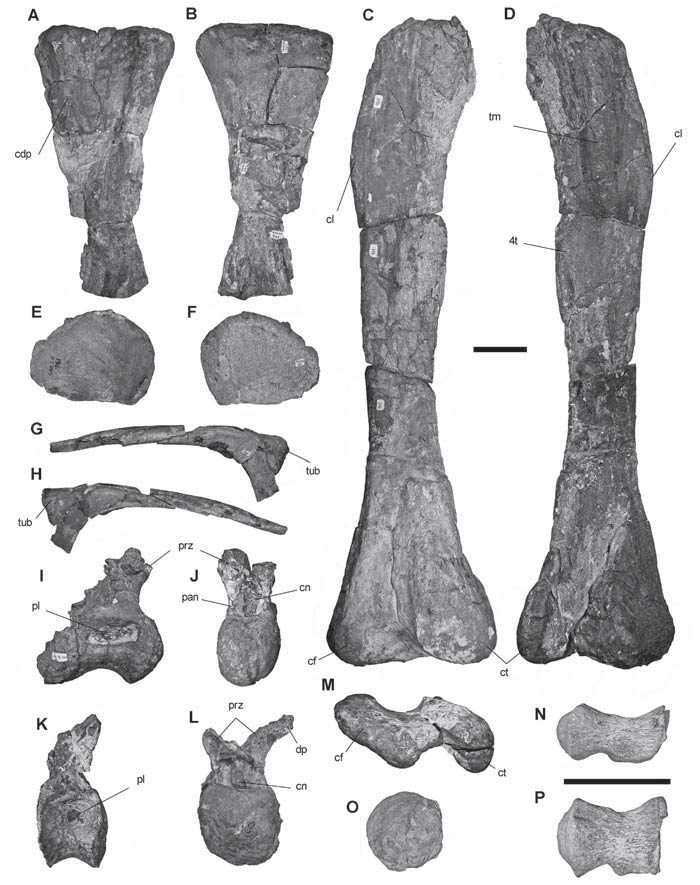
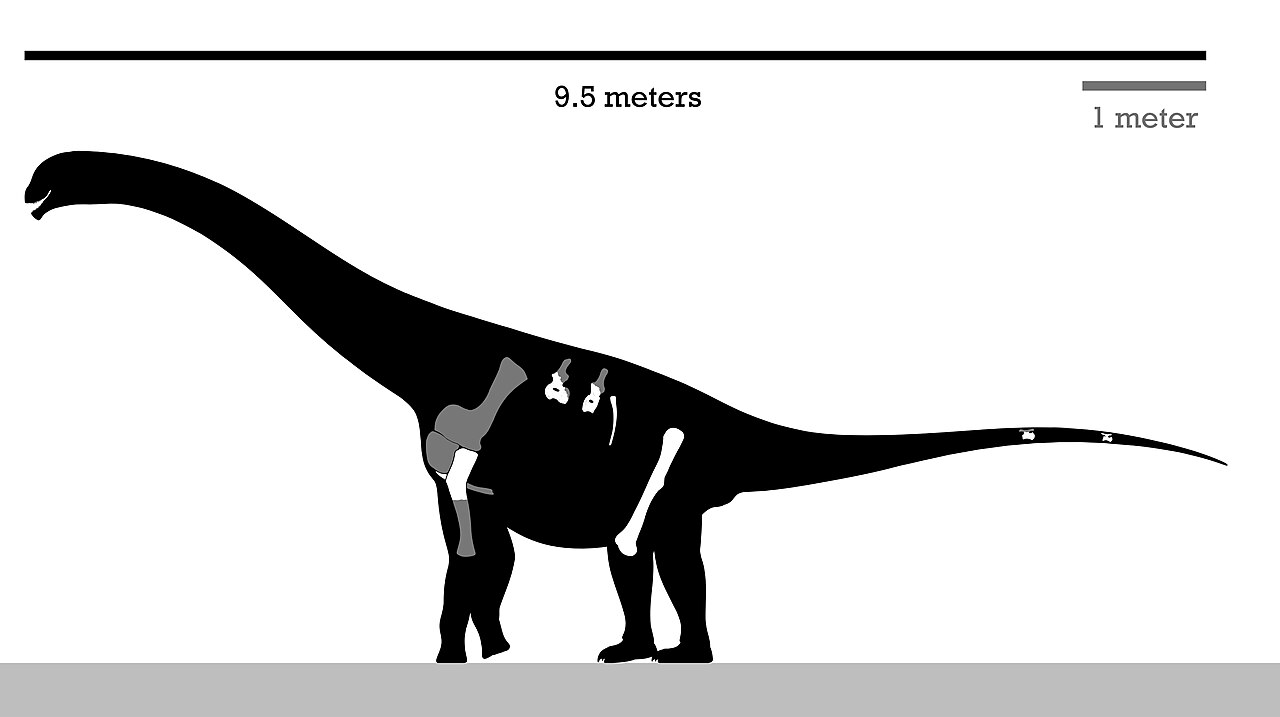
The holotype includes a right femur, the proximal end of a humerus, two dorsal vertebrae, posterior caudal vertebrae, dorsal ribs, a possible fragment of the sternum, other fragmented caudal vertebrae, and indeterminate bones. Most elements are slightly distorted, reddish, and heavy from extensive permineralization. Body size estimates are uncertain, but Thomas Holtz suggested a weight between 8 and 16 metric tons. According to the 2011 description, Atacamatitan is recognized by dorsal centra with curved pleurocoels that do not point backward, dorsal vertebrae with concave ventral surfaces, posterior caudal vertebrae with laterally compressed neural spines that have blade-like anterior margins, and a femur whose proximal end gradually narrows for two-thirds of its length.
The two preserved dorsal vertebrae are fragmented with partial neural arches and are opisthocoelic.
Quick Facts
- Taxon
- Atacamatitan
- Type Species
- Atacamatitan chilensis
- Type Species Authority
- Kellner et al., 2011
Facts from the source article.
Lore & Background
In February 2000, a joint Chilean-Brazilian expedition organized by the Chilean National Museum of Natural History and the National Museum of Brazil searched for Mesozoic fossils in the Antofagasta Region. They discovered deposits of the Tolar Formation, about 150 km north of Calama and 50 km east of El Abra copper mine. A second expedition in July 2001 excavated the formation and uncovered the holotype, SGO-PV-961, near Conchi Viejo in the Atacama Desert. The geological age of the formation is uncertain, ranging from Late Cretaceous to Paleocene, but the discovery of Atacamatitan supports a Cretaceous age.
Reader's Guide
Atacamatitan is significant as one of the most complete titanosaurs known from Chile, providing rare evidence of sauropod dinosaurs in the region. The holotype includes a right femur, partial humerus, dorsal and caudal vertebrae, ribs, and a possible sternal fragment. Its femur measures 1.10 m, and the animal's weight was estimated between 8 and 16 tonnes. The species is distinguished by dorsal vertebrae with rounded pleurocoels that do not point posteriorly, and a femur that narrows gradually toward the distal end. Although fragmentary, Atacamatitan was placed within Lithostrotia in a 2012 cladistic analysis, though many analyses exclude it due to incomplete remains. Its discovery helps clarify the Cretaceous age of the Tolar Formation and expands knowledge of South American titanosaurs.
Did You Know?
- Atacamatitan was named after the Atacama Desert, where its remains were found.
- The holotype was discovered in an outcrop surface of 2 m² near Conchi Viejo town.
- The right femur of Atacamatitan measures 1.10 m (110 cm).
- Its estimated weight ranges from 8 to 16 tonnes.
The Road to Discovery
In the early 2000s, a collaboration between Chilean and Brazilian paleontologists set out to search for Mesozoic-age fossils in the northern reaches of Chile. The first foray, mounted in February 2000 under the joint auspices of the Chilean National Museum of Natural History and the National Museum of Brazil, targeted the Antofagasta Region. That preliminary survey proved fruitful, revealing the sedimentary deposits of what would be recognized as the Tolar Formation, situated roughly 150 kilometers north of the town of Calama and 50 kilometers east of the El Abra copper mine. A follow-up expedition in July 2001 shifted focus to active excavation. Working from a modest two-square-meter outcrop near the small settlement of Conchi Viejo in the Atacama Desert, the team recovered the fossil material that would become the holotype specimen SGO-PV-961. All the bones came from a single individual, and the assemblage was eventually named and formally described by Alexander and colleagues in 2011, cementing Atacamatitan's place among Chile's sauropod fauna.
A Portrait in Bone
The holotype specimen SGO-PV-961 yields a partial but informative picture of this titanosaur's skeleton. The assemblage includes a right femur, the proximal portion of a humerus, two dorsal vertebrae, several posterior caudal vertebrae, dorsal ribs, a possibly fragmentary sternal element, and assorted indeterminate bone fragments. Many of these pieces show slight distortion and carry a distinctive reddish hue, their bulk amplified by extensive permineralization. Thomas Holtz estimated the animal's mass at somewhere between eight and sixteen tonnes, though such figures remain uncertain given the fragmentary preservation. The femur, measuring 1.10 meters, appears notably more gracile than the other limb elements, a trait the authors flagged as a potential autapomorphy hinting at relatively robust forelimbs. The dorsal vertebrae are opisthocoelic, and their pleurocoels are rounded and less elongated than those seen in related titanosaurs like Gondwanatitan or Saltasaurus. The strongly concave ventral margin of the dorsal centra further sets this species apart from its South American counterparts.
Where It Fits in the Tree
Despite being one of the more complete titanosaurian skeletons recovered from Chile, Atacamatitan's fragmentary holotype has made it a difficult taxon to pin down phylogenetically. In the original 2011 description by Alexander and colleagues, the genus was assigned to Titanosauridae, a broad family encompassing many Late Cretaceous sauropods. However, because so much of the skeleton is missing or only partially preserved, most subsequent cladistic analyses simply exclude Atacamatitan from their datasets rather than risk an unreliable placement. A notable exception came in 2012, when Rubilar-Rogers and Gutstein ran a preliminary cladistic analysis that recovered Atacamatitan within the larger clade Lithostrotia. Their results, however, produced a polytomy in which Atacamatitan, Nemegtosaurus, Rapetosaurus, Titanosaurus, and the Saltasauridae all emerged as unresolved sister taxa. This ambiguity underscores how much our understanding of South American titanosaur diversity still depends on more complete specimens emerging from the continent's rich Cretaceous deposits.
Name, Age, and Legacy
The generic name Atacamatitan is a deliberate nod to the landscape that yielded the bones: the first element references the hyper-arid desert of northern Chile where the outcrop was found, while the suffix draws on the Greek word Τιτάν, meaning titan, a fitting tribute for a sauropod estimated at up to sixteen tonnes. The specific epithet chilensis simply anchors the species to its country of origin. The Tolar Formation itself is a well-stratified red sequence of breccias, conglomerates, and sandstones, yet its precise geological age remains debated, with estimates spanning the Late Cretaceous through to the Paleocene. The very existence of Atacamatitan, a dinosaur, tips the balance in favor of a Cretaceous assignment for the formation. Today the holotype rests in the collections of the Chilean National Museum of Natural History, the same institution that co-organized the 2000 expedition which first identified the site. As one of the most complete titanosaurian skeletons known from Chile, Atacamatitan continues to serve as a valuable reference point for understanding sauropod diversity along the southern Gondwanan margin during the Cretaceous.
Gallery
Frequently Asked Questions
What is Atacamatitan?
Atacamatitan is a titanosaurian sauropod that lived during the Late Cretaceous in what is now Chile. Its name translates to 'titan of the Atacama Desert,' a nod to both its enormous size and its regional home range.
Where were Atacamatitan fossils discovered?
The remains come from the Tolar Formation, a well-stratified red sedimentary deposit in Chile's Antofagasta Region. The site sits roughly 150 kilometers north of Calama and about 50 kilometers east of the El Abra copper mine.
Who first found Atacamatitan and when?
A joint Chilean-Brazilian field team, coordinated by the Chilean National Museum of Natural History and Brazil's National Museum, uncovered the Tolar Formation deposits in February 2000. The expedition had been specifically targeting Mesozoic fossil beds in the area.
What kind of dinosaur was Atacamatitan?
It was a long-necked, four-legged herbivore belonging to the titanosaurian branch of sauropods. Like its relatives, it would have been one of the largest land animals roaming its Late Cretaceous ecosystem.
How big or heavy was Atacamatitan?
No definitive weight estimate has been published for the genus so far. However, given its placement among titanosaurian sauropods, it almost certainly belonged to the heaviest tier of Late Cretaceous land animals.
More in Late Cretaceous dinosaurs 1-24
Spotted an error? Know more?
Reader corrections go straight into our review queue. Suggest an edit · How this site is sourced