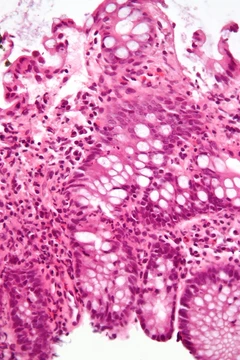
Ulcerative colitis
Chronic inflammation and ulcers of the colon and rectum.
Ulcerative colitis is a long-term inflammatory bowel disease that causes inflammation and ulcers in the colon and rectum. It is one of the two main types of inflammatory bowel disease, the other being Crohn's disease. The condition is notable for its intermittent course, with flares of abdominal pain and bloody diarrhea alternating with periods of remission.
Quick Facts
- Field
- Gastroenterology
- Complications
- Megacolon
- inflammation of the eye
- joints
- or liver
- colon cancer
- Onset
- 15–30 years or >60 years
- Duration
- Long term
- Diagnosis
- Colonoscopy with tissue biopsies
- Differential
- Dysentery
- Crohn's disease
- ischemic colitis
- Treatment
- Dietary changes
- medication
- surgery
- Medication
- Sulfasalazine
- mesalazine
- steroids
- immunosuppressants such as azathioprine
- biological therapy
Facts from the source article.
Did You Know?
- An increased amount of colonic sulfate-reducing bacteria has been observed in some people with ulcerative colitis, resulting in higher concentrations of hydrogen sulfide.
- The protective effect of smoking in ulcerative colitis may be due to hydrogen cyanide from cigarette smoke reacting with hydrogen sulfide to produce non-toxic isothiocyanate.
- Poor prognostic factors include age under 40 at diagnosis, extensive colitis, severe colitis on endoscopy, prior hospitalization, elevated CRP, and low serum albumin.
Signs and symptoms
People with ulcerative colitis typically present with gradually onset diarrhea mixed with blood that persists for weeks. Rectal bleeding occurs in about 90% of individuals, and a similar proportion experience watery or loose stools with increased frequency. Bowel urgency affects 75–90% of patients, and additional symptoms may include fecal incontinence, mucous rectal discharge, and nocturnal defecations. Inflammation limited to the rectum, known as proctitis, can cause urgency or rectal tenesmus—a sensation of needing to evacuate despite passing little stool, which may be mistaken for constipation. In severe disease, bloody diarrhea and abdominal pain become more prominent, with pain ranging from mild discomfort to severe cramping. Disease flares often bring high stool frequency, weight loss, nausea, fatigue, and fever. Chronic bleeding and inflammation can lead to anemia. The clinical presentation depends on the extent of colonic involvement; up to 15% of individuals have severe disease at onset, and up to 45% of those in clinical remission still show objective inflammation. Unlike Crohn's disease, ulcerative colitis is usually confined to the colon, with continuous inflammation that typically starts at the rectum and extends proximally.
Causes
Ulcerative colitis is an autoimmune disease involving T-cell infiltration of the colon, but no direct cause is known. Genetic factors are suggested by familial aggregation, ethnic variation, and twin studies: identical twins show a 10% concordance rate versus 3% in dizygotic twins, and 8–14% of patients have a family history of inflammatory bowel disease. Having a first-degree relative with UC increases risk fourfold. Twelve genomic regions have been linked to UC, including chromosomes 16, 12, 6, 14, 5, 19, 1, and 3, though no single locus is consistently implicated, indicating multiple genes are involved. Some candidate regions encode transporter proteins such as OCTN1 and OCTN2, while others involve cell scaffolding proteins like the MAGUK family. Human leukocyte antigen associations on chromosome 6 may be the most consistent genetic link. Multiple autoimmune disorders are associated with UC, including celiac disease, psoriasis, lupus erythematosus, rheumatoid arthritis, episcleritis, and scleritis, as well as acute intermittent porphyria. Environmental hypotheses include diet, breastfeeding (which may be protective), and medications; one study found a small increase in UC risk with isotretinoin use.
Diagnosis
The initial diagnostic workup includes a complete history, physical examination, laboratory tests, and endoscopy. Severe UC may show elevated erythrocyte sedimentation rate, decreased albumin, electrolyte changes, and elevated alkaline phosphatase. Intestinal inflammation can raise fecal calprotectin or lactoferrin levels. Specific tests include a complete blood count to check for anemia and occasional thrombocytosis; electrolyte and kidney function tests for hypokalemia, hypomagnesemia, and kidney injury; liver function tests to screen for primary sclerosing cholangitis; imaging such as x-ray or CT scan to evaluate for perforation or toxic megacolon; stool culture and Clostridioides difficile assay to rule out infectious colitis; and inflammatory markers like ESR or C-reactive protein. Lower endoscopy—either sigmoidoscopy or colonoscopy—is used to examine the rectum and colon for ulcers and inflammation. The best diagnostic test remains endoscopy with a flexible camera. Flexible sigmoidoscopy may be performed initially, but a complete colonoscopy with entry into the terminal ileum is recommended to rule out Crohn's disease and assess disease extent. Endoscopic findings include mucosal erythema, friability, superficial ulceration, loss of vascular pattern, confluent ulcerations, and pseudopolyps. The simple clinical colitis activity index, created in 1998, is used to assess symptom severity.
Management
Standard treatment depends on the extent and severity of disease, with the goal of inducing remission using medications and then maintaining remission to prevent relapse. For acute stages, a low-fiber diet may be recommended. Mesalazine (also known as mesalamine or 5-ASA) is the first-line maintenance medication for patients in remission and also the first-line agent for active disease limited to the left colon or proctitis; a combination of suppositories and oral mesalazine may be used. Corticosteroids such as prednisone are added in active disease if mesalazine alone does not achieve remission, but they are not used long-term due to risks. For severe disease or when remission cannot be achieved with mesalazine and corticosteroids, immunosuppressants like azathioprine and biologic agents such as infliximab, adalimumab, ustekinumab, vedolizumab, or risankizumab are given. Monoclonal antibodies targeting the p19 subunit of IL-23—guselkumab, mirikizumab, and risankizumab—are approved for moderately to severely active UC. Sulfasalazine, a prodrug of mesalazine, may be used as an alternative but has greater potential for serious side effects and has not shown superiority in large trials. A budesonide formulation was approved for active UC in January 2013. Tofacitinib, approved in 2018, is the first oral medication for long-term use in moderately to severely active UC. Cyclosporine is effective for severe UC, and tacrolimus has also shown benefits. Etrasimod was approved in the United States in October 2023.
More in Inflammatory Diseases of the Digestive System
Spotted an error? Know more?
Reader corrections go straight into our review queue. Suggest an edit · How this site is sourced