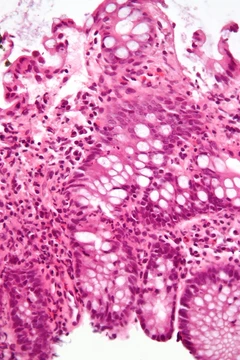
Colitis
Inflammation of the colon, acute or chronic.
Colitis is swelling or inflammation of the large intestine (colon). It may be acute and self-limited or long-term, and broadly fits into the category of digestive diseases. In medical contexts, the label colitis (without qualification) is used when the cause is undetermined or the context is clear.
Quick Facts
- Field
- Gastroenterology
Facts from the source article.
Did You Know?
- Signs seen on colonoscopy include colonic mucosal erythema, ulcerations, and hemorrhage.
- Common symptoms may include persistent hemorrhagic diarrhea with pus either present or absent in the stools.
- Less common non-specific symptoms that may accompany colitis include arthritis, mouth ulcers, and painful, red and swollen skin.
Diagnosis
Symptoms suggestive of colitis are investigated through medical history, physical examination, and laboratory tests such as CBC, electrolytes, stool culture and sensitivity, and stool ova and parasites. Additional tests may include medical imaging like abdominal computed tomography or X-rays, and endoscopic examinations such as sigmoidoscopy or colonoscopy. A biopsy for histopathology is an important investigation; a small tissue sample is removed during endoscopy and examined under a microscope. The biopsy report should note any chronic colitis, disease activity, and epithelial damage like erosions or ulcerations.
Types
There are many types of colitis, classified by cause. Inflammatory bowel disease includes chronic colitides such as ulcerative colitis, which affects the large intestine, and Crohn's disease, which often leads to colitis. Microscopic colitis is diagnosed microscopically while appearing normal macroscopically; subtypes include lymphocytic and collagenous colitis. Other types include diversion colitis, chemical colitis, chemotherapy-induced colitis, immunotherapy-induced colitis, radiation colitis, checkpoint inhibitor induced colitis, ischemic colitis, and infectious colitis. Clostridioides difficile colitis, informally called C-diff colitis, classically forms pseudomembranes and is often termed pseudomembranous colitis. Parasitic infections like Entamoeba histolytica can also cause colitis. Indeterminate colitis has features of both Crohn's disease and ulcerative colitis.
Treatment
Treatment can include medications such as steroids and dietary changes; in some instances, hospitalization and surgery may be required. Several studies have found a significant relationship between colitis and dairy allergy, suggesting some patients may benefit from an elimination diet. The use of oral probiotic supplements has been considered as a possible therapy for Crohn's disease and ulcerative colitis. A Cochrane review in 2020 did not find clear evidence of improved remission likelihood or lower adverse events in people with Crohn's disease following probiotic treatment. For ulcerative colitis, there is low-certainty evidence that probiotic supplements may increase the probability of clinical remission; people receiving probiotics were 73% more likely to experience disease remission and over 2x as likely to report improvement in symptoms compared to placebo, with no clear difference in adverse effects. The likelihood of remission was 22% higher if probiotics were used in combination with 5-aminosalicylic acid therapy.
Research
In mouse experiments, colitis was successfully treated using mesenchymal stem cells. Huang and colleagues later identified specific genes and biomarkers linked to colon cancer risk in colitis patients, finding a connection between these markers and disease progression. Colitis is more frequent in regions where worm infections are rare and less common where they are widespread, as helminths may influence the autoimmune response. Initial tests of Trichuris suis ova showed promise for inflammatory bowel disease, but subsequent Phase 2 trials—using a different formulation than the earlier successful studies—failed, leading to most being halted.
More in Inflammatory Diseases of the Digestive System
Spotted an error? Know more?
Reader corrections go straight into our review queue. Suggest an edit · How this site is sourced