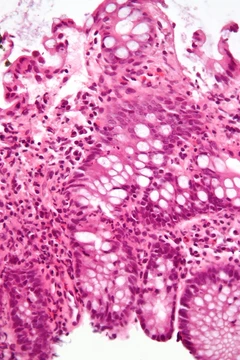
Duodenal lymphocytosis
Increased intra-epithelial lymphocytes in duodenal mucosa, often linked to coeliac disease.
Duodenal lymphocytosis, also referred to as lymphocytic duodenitis or duodenal intraepithelial lymphocytosis, is a microscopic finding of an elevated number of intra-epithelial lymphocytes in duodenal biopsies. It is most commonly associated with coeliac disease but can occur in various other disorders.
Quick Facts
- Field
- Gastroenterology
- Causes
- Coeliac disease, environmental enteropathy and others
- Diagnosis
- Histological examination of duodenal biopsy
- Frequency
- 3–7% of people having duodenal biopsy
Facts from the source article.
Did You Know?
- Possible causes include environmental enteropathy (tropical sprue), autoimmune enteropathy, small intestinal bacterial overgrowth, NSAID damage, and Crohn's disease.
- In one series, diarrhoea, thyroiditis, weakness and folate deficiency predicted development of gluten sensitivity and coeliac disease in 23 of 85 patients over 2 years.
Presentation
The condition is defined by an increased proportion of intra-epithelial lymphocytes in the duodenal epithelium, typically exceeding 20–25 per 100 enterocytes. Intra-epithelial lymphocytes are normally present in the intestine, with higher numbers in crypts and the jejunum, and are mostly T cells. Increased counts are reported in around 3% of duodenal biopsies, though this may reach up to 7% depending on case mix.
Diagnosis
Diagnosis requires accurate counting of intraepithelial lymphocytes on histological examination of the duodenum, with the additional requirement that villous architecture appears normal. In coeliac disease, this finding represents the least severe change, known as Marsh I stage. Antibodies associated with coeliac disease, such as IgA endomysial and anti-transglutaminase antibodies, are reported in about 11% of cases and are highly sensitive and specific for coeliac disease. Around 33% of cases carry the HLA-DQ2 allele, which is present in over 90% of people with coeliac disease; absence of HLA-DQ2 or HLA-DQ8 makes coeliac disease unlikely. Because antibody-negative coeliac disease occurs, HLA status, persistence or progression of intraepithelial lymphocyte numbers after gluten challenge, and symptomatic improvement on a gluten-free diet have been used to confirm the diagnosis, which was made in 22% of one series of over 200 adult cases. Helicobacter infection is common at endoscopy but is not considered a meaningful cause in children. Other infections such as Cryptosporidiosis and Giardiasis can also be associated with increased intraepithelial lymphocytes.
More in Inflammatory Diseases of the Digestive System
Spotted an error? Know more?
Reader corrections go straight into our review queue. Suggest an edit · How this site is sourced