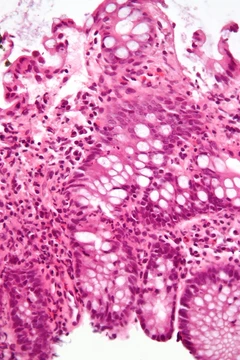
Epiploic appendagitis
A self-limiting inflammation of colonic fat sacs mimicking acute abdomen.
Epiploic appendagitis (EA) is an uncommon, benign, self-limiting inflammatory condition of the epiploic appendices, which are small, fat-filled sacs along the colon and rectum. It typically results from torsion or venous thrombosis, causing acute abdominal pain that can mimic appendicitis, diverticulitis, or cholecystitis. The condition is notable for being diagnosed incidentally on CT scans and for resolving without surgery in nearly all cases.
Quick Facts
- Age range
- 12 to 82 years
- Peak age
- 40s and 50s
- Sex predominance
- Men
- Number of epiploic appendages
- 50–100
- Appendage length
- 0.5 to 5 cm / 1.97 in
Facts from the source article.
Signs and symptoms
The condition commonly occurs in patients in their 40s and 50s, predominantly in men. It presents with acute onset of pain, often in the left lower quadrant, leading to frequent misdiagnosis as diverticulitis. Unlike diverticulitis, patients do not typically report fever, nausea, or leukocytosis, and bowel habit changes are uncommon, though a few may have constipation or diarrhea.
Peritoneal loose body
It is rare but possible for epiploic appendagitis to result in a peritoneal loose body, a free-floating mass of dead fibrous tissue surrounded by calcification. This arises from torsed, infarcted, or detached epiploic appendages that become fibrotic. If the loose body grows large enough, it can cause urinary retention or bowel obstructions. The epiploic appendages, also called appendices epiploicae, number 50–100, are oriented in two rows parallel to the taenia coli, each 0.5 to 5 cm long and attached by vascular stalks. Torsion can cause ischemia and pain mimicking diverticulitis or appendicitis, though this is rare.
Diagnosis
Epiploic appendagitis is more common in patients older than 40 years but can occur at any age, with reported ages from 12 to 82 years; men are slightly more affected. Patients describe a localized, strong, non-migratory sharp pain after eating, with tender abdomens but no fever, vomiting, or leukocytosis. Pain typically occurs in the right or left lower quadrant, mimicking appendicitis on the right or diverticulitis on the left. Several conditions mimic epiploic appendagitis, including omental infarction, which presents with pain of a few days' duration in the right lower or upper quadrant and is common in pediatric patients (about 15% of cases). Omental infarction can result from trauma, thrombosis, or other causes, and CT shows a solitary large non-enhancing omental mass, often without bowel wall thickening, helping differentiate it from diverticulitis.
Epidemiology
Acute epiploic appendagitis is usually associated with obesity, hernia, and unaccustomed exercise. Inflammation normally resolves on its own, but uncommon complications include adhesion, bowel obstruction, intussusception, intraperitoneal loose body, peritonitis, or abscess. Treatment involves reassurance and analgesics, with symptoms resolving in two weeks under non-invasive care; hospitalization is not necessary.
More in Inflammatory Diseases of the Digestive System
Spotted an error? Know more?
Reader corrections go straight into our review queue. Suggest an edit · How this site is sourced