Sorong
Gateway to Raja Ampat and eastern oil hub.

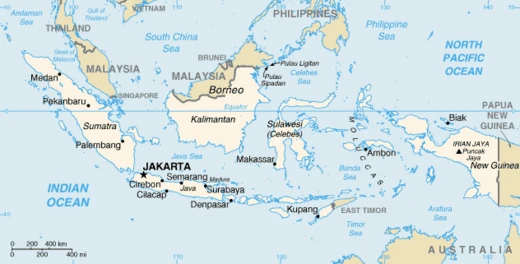
Sorong is the largest city and capital of Southwest Papua, an Indonesian province. It sits at the western tip of New Guinea, bordered only by Sorong Regency. The city is the main access point to the Raja Ampat Islands, a coral reef system renowned for its exceptionally high marine biodiversity. It also functions as a logistics center for Indonesia's expanding oil and gas operations in the east. Sorong grew quickly in the decade after 2010, and further growth is expected as road connections link it to other frontier towns on the Bird's Head Peninsula. As of mid-2024, the official population estimate was 286,028, with 150,236 males and 135,729 females. The city's suburban areas include tropical rainforest and mangrove forest, which have become increasingly popular for ecotourism, especially birdwatching and wildlife observation.
The name Sorong comes from the Biak word *Soren*, meaning "deep and wavy ocean." The Biak-Numfor people, who sailed among various islands before settling in the Raja Ampat Islands, first used this name for a place called "Daratan Maladum." Over centuries of contact with Chinese merchants, European missionaries, and people from Maluku and Sangihe-Talaud, the name evolved into Sorong.
Dutch influence in the region was limited until 1906, when a colonial post was established on Doom Island, which became the Dutch administrative center. In the 1930s, the Dutch oil company NNGPM discovered oil off Sorong's coast. The resulting oil fields expanded Dutch colonial influence in Western New Guinea and made Sorong a valuable military target. During World War II, Japan occupied Sorong in 1942, using it as a base for the Western New Guinea campaign. The Battle of Sansapor in June 1944 ended Japanese control over the Bird's Head Peninsula, and by August 1944, the US 6th Division removed remaining Japanese forces. After the Indonesian War of Independence, the colonial administration built the 58-kilometer Klamono-Sorong pipeline to boost oil production, but output declined after the war, dropping 33% by 1961. This decline helped end Dutch colonial rule, as the territory was no longer seen as economically viable. Under Indonesian administration, oil production returned to pre-war levels and more than tripled by 1967. Today, Sorong remains a major oil and gas producer in Indonesian New Guinea.
Quick Facts
- Official Name
- City of Sorong / Kota Sorong
- Settlement Type
- City
- Motto
- Setara – Bersahabat – Dinamis / (Equal – Friendly – Dynamic)
- Leader Title
- Mayor
- Leader Name
- Septinus Lobat
Facts from the source article.
Lore & Background
The name Sorong originates from the Biak word Soren, meaning 'deep and wavy ocean,' first used by Biak-Numfor people who sailed to the region and settled in Raja Ampat. Over centuries of contact with Chinese merchants, European missionaries, and people from Maluku and Sangihe-Talaud, the name evolved into Sorong. Dutch colonial influence was minimal until a post was established on Doom Island in 1906. In the 1930s, the Dutch oil company NNGPM discovered oil off the coast, leading to expanded Dutch control and making Sorong a military target. During World War II, Japan occupied Sorong in 1942, using it as a center for the Western New Guinea campaign until the Battle of Sansapor in June 1944 and the subsequent removal of Japanese forces by the US 6th Division in August 1944. After the Indonesian War of Independence, the Dutch built the 58-kilometer Klamono-Sorong pipeline to boost oil production, but output declined after the war, dropping 33% by 1961. This decline helped end Dutch colonial rule, as the territory was no longer seen as economically viable. Under Indonesian administration, oil production returned to pre-war levels and more than tripled by 1967. Today, Sorong remains a major oil and gas producer in Indonesian New Guinea. In 1972, Sorong became an autonomous city, then an administrative city.
Reader's Guide
Sorong's significance lies in its dual role as the administrative and economic center of Southwest Papua and as the primary gateway to the Raja Ampat Islands, a globally important marine biodiversity hotspot. The city's rapid growth since 2010, driven by its position as a logistics hub for Indonesia's eastern oil and gas frontier, is expected to continue as road links connect it to other frontier towns on the Bird's Head Peninsula. The construction of a container port with an annual capacity of 500,000 TEUs, inaugurated in 2021, underscores its growing role in regional trade. Sorong's population, estimated at 286,028 in mid-2024, is religiously diverse, with Protestants forming the largest group. The city's tropical rainforest climate and surrounding mangrove and rainforest areas have become popular for ecotourism, particularly birdwatching. The phrase 'Sorong to Samarai' is used across Papua New Guinea and Indonesian Papua to express solidarity, sometimes invoked by Papuan independence activists. Sorong's history, from Dutch colonial oil extraction to its current status as a growing city, reflects broader patterns of resource-driven development and geopolitical change in the region.
Did You Know?
- Sorong was occupied by Japan in 1942 during World War II and served as the center of Japanese operations for the Western New Guinea campaign.
- The city's container port, inaugurated in 2021, has an annual handling capacity of 500,000 twenty-foot equivalent units (TEUs).
- The phrase 'Sorong to Samarai' is used in Papua New Guinea and Indonesian Papua to express solidarity and oneness.
More in Indonesian Cities 1-24
Spotted an error? Know more?
Reader corrections go straight into our review queue. Suggest an edit · How this site is sourced