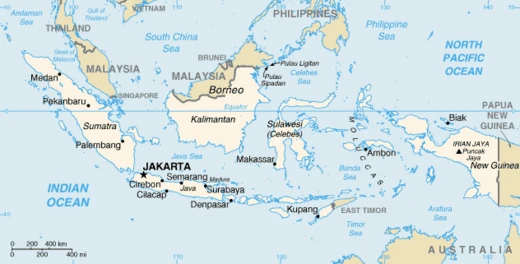
Ambon, Maluku
Capital of Maluku, UNESCO City of Music since 2019.

Ambon is the capital and largest city of the Indonesian province of Maluku. Known as Indonesia's music city, it was recognized as a UNESCO City of Music in 2019, following George Town, Penang, Malaysia, which received the designation in 2017. The city's development began with Portuguese arrival in 1513 and the construction of Fort Kota Laha around 1575, later captured by the Dutch in 1605 and renamed Fort Victoria, which became a center of colonial administration.
Quick Facts
- Official Name
- City of Ambon / Kota Ambon
- Settlement Type
- City
- Motto
- abs · Bersatu Manggurebe Maju (Ambonese) / "Unite and Compete to Progress"
- Established Title
- Incorporated
- Established Date
- 7 September 1575
- Leader Title
- Mayor
- Leader Name
- Bodewin Wattimena · id (indp.)
Facts from the source article.
Lore & Background
The Dutch seized the fort in 1605, renamed it Victoria, and made it the center of colonial administration. After a severe earthquake, it was renovated and called Nieuw Victoria, though locally known as Fort Victoria. This fort is historically significant as the site where national hero Pattimura was executed by hanging on 16 December 1817. During the Japanese occupation starting 1 February 1942, citizens suffered poverty and famine. Remnants include the Ambon War Cemetery and Japanese torpedoes discovered in Ambon Bay.
Reader's Guide
Ambon's significance lies in its role as a colonial hub and its modern recognition as a cultural center. The city's anniversary, set as 7 September 1575, commemorates both the start of Fort Kota Laha's construction and the 1921 achievement of equal political rights for Ambon citizens. Religiously, Ambon is Protestant-majority (59.41% Christian, 40.47% Muslim), with notable buildings including GPM Maranatha, Saint Francis Xavier Cathedral, Al-Fatah Grand Mosque, and the oldest Ambon Jami Mosque (built 1860). The city is divided into five districts: Nusaniwe, Sirimau, Teluk Ambon, Baguala, and Leitimur Selatan. Its tropical rainforest climate has no real dry season, with the wettest month being June (638 mm precipitation) and the driest November (114 mm). The city's legacy includes its UNESCO City of Music designation in 2019, the first in Southeast Asia.
Did You Know?
- The city's official anniversary is 7 September 1575, marking the start of Fort Kota Laha's construction and the 1921 granting of equal political rights.
- The largest religious group in Ambon is Christian at 59.41%, with Protestants comprising 56.93% of the population.
A City Defined by Sound
Ambon has long carried a reputation as a place where music is woven into daily life, a distinction that reached its formal peak in 2019 when it became the first city in all of Southeast Asia to earn the UNESCO City of Music title. The city's beloved nickname, Ambon Manise, translates roughly to "beautiful Ambon" in the local Ambonese language, and that sense of aesthetic pride extends well beyond scenery into the sonic landscape of the community. The cultural fabric of the city is deeply shaped by its mestizo heritage; the very term "Ambonese" (Ambonezen) was originally reserved for the mixed-ancestry residents of the city itself before gradually broadening in the twentieth century to encompass all inhabitants of Central Maluku. This layered identity—part indigenous, part colonial, part musical—gives Ambon a character that feels distinct from other Indonesian cities, one where the rhythm of the sea and the legacy of centuries of cultural blending produce a creative output that the world has now officially acknowledged.
Forts, Conquest, and the Long Colonial Shadow
The story of Ambon as a settled urban center begins with Portuguese sailors who reached the island in 1513, but it was not until roughly 1575 that a permanent structure took shape: the Fort of Nossa Senhora da Anunciada, later called Kota Laha or Ferangi Fort, raised on the Honipopu Plain by local laborers. Those workers, in the process of building, formed village-like groupings such as Soya, which would eventually evolve into organized territorial genealogical societies and become the bedrock of the modern city. The Dutch East India Company seized the fort in 1605 with military support from Ternate, Luhu, Hitu, and Gowa, renaming it Victoria. After a devastating earthquake, it was rebuilt as Nieuw Victoria, though locals kept calling it Fort Victoria. The site carries a dark weight: on 16 December 1817, the national hero Pattimura was hanged there. The VOC's rule was marked by authoritarian figures like Adrian Martensz Block, who relied on forced labor to expand the fort, and Herman van Speult, who enforced brutal spice-trade monopolies. In 1796 the VOC, already on the verge of its 1799 bankruptcy, surrendered to the British under Admiral Pieter Ramier, and Ambon remained under British control until 1803.
From Colonial Subject to Self-Governing City
The political journey of Ambon's residents spans centuries of struggle. Under the Dutch East Indies, the city became the capital of the Government of Amboina within the broader Government der Molukken, established in 1817. A watershed moment came on 7 September 1921, when the people of Ambon were granted equal rights alongside the colonial administration—a hard-won political victory that opened a path for local participation in governance. The Japanese occupation, which began on 1 February 1942 after the Battle of Ambon, brought poverty and famine to the population, and the city's strategic value as a naval and air base made it a target. Physical traces of that period endure today, including the Ambon War Cemetery honoring Allied soldiers and Japanese torpedoes resting on the seabed of Ambon Bay. After independence, the city was formally established under Law Number 60 of 1958, enacted on 17 July 1958. Its anniversary was set at 7 September 1575 during a 1972 seminar at Pattimura University, merging the founding of the original fort with the 1921 rights milestone, and was first celebrated on 7 September 1973.
A Tropical Landscape Shaped by Hills and Rain
Ambon covers 359.45 square kilometres of land, most of which rises into hilly or steeply sloping terrain, with only about 17 percent of the area lying relatively flat. The city sits close to the equator, and its Köppen classification is Af—a tropical rainforest climate with no true dry season. Rainfall swings dramatically between months: June brings a deluge of 638 millimetres, while November, the driest month, still delivers 114 millimetres. Temperatures remain remarkably stable year-round, hovering between a July average of 25 degrees Celsius and a December peak of 27.2 degrees. The population has grown steadily, from 331,254 at the 2010 Census to 347,288 by 2020, with an official mid-2024 estimate of 357,289. Administratively, the city is split into five districts—Nusaniwe, Sirimau, Teluk Ambon, Baguala, and Leitimur Selatan—further divided into 50 sub-districts and villages. Sirimau is by far the most populous district at 178,611 residents, while South Leitimur is the smallest with just 11,862.
Frequently Asked Questions
Who is Ambon, Maluku?
Ambon is the capital and most populous city of Indonesia's Maluku province, sitting on an island in the eastern archipelago. It is best known worldwide for its deep-rooted musical culture and its standing as a UNESCO-recognized City of Music.
What are Ambon, Maluku's powers and role?
The city anchors the administrative and economic life of the entire Maluku region. It also holds the distinction of being Indonesia's first UNESCO City of Music, a title it earned in 2019, reflecting how central song and melody are to everyday life there.
How does Ambon, Maluku's story begin?
European contact with the island started when Portuguese sailors arrived in 1513, and a defensive fort was raised around 1575. Dutch forces later seized that structure in 1605, renamed it, and turned it into a base for colonial governance.
Why is Ambon, Maluku important?
As the provincial capital, it serves as the political and commercial hub for the Maluku islands. Its 2019 UNESCO City of Music designation also placed it on the global cultural map, joining a small group of cities celebrated specifically for their musical heritage.
What is the significance of Fort Victoria in Ambon, Maluku?
Originally constructed by the Portuguese around 1575 under the name Fort Kota Laha, the structure was captured by the Dutch in 1605 and given its current name. It subsequently functioned as a key center for colonial administration in the region.
More in Indonesian Cities 1-24
Spotted an error? Know more?
Reader corrections go straight into our review queue. Suggest an edit · How this site is sourced