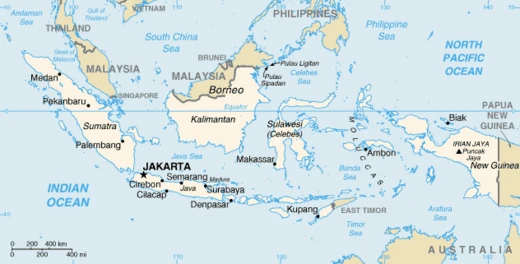
Bengkulu (city)
Capital of Bengkulu Province, site of Sukarno's exile.

Bengkulu, formerly known as Bencoolen (Dutch: Benkoelen), is the capital of the Indonesian province of Bengkulu and the second largest city on the west coast of Sumatra Island after Padang. Historically under the influence of the kingdom of Inderapura and the Sultanate of Banten, the city also served as the place of exile for Sukarno from 1939 to 1942.
Quick Facts
- Official Name
- City of Bengkulu / id · Kota Bengkulu
- Settlement Type
- City
- Established Title
- Founded
- Established Date
- 18 March 1719
- Leader Title
- Mayor
- Leader Name
- Dedy Wahyudi
Facts from the source article.
Lore & Background
The Bengkulu region was historically inhabited by various ethnic communities and small local chiefdoms, and was influenced by the Srivijaya empire during the early medieval period. From around the 15th century, it became associated with the Banten Sultanate through trade, particularly in pepper. During the 17th century, the Inderapura Kingdom, a Minangkabau-linked coastal kingdom, also exerted influence over the area.
The British East India Company established Bengkulu (Bencoolen) in 1685 as a trading center for pepper after losing access to Banten. In 1714, the British constructed Fort Marlborough, one of the largest British forts in Southeast Asia. Under the Anglo-Dutch Treaty of 1824, the British ceded Bencoolen to the Dutch in exchange for Malacca, and it became part of the Dutch East Indies until the Japanese occupation.
During the 1930s, Sukarno was exiled to Bengkulu by the Dutch colonial government. While there, he met Fatmawati, who later became his wife and Indonesia’s first First Lady. After Indonesian independence, Bengkulu became part of South Sumatra Province before officially becoming the capital of the newly established Bengkulu Province in 1968.
Reader's Guide
Bengkulu's significance lies in its layered colonial history and its role in Indonesia's independence narrative. As a British trading post from 1685, it was a rare British foothold in Sumatra, marked by the construction of Fort Marlborough. The city's cession to the Dutch in 1824 reshaped colonial boundaries in the region. Its most notable modern legacy is as the exile site of Sukarno, Indonesia's founding president, from 1939 to 1942, where he met his future wife Fatmawati. Today, Bengkulu serves as the administrative, economic, and educational center of Bengkulu Province. The city's location on the Sunda megathrust makes it highly vulnerable to earthquakes and tsunamis, a persistent challenge for its development. Its diverse population reflects centuries of trade and migration, with ethnic groups including Malay, Rejang, Minangkabau, Javanese, and Chinese Indonesians. The economy is primarily supported by trade, services, and government sectors.
Did You Know?
- Bengkulu was known as Bencoolen during British rule and was ceded to the Dutch in exchange for Malacca under the 1824 Anglo-Dutch Treaty.
- The city covers 151.72 km² and had an estimated population of 407,843 in mid-2025.
- Fort Marlborough, built by the British in 1714, is one of the largest British forts in Southeast Asia.
The Bencoolen Experiment: Britain's Pepper Ambition
In 1685, the British East India Company planted a colonial flag on the western Sumatran coast, establishing a trading post they called Bencoolen. The venture was born of necessity rather than choice: Dutch expansion had cut off British access to Banten, and the company needed a new foothold for pepper and other commodities. Within three decades, the British had raised Fort Marlborough in 1714, a structure that would rank among the largest British military installations in all of Southeast Asia. Yet the settlement never truly thrived. Its isolation, punishing tropical climate, and thin commercial returns made Bencoolen a persistent financial headache for London. The arrangement ended not through conquest but through diplomacy. Under the Anglo-Dutch Treaty of 1824, Britain traded Bencoolen to the Netherlands in exchange for Malacca. The city then passed into the Dutch East Indies, where it remained until the Japanese occupation during the Second World War upended colonial rule across the archipelago.
Exile and the Seeds of a Nation
Between 1939 and 1942, the Dutch colonial authorities shipped the young nationalist leader Sukarno to Bengkulu, stripping him of his political base in Java and hoping to silence his voice. What the colonizers could not have foreseen was that this remote coastal posting would become the crucible of a personal and political transformation. It was during this period of enforced inactivity that Sukarno met Fatmawati, a woman who would become his wife and, after independence, Indonesia's first First Lady. Their union, forged in the shadow of colonial punishment, gave Bengkulu a place in the national narrative that no amount of trade or fortification ever achieved. The city's airport today bears both their names—Fatmawati Soekarno Airport—a permanent reminder that the most consequential chapter in Bengkulu's history was written not by merchants or governors, but by a prisoner and the woman who stood beside him.
A City on the Edge of the Megathrust
Bengkulu sits on a narrow coastal plain where the Bukit Barisan range presses close from the east and the Indian Ocean stretches endlessly to the west. This geography, while granting the city its tropical rainforest climate—steady temperatures between 23 and 31 degrees Celsius, relentless humidity, and heavy rainfall with no true dry season—also places it directly in the path of one of the planet's most dangerous tectonic features. The Sunda megathrust runs just offshore, and the western Sumatran coast is consistently ranked among the most earthquake- and tsunami-prone zones in Indonesia. The city's 151.72 square kilometres of low-lying land offer little natural elevation to shelter residents from a potential tsunami wave. For the roughly 408,000 people who called Bengkulu home by mid-2025, this proximity to the megathrust is not an abstract geological fact but a living, daily reality that shapes emergency planning and the collective memory of a community that has long learned to live beside the sea's most violent moods.
From Small Town to Provincial Capital
Bengkulu's administrative identity has been reshaped repeatedly since independence. In 1956, it was merely a 'Small Town' of 17.6 square kilometres tucked inside South Sumatra Province. A year later, a new local-government law elevated it to Kotamadya status. The decisive leap came with Law No. 9 of 1967, which carved out Bengkulu Province; the law took effect on 1 June 1968, and the city became its capital. From that point forward, Bengkulu grew into the administrative, economic, and educational heart of the new province. Its territory expanded from the original small-town footprint to 151.7 square kilometres by 1986, and its district structure multiplied from two to four, then to eight, and finally to nine when Singaran Pati was split from Gading Cempaka. By the 2020 Census the population had reached 373,591, and the mid-2025 official estimate pushed past 407,000, making Bengkulu the second-largest city on Sumatra's western coast after Padang.
Frequently Asked Questions
What is Bengkulu (city)?
Bengkulu is a coastal city on Sumatra's western shore that serves as the administrative capital of Bengkulu Province. It is the second-largest city along that stretch of coast, trailing only Padang.
What role did Bengkulu play in Indonesian history?
The city was successively influenced by the Inderapura kingdom and the Sultanate of Banten before entering the colonial era. Its most famous historical moment came when Sukarno was sent there as a political exile from 1939 until 1942.
Why is Bengkulu (city) important to Indonesian fans?
It is widely remembered as the place where Sukarno spent three years in exile, a period that deepened his political thinking ahead of independence. It also became the official provincial capital in 1968, cementing its administrative role.
What was Bengkulu's old colonial name?
British administrators called it Bencoolen, while the Dutch used the spelling Benkoelen. The modern Indonesian name replaced those colonial designations after the country gained independence.
How large is Bengkulu (city) today?
The city spans roughly 152 square kilometers and recorded about 374,000 residents in the 2020 census. Current estimates place the population just above 400,000 as of 2025.
More in Indonesian Cities 1-24
Spotted an error? Know more?
Reader corrections go straight into our review queue. Suggest an edit · How this site is sourced