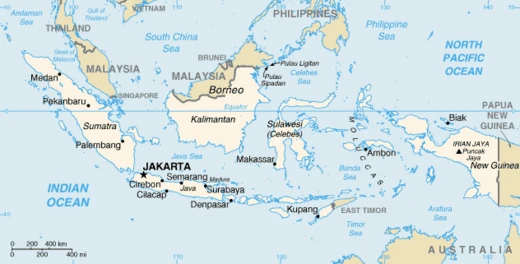
Bandar Lampung
Capital and largest city of Lampung, southern Sumatra.

Bandar Lampung is the capital and largest city of the Indonesian province of Lampung, located on the southern tip of Sumatra. Originally called Tanjungkarang–Telukbetung, it was renamed in 1983 and serves as the chief port and transportation center for the surrounding agricultural area, producing rubber, tea, coffee, and pepper for export.
Quick Facts
- Other Name
- Tanjungkarang–Telukbetung
- Official Name
- City of Bandar Lampung / id · Kota Bandar Lampung
- Settlement Type
- City
- Nickname
- id · Kota Kain Tapis / "City of Tapis"
- Motto
- ljp · Ragom Gawi / "Language and Culture"
- Established Title
- Founded
- Established Date
- 17 June 1682
- Government Type
- Mayor–council
- Governing Body
- Bandar Lampung City Government
- Leader Title
- Mayor
Facts from the source article.
Lore & Background
Bandar Lampung was originally two twin cities, Tanjung Karang and Teluk Betung, which were part of South Lampung Regency before being unified and elevated to independent city status in 1948. Under Dutch colonial administration, the area was part of the Onderafdeling Telokbetong, with Tanjung Karang as its capital and Teluk Betung as the seat of government for the Karesidenan Lampung. During the Japanese occupation, the city was led by a Japanese mayor assisted by an Indonesian deputy mayor.
Reader's Guide
Bandar Lampung's significance lies in its role as the administrative and economic hub of Lampung Province, a major transmigration recipient area. The city's population grew from 881,801 in 2010 to 1,166,066 in 2020, though the mid-2025 estimate shows a drop to 1,088,200 as the urban area has outgrown city boundaries. Dominant ethnic groups include Javanese, Lampungese, Sundanese, and Bantenese, with Chinese and Minangkabau minorities. The city has a tropical rainforest climate with heavy rainfall year-round. Its transportation network includes Radin Inten II Airport, minibus angkot services, bus rapid transit, and Tanjung Karang Station as the terminus of railway service from Palembang. The city's cottage industries include metalworking, hand-weaving, and pottery and tile making. Notable educational institutions include Lampung University and several public and private high schools. Bandar Lampung is twinned with Liwa (Indonesia), Kuantan, Ipoh, and Seberang Perai (Malaysia), and Split (Croatia).
Did You Know?
- Bandar Lampung was originally called Tanjungkarang–Telukbetung until its renaming in 1983.
- The city's official founding date is generally recognized as 1948, when it was unified as a municipality.
- The city's population has remained stable, with the 2020 census recording 1,166,066 residents.
- Bandar Lampung is the sixth-largest city in Sumatra, after Medan, Palembang, Batam, Pekanbaru, and Padang.
Origins & the Twin-City Identity
Bandar Lampung's very name tells a story of merger. For centuries, the southern Sumatran coast was home to two distinct settlements—Tanjungkarang and Telukbetung—each with its own character before they were eventually unified. Under the Dutch colonial framework, the 1912 Staatsblad 462 formally codified the area as the Onderafdeling Telokbetong, with Tanjungkarang serving as its administrative capital while Telukbetung held the seat of government for the broader Karesidenan Lampung. The Dutch also knew the harbor as Oosthaven, a name that reflected its function as an eastern trading port. The city's official founding date traces back to 17 June 1682, when a report by the Banten regent William Craft, based on a description by Pangeran Aria Dipati Ningrat, recorded the settlement at the edge of the sea as the seat of power of a Dipati Temenggung Nata Negara governing roughly three thousand people. After Indonesian independence, a 1948 law finally consolidated the two settlements into a single independent city, and in 1983 the combined entity received its current name, Bandar Lampung, accompanied by the inclusion of three additional districts.
Layers of Colonial Rule
The political history of Bandar Lampung is a palimpsest of foreign administrations. During the Dutch East Indies period, the territory was governed through a layered bureaucracy: Tanjungkarang functioned as the capital of the Onderafdeling, while Telukbetung anchored the Karesidenan Lampung's government seat. When Japan seized control during World War II, the city was placed under a Japanese mayor, with an Indonesian deputy mayor—referred to in Japanese as fuku-shicho—assisting in daily administration. This arrangement, though brief, left a structural imprint on local governance. After Indonesia declared independence in 1945, the two settlements initially remained under the jurisdiction of South Lampung Regency. It was not until a 1948 law that Tanjungkarang and Telukbetung were formally elevated to independent city status, severing their administrative tie to the surrounding regency. The 1980s brought further territorial expansion as three new districts were absorbed, reshaping the city's boundaries and setting the stage for the administrative reorganization that would eventually produce today's twenty-district layout.
A Mosaic of Migrations
The demographic fabric of Bandar Lampung is a product of centuries of movement. The Lampungese, the city's indigenous people, historically lived as peddlers and fishermen along the outskirts. The Javanese community, now the dominant ethnic group, arrived largely through two waves: early 20th-century labor transport organized by the Dutch and the massive transmigration program of the New Order era, which also extended to neighboring South Lampung and Pesawaran Regencies. Across the strait, Sundanese and Bantenese settlers have been present since the era of the Banten Sultanate, making Bandar Lampung the largest concentration of these two groups outside West Java. Chinese and Minangkabau communities, each comprising roughly 3.3 percent of the population, cluster around the city center and its markets. The city ranks as the fifth-largest on Sumatra, trailing only Medan, Palembang, Batam, and Pekanbaru, and its population swelled from roughly 881,801 in 2010 to over 1.16 million by the 2020 census, a growth that has pushed the urban area beyond the formal city limits.
Port, Industry & the Pulse of Daily Transit
Situated at the head of Lampung Bay on Sumatra's southern coast, Bandar Lampung has long functioned as the region's chief port and transportation hub. The surrounding agricultural hinterland produces rubber, tea, coffee, and pepper for export, all funneling through the city's air, road, and rail connections. Local cottage industries add texture to the economy: metalworking, hand-weaving, and the crafting of pottery and tiles remain active traditions. Getting around the city is dominated by the angkot—short for Angkutan Kota, or 'City Transportation'—a privately operated minibus that runs cheaply along fixed routes linking Tanjungkarang, the urban heart, with neighborhoods like Garuntang, Teluk Betung, Rajabasa, Sukarame, and Langkapura. For longer journeys, Radin Inten II Airport in neighboring South Lampung provides air access, reachable by bus or minibus. In 2011, the city's transportation office announced plans to launch a bus rapid transit service on two of seven proposed corridors, marking an early step toward modernizing the city's transit infrastructure.
Frequently Asked Questions
What is Bandar Lampung and where is it located?
Bandar Lampung is the capital and most populous city of Indonesia's Lampung province, sitting at the very southern tip of Sumatra island. It functions as the region's primary urban and administrative hub.
What was Bandar Lampung originally called, and when did it get its current name?
The city was historically known as Tanjungkarang–Telukbetung before being officially renamed Bandar Lampung in 1983. Its formal founding as a city dates back to 1948.
What role does Bandar Lampung play in the local economy?
It serves as the chief port and main transportation gateway for the surrounding agricultural belt, which is a major exporter of rubber, tea, coffee, and pepper. The city essentially acts as the commercial engine for the wider Lampung region.
How large is Bandar Lampung's population?
As of a mid-2025 estimate, the city is home to roughly 1.17 million people, making it by far the most densely populated urban center in Lampung.
Why is Bandar Lampung considered important for Sumatra's trade?
Because it anchors the southern Sumatran port network, it channels agricultural exports from the hinterland out to national and international markets. Its position as the transport and logistics hub gives it outsized influence relative to its size.
More in Indonesian Cities 1-24
Spotted an error? Know more?
Reader corrections go straight into our review queue. Suggest an edit · How this site is sourced