Cilegon
Major industrial city and largest steel producer in Southeast Asia.

Cilegon is a major coastal industrial city in Banten province, Indonesia, located on the island of Java. It is known as 'Steel City' due to being the largest steel producer in Southeast Asia, with about 6 million tons of steel produced annually in the Krakatau Steel Industrial Area.
Quick Facts
- Official Name
- City of Cilegon / id · Kota Cilegon
- Nickname
- Steel City
- Motto
- Akur Sedulur Jujur Adil Makmur / (Get along with fellows; honest, fair, and prosperous)
- Settlement Type
- City
- Leader Title
- Mayor
- Leader Name
- Robinsar
Facts from the source article.
Lore & Background
Cilegon is situated on the most northwest coast of Java, at the mouth of the Cilegon River on Ciwandan Bay, an inlet of the Sunda Strait. It is administratively a semi-enclave within Serang Regency, bordered by Serang Regency to the east and south, and the Sunda Strait to the north and west. The city covers 162.51 km² and had a population of 374,464 at the 2010 Census, rising to 434,896 at the 2020 Census, with an official estimate of 470,378 as of mid-2023.
The city's industrial significance is anchored by the Krakatau Steel Company, a vital Indonesian firm producing steel for domestic and foreign needs, along with the Asahimas Chemical Company. Other important facilities include the Merak Harbour, the Krakatau Steel Industrial Zone (housing PT. Krakatau Steel Tbk, Asahimas, Siemens, KS-POSCO joint venture, Chandra Asri, and Pertamina), PLTU Suralaya, a power plant, and the Krakatau Tirta Industrial Water Treatment Plant. The Sunda Strait Bridge Construction was a planned project, but was officially canceled by the Indonesian government in 2015.
Reader's Guide
Cilegon's significance lies in its role as a vital industrial asset for Indonesia, particularly as the largest steel producer in Southeast Asia, with an annual output of about 6 million tons. The city's economy is heavily driven by heavy industry, including steel, chemicals, and energy, which serve both domestic and foreign markets. Its location on the Sunda Strait and proximity to Merak Harbour make it a key logistical hub.
Demographically, Cilegon experienced rapid population growth from 1991 to 2005, increasing by 47.18% primarily due to migration, making it the fourth largest city in Banten. However, the city has faced religious discrimination: as of 2019, there were 382 mosques and 287 musallas but no churches, Hindu temples, or Buddhist viharas, despite the presence of 6,740 Protestants, 1,743 Catholics, 215 Hindus, 215 Buddhists, and 7 Confucians. A proposal to build a Batak Protestant Christian Church was rejected by local residents, forcing services to be held in Serang.
Cilegon's climate is hot and humid, near the boundary between tropical rainforest and tropical monsoon, with a wet season from October to May and a dry season from June to September. The city is divided into eight districts, and its media includes several radio stations and the newspaper Radar Banten.
Did You Know?
- Cilegon is nicknamed 'Steel City' because it is the largest steel producer in Southeast Asia, producing about 6 million tons of steel annually.
- As of 2019, Cilegon had 382 mosques and 287 musallas, as well as churches such as Gereja Katolik Santo Yusuf, along with Hindu temples and Buddhist viharas.
- The city's population grew 47.18% from 1991 to 2005, primarily due to migrants.
- Cilegon is a semi-enclave within Serang Regency, bordered by the Sunda Strait to the north and west.
The Steel City – Industrial Heart of Southeast Asia
Cilegon earns its nickname "Steel City" through its role as the largest steel producer in Southeast Asia, churning out approximately six million tons of steel annually within the Krakatau Steel Industrial Area. The Krakatau Steel Company stands as a vital pillar of Indonesia's industrial infrastructure, supplying steel for both domestic and foreign needs. Beyond steel, the city hosts a dense cluster of major industrial operations: Asahimas Chemical, Siemens, the KS-POSCO joint venture, Chandra Asri, and Pertamina all operate within the Krakatau Steel Industrial Zone. The city also houses the Merak Harbour, the PLTU Suralaya power plant, the Krakatau power plant, the Krakatau Tirta Industrial Water Treatment Plant, and the Sunda Strait Bridge Construction project along with associated industrial zones. This concentration of critical infrastructure makes Cilegon one of Indonesia's most strategically important assets, a compact 162.51-square-kilometre coastal city that punches far above its size in terms of national and regional economic output.
A Strategic Coastal Enclave on Java's Northwest Shore
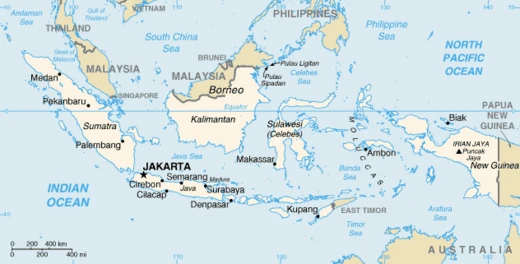
Cilegon occupies a distinctive geographic position on the most northwestern coast of Java, situated at the mouth of the Cilegon River where it meets Ciwandan Bay, an inlet of the Sunda Strait. This placement gives the city a unique administrative character: it functions as a semi-enclave within Serang Regency, bordered by that regency to the east and south, while the Sunda Strait forms its natural boundary to the north and west. The city is divided into eight administrative districts, all of whose villages are classified as urban kelurahan, with one district encompassing five small offshore islands. This coastal and semi-enclosed geography shapes both the city's identity and its strategic value, placing it at the intersection of inland Java and the open waters of the strait that separates Java from Sumatra. The proximity to the Sunda Strait also underpins the city's role as a port and industrial hub, with the Merak Harbour serving as a critical node in Indonesia's maritime logistics network.
Rapid Growth and the Migrant Engine
Cilegon's population trajectory tells a story of rapid, migration-driven expansion. The city's population climbed from 374,464 at the 2010 Census to 434,896 by the 2020 Census, with the official mid-2023 estimate reaching 470,378. Between 1991 and 2005 alone, the population surged by 47.18 percent, averaging an annual growth rate of 2.66 percent—growth attributed primarily to migrants entering the city in search of industrial employment. This influx of workers has made Cilegon the fourth-largest city in Banten province. The administrative structure reflects this density: eight districts, all composed of urban kelurahan rather than rural villages, with one district extending to five small offshore islands. The city's media landscape, including local radio stations such as Cilegon Mandiri FM and Cilegon Pass FM, and its newspaper coverage through Radar Banten, all serve this growing and industrially focused urban population.
Tropical Rhythms on the Java Coast
Cilegon experiences a hot and humid climate that sits near the boundary between the tropical rainforest (Af) and tropical monsoon (Am) classifications under the Köppen system. Despite its relatively close proximity to the equator, the city observes clearly defined wet and dry seasons rather than year-round uniform rainfall. The wet season dominates the calendar, stretching from October through May, while the remaining four months constitute the dry period. Rainfall peaks in January, the wettest month, with an average of 319 millimetres (12.6 inches), and reaches its lowest point in August, the dry-season trough, at approximately 71 millimetres (2.8 inches) per month. This seasonal rhythm of heavy monsoon rains followed by a drier stretch shapes daily life and the operational environment for the city's extensive industrial infrastructure, including its power plants, water treatment facilities, and harbour operations along the Sunda Strait.
Frequently Asked Questions
What is Cilegon?
Cilegon is a coastal city in Banten province on the northwest shore of Java, best known as Indonesia's dominant steel-producing hub. It covers roughly 162.5 square kilometers and is home to around 470,000 residents spread across eight administrative districts.
Why do fans call Cilegon the 'Steel City'?
The nickname comes from the Krakatau Steel Industrial Area, which makes Cilegon the largest steel producer in all of Southeast Asia, churning out roughly six million tons of steel every year.
What is Cilegon's role in Indonesia's economy?
As the country's primary steel-manufacturing center, Cilegon supplies the raw material backbone for construction, infrastructure, and heavy industry across Indonesia. Its entire urban layout is organized largely around this single industrial function.
Where exactly is Cilegon on the map?
It sits along the northwest coast of Java in Banten province, placing it relatively close to Jakarta while maintaining its own distinct coastal-industrial identity.
How does Cilegon compare to other Indonesian cities?
While it is far from the largest city by population, its industrial output per square kilometer puts it in a league of its own, making it the go-to reference point for steel production across Southeast Asia.
More in Indonesian Cities 1-24
Spotted an error? Know more?
Reader corrections go straight into our review queue. Suggest an edit · How this site is sourced