Banjarmasin
Largest city in South Kalimantan, former provincial capital.

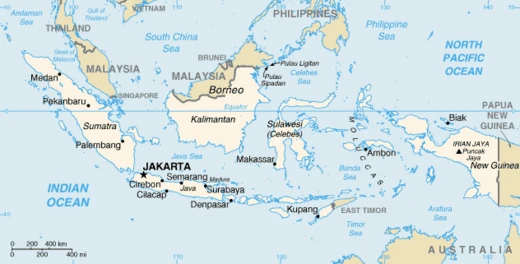
Banjarmasin is the largest city in South Kalimantan, Indonesia, and was the capital of the province until 15 February 2022. Historically the centre of the Banjarese culture and the capital of the Sultanate of Banjar, it is the biggest city in South Kalimantan and one of the main cities of Kalimantan, located on a delta island near the confluence of the Barito and Martapura rivers.
Quick Facts
- Official Name
- City of Banjarmasin / Kota Banjarmasin
- Nicknames
- id · Kota Seribu Sungai / "City of Thousand Rivers"
- Settlement Type
- City
- Motto
- bjn · Kayuh Baimbai / "Rowing Together"
- Leader Title
- Mayor
Facts from the source article.
Lore & Background
The name 'Banjarmasin' is thought to be a corrupted version of 'Bandar Masih' (Port Masih), named for Patih Masih, who ruled the port and surrounding villages. The oldest possible mention in foreign records comes from the account of Odoric of Pordenone, a Franciscan friar who visited a place called 'Thalamasin' between 1318 and 1328; Scottish Orientalist Henry Yule identified 'Thalamasin' with Banjarmasin. Another early mention appears in the 14th-century Chinese book Daoyi Zhilüe by Wang Dayuan, which describes a country called 'Pa-nan-pa-hsi' that American linguist William Woodville Rockhill identified as Banjarmasin.
The history of Banjarmasin itself began during the founding of the Sultanate of Banjar. According to folk stories and the Hikayat Banjar, Raden Samudra fled to the region, met Patih Masih, and grew the port into the town of Bandar Masih. With help from the Demak Sultanate, Samudra defeated his rival Prince Tumenggung, proclaimed the Banjar Sultanate, and changed his name to Sultan Suriansyah I.
Reader's Guide
Banjarmasin holds significance as the historical and cultural heart of the Banjarese people and as the former capital of the Sultanate of Banjar. It served as the de jure seat of the South Kalimantan governor and provincial parliament until the capital was legally moved to Banjarbaru on 15 February 2022. The city is the third most populous on the island of Borneo, with an estimated mid-2025 population of 682,360. Its urban agglomeration, Greater Banjarmasin (also called Banjarbakula or Banjar Raya), covers 6,737.70 km² and had over two million inhabitants in mid-2024, accounting for almost half of the province's population. The city's early history is documented in foreign records from the 14th century, including the travel account of Odoric of Pordenone and the Chinese text Daoyi Zhilüe, which provide rare glimpses into the region's pre-sultanate era, including descriptions of sago processing, sugar palm use, and blowpipe weapons. Archaeological finds in the region, such as stone tools discovered by H. Kupper in 1939, indicate Neolithic habitation.
Did You Know?
- Banjarmasin was the capital of South Kalimantan province until 15 February 2022, when the capital was legally moved to Banjarbaru.
- The oldest possible mention of Banjarmasin in foreign records comes from the 14th-century account of Italian Franciscan friar Odoric of Pordenone, who called it 'Thalamasin'.
- Greater Banjarmasin, also known as Banjarbakula, is an urban agglomeration of over two million people covering 6,737.70 km².
Geography & the Greater Urban Agglomeration
Banjarmasin sits on a delta island where the Barito and Martapura rivers meet, a position that has shaped its identity as a water-bound city for centuries. The municipal area spans just 98.37 square kilometres, yet it packs a dense population—625,481 residents at the 2010 Census, growing to 657,663 by 2020, with an official mid-2025 estimate of 682,360 (nearly evenly split between 341,375 males and 340,985 females). That makes it the third most populous city on the island of Borneo and the largest in South Kalimantan. Beyond the city proper, the urban agglomeration known as Banjarbakula (or Banjar Raya) stretches across 6,737.70 square kilometres, encompassing Banjarbaru, portions of Banjar Regency including Martapura, Barito Kuala Regency, and Tanah Laut Regency. By mid-2024, this sprawling metropolitan region was home to roughly 2,076,771 people—nearly half of the entire province's population.
Etymology & Cultural Mosaic
The name Banjarmasin is widely believed to be a linguistic distortion of Bandar Masih, meaning Port Masih, named after Patih Masih, a ruler of the port and its surrounding villages. The name Masih itself traces back to the Ngaju language, spoken by Dayak communities in the interior. In Ngaju, Oloh Masi referred to the coastal-dwelling Malay population whom inland Dayaks encountered during regular trading visits. Over time, some Dayak groups settled permanently at the port, weaving their customs into the emerging Banjar identity alongside Javanese and Malay influences. This layered ethnic blending—Dayak, Javanese, Malay—gave Banjarmasin a distinctive cultural character that set it apart from other Bornean port towns. The city became the historic heart of Banjarese culture and the capital of the Sultanate of Banjar, a political entity that would define the region for centuries.
Prehistoric Roots & Early Kingdoms
Long before any written chronicle, the Banjarmasin region was already a human settlement. In 1939, European archaeologist H. Kupper uncovered several prehistoric sites in the area, yielding choppers and other stone implements that bear the hallmarks of Neolithic culture. Many of these artifacts were found in Awang Bangkal, roughly 50 kilometres from the modern city. Scholars suggest that migration from mainland Asia to Borneo was facilitated when the two landmasses were still connected by the Sunda Shelf. By the early 15th century, written records from the region remain scarce, but external accounts point to several early polities: Tanjungpuri, theorized to have been established by Malay settlers from Srivijaya, and Negara Daha and Dipa, attributed to Javanese migrants from Majapahit. Hinduism and Buddhism took root in the area between the first and fifteenth centuries, leaving behind two surviving temples—Candi Laras and Candi Agung. The Ma'anyan people may have governed the archipelago's oldest kingdom, Nan Sarunai, though its existence remains debated, resting on carved stone tombs and a folk song called Usak Jawa.
The Odoric Account & Medieval Banjarmasin
The earliest possible foreign reference to Banjarmasin appears in the travel narrative of Odoric of Pordenone, an Italian Franciscan friar who journeyed through India, Indonesia, and China between 1318 and 1328. After stopping in Java, Odoric described a place he called Thalamasin, where the king commanded many islands and the people harvested flour from trees, collected honey and wine from others, and used a deadly poison. Scottish orientalist Henry Yule later identified Thalamasin as a corrupted form of the Malay Tanah Masin—the land of salt—and argued the geographical and cultural details pointed squarely to southern Borneo. Yule inferred that the inhabitants subsisted primarily on sago rather than rice, and that the sugar palm yielded palm wine, palm sugar, and a sticky molasses-like product likely resembling dodol. Odoric also described warriors carrying a cane about a fathom long, a description matching the sumpit blowpipe associated with Dayak hunting traditions. These records predate the formal founding of the Sultanate of Banjarmasin in 1526 by roughly two centuries, confirming the polity's existence as a recognized entity in the fourteenth century.
Frequently Asked Questions
What is Banjarmasin?
Banjarmasin is the biggest city in South Kalimantan, Indonesia, perched on a delta island where the Barito and Martapura rivers converge. With roughly 682,000 residents, it ranks as the third most populous city on the island of Borneo.
What was Banjarmasin's historical role?
The city served as the seat of the Sultanate of Banjar, anchoring the region's political life for centuries. It also held the title of provincial capital for South Kalimantan until that designation was transferred on 15 February 2022.
Where exactly is Banjarmasin located?
It sits on a delta island at the meeting point of the Barito and Martapura rivers in the province of South Kalimantan. The urban area spans about 98 square kilometres of land.
What is Banjarmasin known for culturally?
It is widely regarded as the heartland of Banjarese culture, the traditional identity of the Banjar people. Its riverside setting has long shaped local customs, festivals, and daily life in ways distinct from other Kalimantan cities.
Did Banjarmasin lose its provincial-capital status?
Yes — on 15 February 2022 the administrative capital of South Kalimantan was moved elsewhere. Even so, Banjarmasin remains the province's largest city and its most prominent urban centre.
More in Indonesian Cities 1-24
Spotted an error? Know more?
Reader corrections go straight into our review queue. Suggest an edit · How this site is sourced