Depok
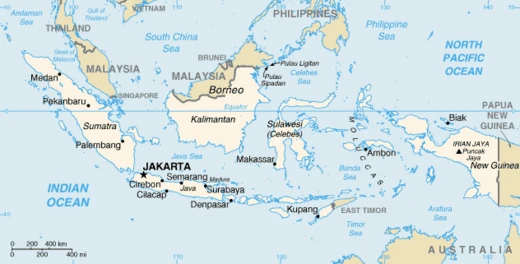
Depok is a landlocked city in West Java, south of Jakarta.

Depok is a landlocked city in West Java, sitting directly south of Jakarta. It ranks as the third-largest urban hub in the Greater Jakarta area, behind Jakarta and Bekasi, and spans roughly 199.91 square kilometers. The city is recognized as a hub for education and business. At the 2010 census, its population stood at 1,738,600; by 2020, it had grown to 2,056,400. Official estimates for mid-2024 put the figure at 2,163,635—1,088,759 males and 1,074,876 females—giving a density of about 10,823 people per square kilometer. Depok became an independent city on April 20, 1999, after being carved out from parts of Bogor Regency. It is Indonesia’s second most populous suburban city, after Bekasi, and ranks among the ten most populous suburban cities worldwide.
The name “Depok” has two possible origins. One theory holds that the area was already called Depok when Cornelis Chastelein, a senior official of the Dutch East India Company, bought about 12.44 square kilometers of land there on May 18, 1696—roughly 6.2% of Depok’s current area. Besides setting up plantations with local help, Chastelein did missionary work, introducing Christianity to the population. He founded a local congregation called De Eerste Protestante Organisatie van Christenen (DEPOC). In the 1950s, some Depok community members in the Netherlands claimed this acronym influenced the modern city name. Another explanation traces the name to the Indonesian word *padepokan* (hermitage), since the site had been used as a religious retreat. Before his death on June 28, 1714, Chastelein wrote a will freeing the enslaved families of Depok and granting them portions of his land, turning them into landowners. These twelve slave families became free men, women, and children with entitlement deeds from Chastelein’s will. They are also referred to as Mardijkers, a term derived from *merdeka* (freedom in Indonesian). June 28 has been designated as Depokse Dag (Depok Day) by descendants of the original Depok families. On June 28, 2014, to mark the 300th anniversary of Chastelein’s will, they erected a three-meter-high monument on their land, but the city government at the time prohibited it, citing its association with Dutch colonial history. The twelve original Depok family names come from Balinese, Ambonese, Buginese, Sundanese, and Portuguese Indo (Mestizo and Mardijker) backgrounds.
Quick Facts
- Settlement Type
- City
- Official Name
- City of Depok / Kota Depok
- Nickname
- id · Kota Belimbing / (Starfruit City)
- Motto
- sa-latn · Paricara Darma / (Servant of the righteousness)
- Established Title
- Settled
- Established Date
- 18 May 1696
Facts from the source article.
Lore & Background
The name 'Depok' has two possible origins. One suggests the region was already known as Depok when Cornelis Chastelein, a senior official in the Dutch East India Company, purchased land there on 18 May 1696. He introduced Christianity and founded a congregation named De Eerste Protestante Organisatie van Christenen (DEPOC), which some claim influenced the modern name. An alternative explanation is that the name derives from the Indonesian word padepokan (hermitage), as the site had previously been used as a religious retreat. Before his death on 28 June 1714, Chastelein freed 12 enslaved families and granted them pieces of his land, transforming them into landowners. These families, of Balinese, Ambonese, Buginese, Sundanese, and Portuguese Indo descent, became known as the Mardijker's, from the word Merdeka (freedom). The 12 original family names include Isakh, Jacob, Jonathans, Joseph, and Samuel, baptized after conversion to Protestant Christianity. Descendants still live in Indonesia, the Netherlands, Norway, Canada, and the United States.
Reader's Guide
Depok's significance lies in its unique colonial history and its modern role as a major suburban center. The 1714 will of Cornelis Chastelein, which freed enslaved families and granted them land, created a distinct community whose descendants maintain ties across several countries. This legacy is commemorated by some as Depokse Dag (Depok Day) on June 28, though a 2014 monument to the event was prohibited by the city government due to its association with Dutch colonial history. Depok's administrative evolution—from a special status Gemeente in 1871, to an administrative city within Bogor Regency in 1982, to an autonomous city in 1999—reflects broader Indonesian governance changes. The city experienced violence during the Bersiap period of 1945, leading some original families to flee. Today, Depok is a center of education, hosting the University of Indonesia and other institutions, and has a diverse population including Betawi, Javanese, Sundanese, Batak, and Minangkabau ethnic groups. Its economy features a mix of traditional markets and modern malls, and its geography includes two major rivers, 13 tributaries, and 22 lakes.
Did You Know?
- Depok's name may derive from the acronym DEPOC, for De Eerste Protestante Organisatie van Christenen, a congregation founded by Cornelis Chastelein.
- On 28 June 1714, Chastelein freed 12 enslaved families and granted them land; this date is commemorated as Depokse Dag by descendants.
- Depok became an autonomous city on 20 April 1999, after merging with neighboring districts of Bogor Regency.
- The city has a tropical rainforest climate and is situated on alluvial deposits above a Pleistocene bedrock formation.
Frequently Asked Questions
What is Depok?
Depok is a landlocked city in West Java, Indonesia, sitting directly south of Jakarta. It serves as a major hub for higher education and commerce within the Greater Jakarta metropolitan area.
Where exactly is Depok located?
The city is positioned in the province of West Java, with its northern border abutting Jakarta. It ranks as the third-largest urban center in the Greater Jakarta region, behind Jakarta and Bekasi.
What is Depok most known for?
Depok is widely recognized as a center of education and business, being home to the University of Indonesia. Its academic and commercial identity distinguishes it from many neighboring cities in the metro area.
How large is Depok's population?
As of mid-2024, roughly 2.16 million people live across the city's approximately 199.91 square kilometers. That translates to a population density of about 10,823 residents per square kilometer.
When did Depok become its own city, and who leads it now?
Depok was officially established as an autonomous city on April 20, 1999, after being carved out of a larger administrative area. As of 2025, Mayor Mohammad Idris holds office, having taken the role in 2021 with a term extending through 2026.
More in Indonesian Cities 1-24
Spotted an error? Know more?
Reader corrections go straight into our review queue. Suggest an edit · How this site is sourced