Lake Geneva
Large Alpine lake shared by Switzerland and France.

Giles Laurent · CC BY-SA 4.0
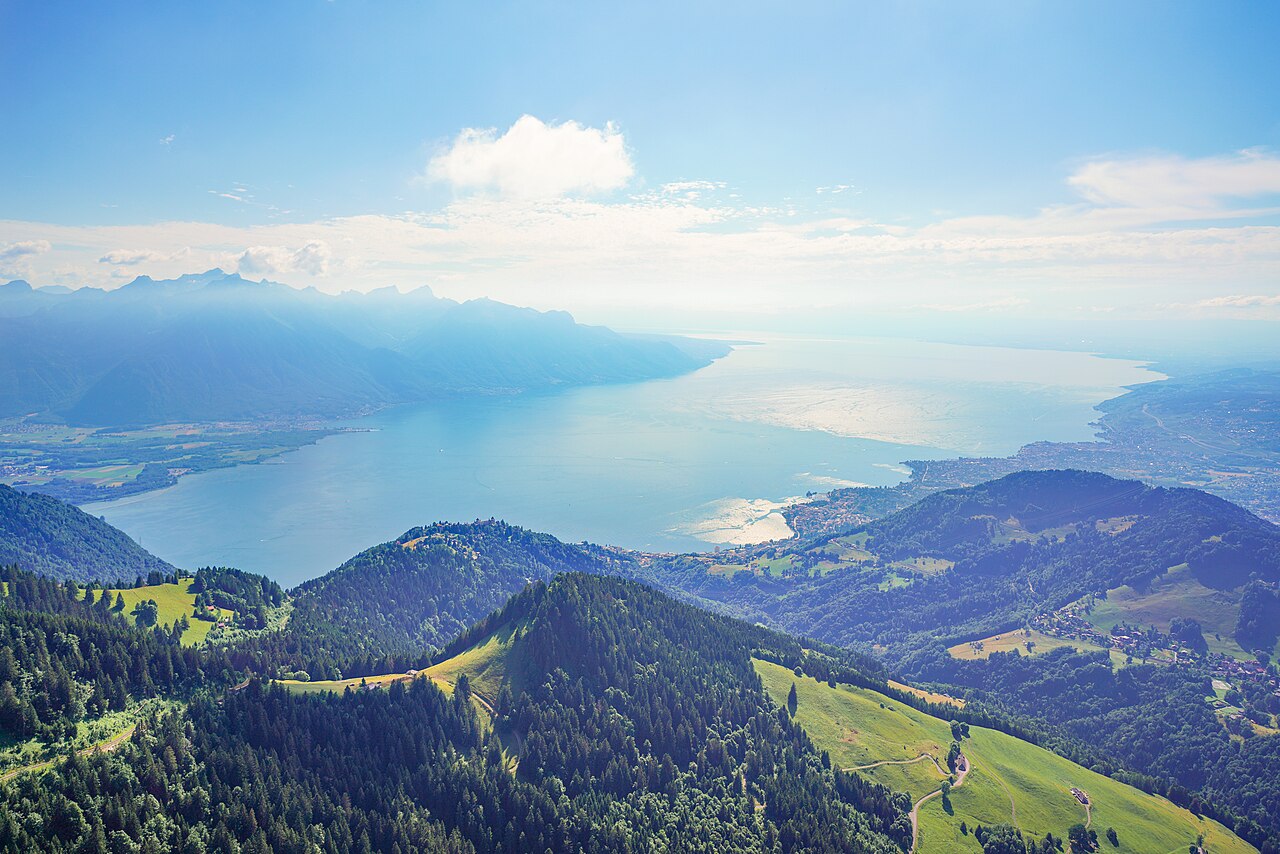
Lake Geneva is a deep alpine lake on the northern side of the Alps, straddling the border between Switzerland and France. It ranks among Western Europe’s largest lakes and is the biggest along the Rhône River’s path. Switzerland holds sixty percent of its area (345.31 km²), split across the cantons of Vaud and Geneva, while France claims the remaining forty percent (234.71 km²) in the department of Haute-Savoie.
The lake’s name has ancient roots. During Julius Caesar’s time, it was called *lacus Lemannus*, derived from the Greek *Liménos Límnē*, meaning “port’s lake.” In Medieval Latin it appeared as *Lacus Lausonius* or *Lacus Losanetes*, linked to a nearby town or district, and in Old French it was *Lac de Lausanne*. As Geneva grew in prominence, it became *Lac de Genève* (Lake Geneva in English), though *Le Léman* remains the common French name and appears on local maps.
Geographically, the lake splits into three parts based on its formation from tectonic folding, glacial erosion, and sedimentation. The *Haut Lac* (Upper Lake) stretches east from the Rhône estuary to the line between Meillerie and Rivaz. The *Grand Lac* (Large Lake) is the biggest and deepest basin, with the lake’s greatest width. The *Petit Lac* (Small Lake) is the narrower, shallower southwestern section, running from Yvoire–Promenthoux near Prangins to Geneva’s exit. According to Swisstopo, *Lac de Genève* specifically refers to the part of the Petit Lac within Geneva’s cantonal borders (excluding the exclave of Céligny), roughly from Versoix–Hermance to the Rhône outflow in Geneva.
The southern shore is bordered by the Chablais Alps, while the western Bernese Alps lie to the east. From certain spots, the high peaks of Grand Combin and Mont Blanc are visible. The Rhône River flows through the lake, originating at the Rhône Glacier near the Grimsel Pass to the east, then passing through Valais and entering the lake between Villeneuve and Le Bouveret before exiting slowly at Geneva. Other tributaries include La Dranse, L’Aubonne, La Morges, La Venoge, La Vuachère, and La Veveyse.
As Switzerland’s largest body of water, it far surpasses any other connected to the main Alpine valleys. The lake is crescent-shaped, with its horns pointing south; the northern shore runs 95 km, the southern 72 km.
Quick Facts
- Native Name
- fr · Léman / de · Genfersee / it · Lago di Ginevra/Lemano / rm · Lai da Genevra
- Location
- Switzerland, France
- Lake Type
- Glacial lake
- Inflow
- Rhône, Dranse
- Outflow
- Rhône
- Catchment
- 7975 km2
- Length
- 73 km
- Area
- 580.03 km2
- Depth
- 153.4 m
- Max Depth
- 310 m
- Volume
- 89 km3
- Residence Time
- 11.4 years
Facts from the source article.
Lore & Background
Lake Geneva is divided into three parts: Haut Lac, Grand Lac, and Petit Lac. The lake lies on the course of the Rhône, which enters between Villeneuve and Le Bouveret and exits at Geneva. Its greatest depth, 310 m, is in the broad portion between Évian-les-Bains and Lausanne. The lake's surface is the lowest point of the canton of Vaud. The beauty of its shores has long been celebrated, with the northern shore featuring gentle vine-covered slopes and the southern shore more rugged mountains. The average surface elevation is controlled by the Seujet Dam in Geneva. Due to climate change, the average temperature of deep water increased from 4.4 °C in 1963 to 5.5 °C in 2016, and surface temperatures have also risen. While the cold Bise wind can affect the lake, complete freezing is rare and not a typical characteristic.
Reader's Guide
Lake Geneva is historically and environmentally significant as the largest body of water in Switzerland and a key part of the Rhône river system. Its name has evolved from lacus Lemannus in Roman times to Lac de Genève in English, though Le Léman remains the customary French name. The lake has faced environmental challenges: in the late 1960s pollution made swimming dangerous, and by the 1980s eutrophication nearly wiped out fish. The endemic whitefish Coregonus fera became extinct, though the name fera is still used for an introduced species. Pollution levels have since been cut back, making swimming safe again. Since 2016, the invasive quagga mussel has dramatically changed biodiversity, coating the entire lake floor and destroying the native food chain. The lake hosts major sport events including the Bol d'or yacht race and the Tour du Lac rowing event, the longest non-stop rowing regatta in the world. Notable residents have included Edmund Ludlow, Mary and Percy Shelley, Lord Byron, Empress Elisabeth of Austria, Vladimir Lenin, Charlie Chaplin, and several actors.
Did You Know?
- The name lacus Lemannus was in use during the time of Julius Caesar.
- The greatest depth of the lake is 310 m (1,020 ft), measured between Évian-les-Bains and Lausanne.
- In 2024, scientists found that 100% of the biomass sampled from the lake floor were Quagga mussels.
- The Tour du Lac rowing event is 160 km (99 mi), the longest non-stop rowing regatta in the world.
Glacial Origins & Physical Profile
Carved into existence at least two million years ago during the Pleistocene Ice Age, Seneca Lake is the product of repeated advances and retreats of continental glaciers reaching thicknesses of up to two miles. As the largest and deepest member of New York's eleven-lake glacial chain, it stretches 38 miles from Watkins Glen at its southern tip to Geneva at its northern end, spanning four counties and covering 66.9 square miles. Its maximum depth exceeds 618 feet, with an average of 291 feet, and it holds an estimated 3.81 cubic miles of water—roughly half the total volume of the entire Finger Lakes. Rather than depending on a single major river inflow, the lake is replenished by underground springs delivering approximately 328,000 gallons per minute. This constant spring-fed circulation keeps water moving in a circular pattern, making a full freeze-over highly unlikely, while temperatures near the bottom hold steady around 39 degrees Fahrenheit year-round. Its two principal inlets are Catharine Creek at the south and the Keuka Lake Outlet, and its outflow feeds the Seneca River and the Cayuga-Seneca Canal system linking it to Cayuga Lake.
Aquatic Life & Strategic Depth
Seneca Lake has earned the title of lake trout capital of the world, a distinction cemented by its annual National Lake Trout Derby. Its considerable depth creates distinct thermal zones that support a layered aquatic community: coldwater species such as lake trout and landlocked Atlantic salmon thrive in the deeper, cooler layers, while warmwater fish including smallmouth bass, yellow perch, largemouth bass, northern pike, and pickerel populate the shallower regions. The lake also sustains a notably robust population of alewife shad, locally known as sawbellies. Beyond its ecological richness, Seneca's depth and accessibility make it a valuable asset for the United States Navy, which uses the lake to conduct testing and evaluation of range on equipment such as sonar systems. The combination of a stable near-freezing bottom temperature, a diverse fishery spanning at least nine species, and a volume of water that rivals smaller inland seas gives the lake a dual identity as both a premier recreational fishing destination and a site of national defense utility.
Indigenous Roots & Colonial Displacement
Seneca Lake takes its name from the Seneca people, a branch of the Iroquois Confederacy whose villages dotted the surrounding hillsides for generations. Among their settlements was Kanadaseaga, known to colonists as Seneca Castle. That world was shattered during the American Revolutionary War, when the 1779 Sullivan Expedition systematically destroyed Iroquois villages across the region. Following Britain's defeat, the Iroquois were compelled to cede their lands, and millions of acres were sold off; portions were granted to Continental Army veterans as payment for military service. A slow trickle of European-American settlers began arriving around 1790, but they remained largely isolated without a viable market or transportation route for their crops. That isolation ended in 1825 with the opening of the Erie Canal, which linked the Finger Lakes region to the broader world. Steamships, barges, and ferries soon filled the lake, and the earlier Crooked Lake Canal connected Seneca to neighboring Keuka Lake. Numerous canal barges sank during operations and now rest on the lake floor, with a collection near Watkins Glen being preserved for scuba diving by the Finger Lakes Underwater Preserve Association.
Folklore, Wine & Cultural Life
Seneca Lake's cultural tapestry weaves together legend, agriculture, and modern recreation. In 1900, newspapers reported that the steamboat Otetiani had encountered a 25-foot sea serpent with two rows of sharp white teeth on the evening of July 14, 1899; the vessel allegedly rammed the creature, breaking its spine, before it sank to the bottom—though a later Geneva Gazette report suggested the affair was a hoax. The southern cliff face bears painted rocks from 1929, created for the Sullivan Sesquicentennial, depicting an American flag, a teepee, and Native American figures, though historian Barbara Bell has noted the imagery contains errors, as the Seneca used longhouses rather than teepees. The lake is also famous for the Seneca Drums, unexplained booming sounds and vibrations reported for over a century. On the agricultural side, the region's macroclimate supports more than 50 wineries, many farm-based, anchored by the Seneca Lake AVA and a dedicated wine trail. Geneva at the north end hosts Hobart and William Smith Colleges and Cornell's New York State Agricultural Experiment Station, while Watkins Glen at the south is renowned for its waterfalls and the Watkins Glen International racetrack.
Gallery
Frequently Asked Questions
What is Lake Geneva?
Lake Geneva is a deep alpine lake resting on the northern face of the Alps, shared between Switzerland and France. It ranks among the largest lakes in Western Europe and is the biggest body of water along the Rhône's entire course.
Where exactly is Lake Geneva located?
The lake straddles the Swiss-French border, with Switzerland holding roughly sixty percent of its surface across the cantons of Vaud and Geneva, and France claiming the remaining forty percent in Haute-Savoie. Its surface sits about 372 meters above sea level.
How deep is Lake Geneva?
At its deepest point the lake reaches 310 meters (around 1,020 feet), making it one of the deepest lakes in Europe. Its total surface area spans approximately 580 square kilometers.
What rivers flow into and out of Lake Geneva?
The Rhône is the principal inflow, supplemented by tributaries such as La Dranse, L'Aubonne, La Morges, La Venoge, La Vuachère, and La Veveyse. The Rhône also serves as the lake's sole major outflow, carrying its waters onward downstream.
Where does the name 'Lake Geneva' come from?
The lake's name traces back to the Roman-era term *lacus Lemannus*, which itself derives from the Greek *Liménos Límnē*, essentially meaning 'port's lake.' Medieval Latin carried the name forward before it settled into the form recognized today.
More in Great Lakes Of The World 1-24
Spotted an error? Know more?
Reader corrections go straight into our review queue. Suggest an edit · How this site is sourced