Lake Edward
African Great Lake on the DRC-Uganda border.

Edward H. Mitchell · Public domain
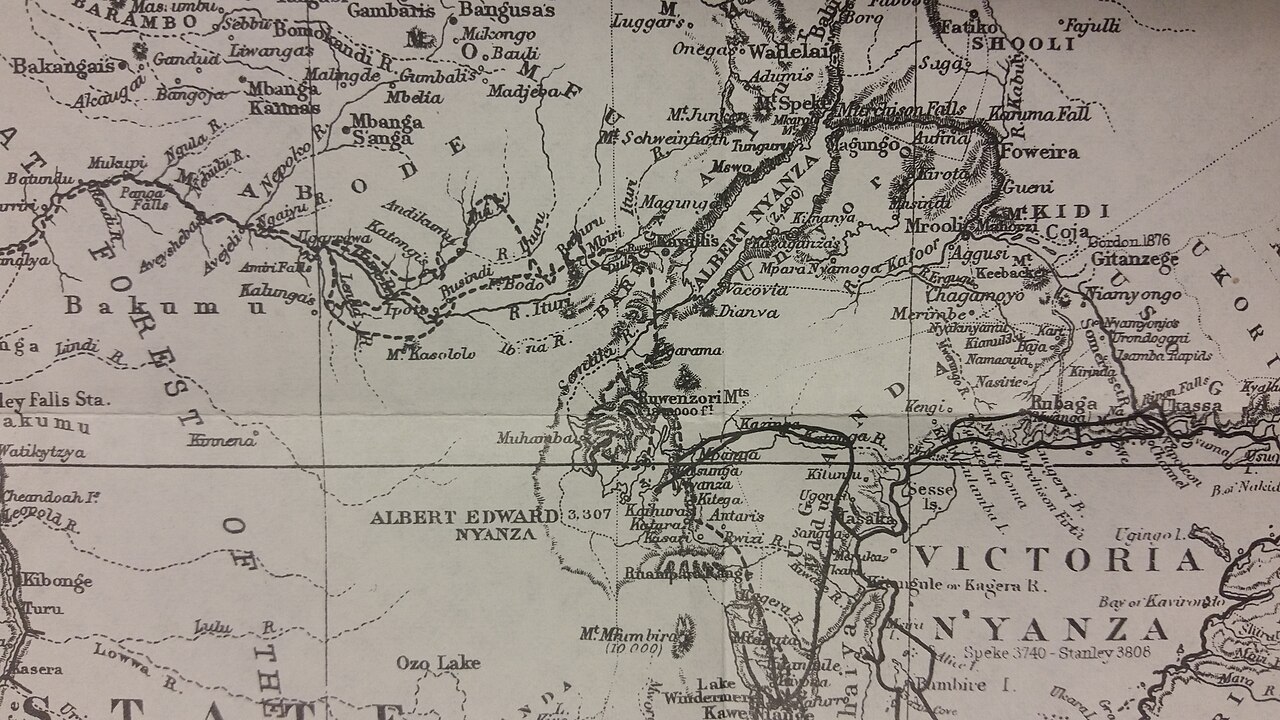
Lake Edward (locally Rwitanzigye or Rweru) is one of the smaller African Great Lakes, located in the Albertine Rift on the border between the Democratic Republic of the Congo and Uganda. It was first seen by Welsh explorer Henry Morton Stanley in 1889 during the Emin Pasha Relief Expedition and named after Albert Edward, Prince of Wales (later King Edward VII). The lake is notable for its volcanic history, ecological significance, and role in regional disputes.
Quick Facts
- Inflow
- Nyamugasani / Ishasha / Rutshuru / Rwindi / Ntungwe / Lubilia
- Outflow
- Semliki River
- Catchment
- 12,096 km2
- Countries
- Democratic Republic of Congo / Uganda
- Length
- 77 km
- Area
- 2,325 km2
- Depth
- 17 m
- Max Depth
- 112 m
- Volume
- 39.5 km3
- Elevation
- 912 m
Facts from the source article.
Lore & Background
Lake Edward lies at an elevation of 920 metres, is 77 kilometres long by 40 kilometres wide, and covers 2,325 square kilometres. It is fed by the Nyamugasani, Ishasha, Rutshuru, Ntungwe, and Rwindi rivers, and receives water from Lake George via the Kazinga Channel. The lake empties north via the Semliki River into Lake Albert, part of the White Nile system. The western escarpment of the Great Rift Valley rises up to 2,000 metres above its western shore, while the southern and eastern shores are flat lava plains. The Ruwenzori Mountains lie 20 kilometres north.
The region shows extensive volcanic activity over the last 5,000 years, with the Katwe-Kikorongo and Bunyaruguru Volcanic Fields on either side of the Kazinga Channel. It is thought that Lakes George and Edward were once joined, but lava flows divided them, leaving only the Kazinga Channel. The Katwe-Kikorongo field includes dozens of craters and cones, with Lake Katwe—a crater lake separated from Lake Edward by just 300 metres of land—being the largest. The volcanic origin of this area was not reported until 1894 by G. F. Scott Elliot, though Stanley visited Lake Katwe in 1889 and noted its salinity and a sulphurous spring without connecting them to volcanism.
In 1973, Uganda renamed the lake Lake Idi Amin after Ugandan dictator Idi Amin; Zaire (now DRC) did not officially rename it. After Amin's overthrow in 1979, it recovered its former name. In 2014, the lake was the center of an oil dispute when SOCO International entered Virunga National Park to prospect for oil, leading to beatings, kidnappings, and torture of villagers and workers who tried to stop them. Plans to redraw park boundaries to exclude the lake were considered, but these conflicted with the World Heritage Convention. On July 6, 2018, a naval skirmish between Uganda and the DRC on the lake resulted in one death and three wounded, with early local reports claiming seven killed.
Reader's Guide
Lake Edward is significant as a transboundary African Great Lake situated within two national parks—Virunga National Park (DRC) and Queen Elizabeth National Park (Uganda)—making it a protected area of international importance. Its volcanic history, including the Katwe-Kikorongo and Bunyaruguru fields, provides insight into the region's geological past, with evidence that lava flows once divided a larger lake into Lakes Edward and George. Ecologically, the lake supports diverse fish species, including over 50 haplochromine species, and its banks host chimpanzees, elephants, crocodiles, and lions. The lake's hippopotamus population, once around 29,000 in the 1970s, declined by 95% due to poaching, falling to a few hundred by 2006 and recovering to 1,500 by 2019. This decline has cascading effects: hippo dung feeds tilapia, and the loss of hippos contributed to a collapse in tilapia stocks, which previously supported 15,000–20,000 metric tons annually and supplied fish for the entire eastern DRC. The resulting economic hardship for local fishermen has been compounded by illegal fishing by rebel groups. The lake's history also includes political renaming, oil disputes, and a 2018 naval skirmish, reflecting ongoing tensions over resources and sovereignty.
Did You Know?
- Lake Edward was renamed Lake Idi Amin in 1973 by Uganda only, but recovered its former name after Amin's overthrow in 1979.
- The lake's hippopotamus population declined by 95% from around 29,000 in the 1970s to a few hundred by 2006, recovering to 1,500 by 2019.
- The Katwe-Kikorongo volcanic field includes Lake Katwe, a crater lake separated from Lake Edward by only 300 metres of land.
Position in the Great Lakes System
Lake Edward occupies a defined place within the broader African Great Lakes system, a collection of water bodies known in Swahili as Maziwa Makuu and in Kinyarwanda as Ibiyaga bigari. These lakes constitute the portion of the Rift Valley lakes situated in and around the East African Rift. Within the drainage taxonomy most commonly used, Lake Edward is grouped among the lakes whose waters ultimately feed the White Nile, sharing that hydrological pathway with Lake Victoria, Lake Kyoga, and Lake Albert. The precise roster of lakes counted as part of the Great Lakes varies from one reference to another, with some lists incorporating smaller rift-valley waters when they belong to the same drainage basin as a larger lake. Collectively, the African Great Lakes hold roughly 31,000 cubic kilometres of water—more than either Lake Baikal or the North American Great Lakes combined—and represent approximately a quarter of all unfrozen surface fresh water on Earth. Lake Edward, though smaller than the headline names, contributes to this extraordinary reservoir and to the network of ten riparian nations that border the region.
Geological Origins
The very existence of Lake Edward is a product of deep geological upheaval. For most of Earth's history, the equatorial plateau's abundant waters followed two broad routes: westward into the Congo River system or eastward toward the Indian Ocean. That arrangement was disrupted roughly twelve million years ago when tectonic forces began pulling the eastern portion of the African continent away from the rest, driving it northeastward under the influence of mantle currents. The resulting rift—a zone of crustal weakness where two plates separate—created troughs, or grabens, capable of collecting water. The basins that formed from these uplifts redirected flow northward, and Lake Edward sits within one of those newly carved depressions. The East African Rift is not a single scar but a complex system of uplifts and downwarps, and the lakes that occupy them, including those in the Western Rift such as Lake Edward, are essentially the water-filled remnants of that ancient splitting. The geological story is still unfolding, as the plates continue their slow divergence.
Living World
As a Western Rift Valley lake, Lake Edward belongs to a freshwater system renowned for an extraordinary concentration of endemic life. The Great Lakes as a whole shelter more than 1,500 species of cichlid fish, along with members of other fish families, and the region accounts for roughly ten percent of all fish species on the planet. Amphibian communities also find important habitat in and around these waters. On the surface and in the shallows, Nile crocodiles are numerous, while the surrounding highlands support elephants, gorillas, and hippopotamus. The broader East African rift system doubles as a flyway for migrating birds, drawing in hundreds of additional species beyond those already resident. These birds are sustained largely by plankton blooms in the lake waters, which in turn feed the fish. The vegetation around the lakes ranges from rainforest to savanna grasses. However, the system faces pressure from rapidly growing invasive plants—surface-choking water hyacinth and shore-clogging papyrus—that can degrade habitat and complicate the delicate balance sustaining so much biodiversity.
The Human Landscape
The human story surrounding Lake Edward is as layered as its geology. The Great Lakes region is bounded by ten nations—Burundi, the Democratic Republic of the Congo, Ethiopia, Kenya, Malawi, Mozambique, Rwanda, Tanzania, Uganda, and Zambia—with Swahili as the most widely spoken tongue and an official or national language in five of those states. The highlands enjoy cool average temperatures of 17 to 19 degrees Celsius and generous rainfall, conditions that sustained dense populations and agricultural surpluses. Those surpluses helped spawn a patchwork of small states and powerful monarchies, among them Buganda, Bunyoro, Karagwe, Rwanda, and Burundi. The region's status as both the long-sought source of the Nile and the watershed triple point where the Nile, Congo, and Zambezi basins converge made it a magnet for European interest. Christian missionaries arrived first in meaningful numbers, and their presence, though limited in conversion success, opened the region to later colonization. Increased global contact brought devastating epidemics to both people and livestock. The four decades straddling the turn of the twenty-first century saw repeated civil wars and conflict, yet in 2022 the UNHCR commended Tanzania for consistently sheltering and aiding refugees fleeing those upheavals.
Gallery

Frequently Asked Questions
Who is Lake Edward?
Lake Edward (locally called Rwitanzigye or Rweru) is a modest-sized African Great Lake that straddles the border between the Democratic Republic of the Congo and Uganda. It sits within the Albertine Rift valley at an elevation of roughly 920 metres above sea level.
What are Lake Edward's stats and standing among the Great Lakes?
Stretching about 77 km in length and 40 km across at its widest point, it covers roughly 2,325 square kilometres of surface. That makes it the 15th-largest lake on the African continent, placing it firmly in the smaller tier of the Great Lakes family.
How did Lake Edward get its name and who first spotted it?
Welsh explorer Henry Morton Stanley was the first European to sight the lake in 1889 while on the Emin Pasha Relief Expedition. He christened it after Albert Edward, the Prince of Wales who would later ascend the throne as King Edward VII.
What role does Lake Edward play in the region?
The lake serves as a shared waterway between two nations, which has historically made it a flashpoint in border disputes between the DRC and Uganda. Ecologically, it supports rich biodiversity and rests atop a volcanic landscape that shaped its basin.
Why does Lake Edward matter to the Great Lakes community?
It represents the smaller, often overlooked members of the African Great Lakes system that still carry enormous ecological and geopolitical weight. Its volcanic origins and cross-border position make it a compelling case study for how geology, ecology, and politics intersect in a single body of water.
More in Great Lakes Of The World 1-24
Spotted an error? Know more?
Reader corrections go straight into our review queue. Suggest an edit · How this site is sourced