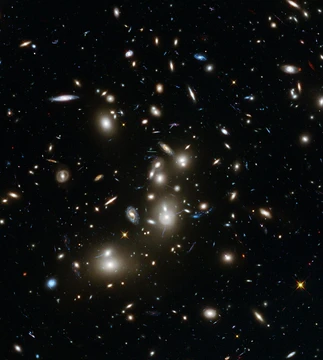
Hickson 74
A compact group of five galaxies dominated by NGC 5910.

Hickson Compact Group 74 (HCG 74) is a compact group of galaxies located about 540 million light-years away in the constellation Serpens. Its brightest and dominant member is the elliptical galaxy NGC 5910, which gives the group its primary distinction. The group is notable for its compact configuration and the presence of a common envelope surrounding its member galaxies.
Quick Facts
- Epoch
- J2000
- Ra
- 15 · 19 · 24.7
- Dec
- +20 · 53 · 47
- Dist Ly
- 167 Mpc
- Group Cluster
- HCG 74
- H Radial V
- 12119 km/s
- Z
- 0.040426
- Appmag V
- 14.96
- Constellation Name
- Serpens
- Names
- PGC 054689, HCG 074A, VV 139a, CGCG 135-045, MCG +04-36-035
Facts from the source article.
Lore & Background
NGC 5910, the central elliptical galaxy of Hickson Compact Group 74, was discovered by astronomer William Herschel on April 13, 1785. It is a strong radio source with a conspicuous nuclear jet. The galaxy appears to have a double nucleus, with a faint nuclear dust lane also observed. A pair of asymmetries in the isophotal profile of NGC 5910—one brighter than the other, weaker asymmetry—suggests a past merger and collision of one or more galaxies.
The group consists of five members in total: NGC 5910, 2MASX J15193179+2053005, PGC 54692, PGC 54694, and MCG+04-36-036. The other galaxies appear to be embedded within a common envelope that belongs to NGC 5910. NGC 5910 lies near the Hercules Superclusters.
Reader's Guide
Hickson Compact Group 74 is significant as a compact galaxy group whose brightest member, NGC 5910, exhibits evidence of a past merger through its double nucleus and asymmetrical isophotal profile. The group's five members are bound within a velocity dispersion of 537 km/s and span a diameter of 260,000 light-years. The fact that the other galaxies appear embedded in a common envelope belonging to NGC 5910 suggests ongoing or recent dynamical interaction. Two type Ia supernovae have been discovered in NGC 5910: SN 2002ec, found in July 2002 via unfiltered KAIT CCD images by Li and Beutler, and PSN J15192497+2054024, discovered on 17 March 2013 by the Catalina Real-Time Transient Survey and Stan Howerton. These supernovae provide additional data on stellar evolution within the group. The group's proximity to the Hercules Superclusters places it in a larger cosmic structure, though the article does not specify a direct physical association.
Did You Know?
- NGC 5910, the brightest member of Hickson 74, is a strong radio source with a conspicuous nuclear jet.
- The group has a velocity dispersion of 537 km/s and a diameter of 260,000 light-years.
- The other galaxies in the group appear embedded within a common envelope belonging to NGC 5910.
More in Galaxy Clusters and Groups 1-24
Spotted an error? Know more?
Reader corrections go straight into our review queue. Suggest an edit · How this site is sourced