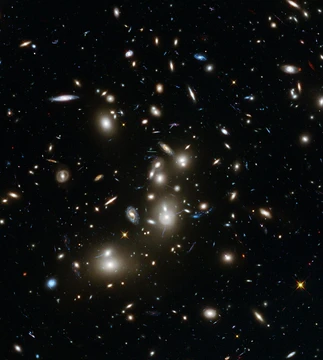
Galaxy group
The smallest and most common galaxy aggregates in the universe.

A galaxy group, or group of galaxies (GrG), is an aggregation of about 50 or fewer gravitationally bound galaxies, each at least as luminous as the Milky Way. Groups are the smallest aggregates of galaxies and are the most common structures in the universe, accounting for at least 50% of galaxies in the local universe. The Milky Way is part of a group called the Local Group.
- Max members
- 50
- Diameter range
- 1 to 2 megaparsecs (Mpc)
- Typical mass
- 10^13 solar masses
- Velocity dispersion
- 150 km/s
- Xray emission fraction
- about half of local groups
- Xray emission zone
- 50–500 kpc
Lore & Background
Groups of galaxies typically contain no more than 50 galaxies within a diameter of 1 to 2 megaparsecs, with a mass of about 10^13 solar masses and a velocity spread of roughly 150 km/s. This definition is a guide, as larger systems are sometimes classified as groups. In the local universe, about half of groups exhibit diffuse X-ray emissions from their intracluster media, and those that do tend to have early-type galaxies as members. The X-ray emissions come from zones within the inner 10–50% of the groups' virial radius, generally 50–500 kpc.
Several subtypes exist. Compact groups consist of a small number of galaxies (typically around five) in close proximity and relatively isolated; the first discovered was Stephan's Quintet in 1877, and Paul Hickson created a catalogue of such groups in 1982. Compact groups show the effect of dark matter, as visible mass is far less than needed to hold them together, and they are not dynamically stable over Hubble time, indicating galaxies evolve by merger. Fossil groups are believed to be the end-result of galaxy merging within a normal group, leaving behind the X-ray halo; the closest fossil group to the Milky Way is NGC 6482. Proto-groups are groups in the process of formation, containing galaxies and protogalaxies embedded in dark matter haloes that are fusing into singular dark matter halos.
Reader's Guide
Galaxy groups are significant as the smallest aggregates of galaxies and the most common structures in the universe, accounting for at least 50% of galaxies in the local universe. They occupy a mass range between very large elliptical galaxies and clusters of galaxies. Their study provides insight into galaxy evolution, particularly through compact groups, which are not dynamically stable over Hubble time and thus show that galaxies evolve by merger over the age of the universe. Fossil groups, being old and undisturbed systems with little infall of luminous galaxies since their initial collapse, serve as important laboratories for studying galaxy formation and evolution as well as the intragroup medium in isolation. The presence of diffuse X-ray emissions in about half of local groups, associated with early-type galaxies, further informs understanding of the intracluster medium. Groups also demonstrate the influence of dark matter, as visible mass in compact groups is insufficient to gravitationally bind them. The Local Group, which contains the Milky Way, is itself a galaxy group, underscoring the relevance of these structures to our own cosmic neighborhood.
Did You Know?
- The Milky Way is part of a group of galaxies called the Local Group.
- The first compact group discovered was Stephan's Quintet in 1877.
- The closest fossil group to the Milky Way is NGC 6482, an elliptical galaxy about 180 million light-years away.
Scale and Hierarchy in Cosmic Structure
Galaxy groups and clusters stand at the top of the gravitationally bound hierarchy in the universe, representing the densest nodes of large-scale cosmic structure. In cold dark matter models of structure formation, the smallest objects collapse first and progressively assemble into ever-larger configurations, with clusters emerging as the final, most massive bound objects. This assembly is comparatively recent, occurring somewhere between ten billion years ago and the present. Groups, the smallest aggregates, typically hold no more than fifty galaxies within a diameter of one to two megaparsecs and carry a mass around ten to the thirteenth solar masses. Clusters, by contrast, can encompass thousands of individual galaxies. Despite their enormity, clusters are often embedded within still larger, non-gravitationally bound superclusters. Groups are remarkably common, accounting for at least half of all galaxies in the local universe. Our own Milky Way belongs to the Local Group, which contains more than fifty-four galaxies. In 2017, researchers S. Paul, R. S. John, and colleagues established clear mass-based criteria for distinguishing groups from clusters, placing the boundary at eight times ten to the thirteenth solar masses.
The Dark Matter Enigma
When astronomers first examined the velocities of galaxies within clusters, they encountered a deep puzzle: the speeds were far too high for the visible galaxies' mutual gravity to hold the system together. X-ray observations later revealed vast reservoirs of intergalactic gas, the intracluster medium, blazing at temperatures between ten million and a hundred million kelvins. This hot gas, radiating X-rays through bremsstrahlung and atomic line emission, carries roughly twice the mass of all the galaxies combined. Yet even this substantial addition falls short of explaining the gravitational binding. By analyzing the gas in hydrostatic equilibrium with the cluster's gravitational field, researchers deduced that the total mass is approximately six times greater than the mass of galaxies plus hot gas. In a typical cluster, only about five percent of the mass resides in galaxies, perhaps ten percent in the X-ray-emitting gas, and the overwhelming remainder is dark matter. The Bullet Cluster observations have been cited as the strongest evidence for this invisible component, though Brownstein and Moffat have proposed a modified gravity theory that can also account for X-ray cluster masses without invoking dark matter.
A Multiband Window into Clusters
Detecting and studying galaxy clusters demands a toolkit spanning the electromagnetic spectrum and beyond. Optical and infrared telescopes identify clusters by searching for overdensities of galaxies, confirming them through redshift measurements of multiple members; infrared surveys prove especially valuable for catching more distant, higher-redshift clusters. X-ray telescopes reveal the hot intracluster medium, making clusters among the brightest extragalactic X-ray sources alongside active galactic nuclei. Radio observations uncover diffuse structures and groups of radio sources that serve as tracers of cluster locations, while imaging around individual radio sources at high redshift has even detected protoclusters in the act of forming. The Sunyaev-Zel'dovich effect offers another powerful probe: hot electrons in the intracluster medium scatter cosmic microwave background radiation via inverse Compton scattering, leaving a characteristic shadow at certain radio frequencies. Finally, gravitational lensing allows astronomers to map the distribution of dark matter by measuring how a cluster's total mass distorts the apparent shapes of background galaxies.
Reading the Thermal History of Clusters
Clusters of galaxies are the most massive and most recently formed objects in the hierarchical structure formation of the universe, making them invaluable for understanding how galaxies form and evolve. Two key properties make clusters particularly informative: their masses are sufficient to retain energetic gas ejected by member galaxies, and the thermal energy of that gas falls squarely within the X-ray bandpass, rendering it directly observable. The state of intracluster gas at any given moment reflects a complex interplay of shock heating during accretion, radiative cooling, and thermal feedback triggered by that cooling. Consequently, the density, temperature, and substructure of the X-ray-emitting gas encode the entire thermal history of cluster formation. To decode this history more precisely, researchers turn to entropy, the thermodynamic quantity most directly altered when the thermal energy of intracluster gas increases or decreases. By studying entropy profiles, astronomers can reconstruct the sequence of heating and cooling events that shaped each cluster over billions of years.
Frequently Asked Questions
What exactly is a galaxy group?
A galaxy group is the smallest recognized collection of gravitationally bound galaxies, typically containing no more than about 50 members, each roughly as bright as the Milky Way or brighter. Think of it as the most basic "family unit" of galaxies in the cosmic hierarchy.
How large and massive is a typical galaxy group?
Most groups span roughly 1 to 2 megaparsecs across and carry a total mass on the order of 10^13 solar masses. Their internal velocity dispersion sits around 150 km/s, and roughly half of local groups produce detectable X-ray emission from hot gas in their central 50–500 kpc region.
How do galaxy groups differ from galaxy clusters?
Groups are the smallest and most numerous galaxy aggregates, capped at around 50 members, whereas clusters contain hundreds to thousands of galaxies and are far more massive. In the local universe, at least half of all galaxies reside in groups rather than in larger structures.
Why are galaxy groups important in cosmology?
Because they are the most common large-scale structure, groups serve as a baseline for understanding how gravity binds galaxies together before hierarchical merging builds clusters and superclusters. They also represent the simplest environment for studying galaxy interactions and evolution.
What is the Local Group and where does the Milky Way fit in it?
The Local Group is the specific galaxy group that contains the Milky Way, Andromeda, and dozens of smaller companion galaxies. It is one of the nearest examples of a group, making it a key laboratory for studying how group-scale dynamics work.
More in Galaxy Clusters and Groups 1-24
Spotted an error? Know more?
Reader corrections go straight into our review queue. Suggest an edit · How this site is sourced