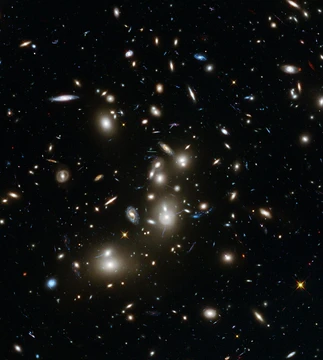
Galactic orientation
Spatial orientation of a galaxy's plane relative to Earth.

A galaxy's orientation refers to how its galactic plane is positioned in space, assuming such a plane exists. For spiral galaxies, this orientation is determined from Earth by measuring the tilt of the galactic plane relative to the sky and the position angle of the galaxy's major axis. The result gives a vector perpendicular to the plane—for the Milky Way, this vector points toward the galactic pole. Knowing how these spin vectors are distributed across galaxies is essential for understanding where galaxies got their angular momentum, since their rotation is thought to reflect the conditions present when they formed.
Galaxies are vast, gravitationally bound collections of stars, gas, dust, and dark matter. The Milky Way is just one of billions. They come in several types: spirals, ellipticals, irregulars, and peculiars. Sizes vary from dwarf irregulars with only a few thousand stars to giant ellipticals containing up to 10¹³ stars. Ellipticals appear spherical or elliptical; spirals range from lenticular S0 types through barred Sb galaxies to Sc galaxies with prominent spiral arms. By count, ellipticals make up 13% of galaxies, S0s 22%, spirals (Sa, Sb, Sc) 61%, irregulars 3.5%, and peculiars 0.9%. Most galaxies have a dense central region of older stars called the nuclear bulge, surrounded by a disk of young, hot stars. Ellipticals are more common in galaxy clusters, often with a giant elliptical at the center, while spirals are more common in the field—outside clusters.
Galactic clusters are large, gravitationally bound groups of galaxies. Their evolution depends on how and when they formed and how their structure and members have changed over time. Gamow (1952) and Weizsäcker (1951) argued that galaxy rotations are important for cosmology, suggesting they might reveal the physical conditions of galaxy formation. Three main scenarios explain the origin of clusters and superclusters, each based on different assumptions about the early universe and each predicting different alignments of galaxy spin vectors. These three models—the pancake model, the hierarchy model, and the primordial vorticity theory—are mutually exclusive because their predictions contradict one another. All three, however, rest on cosmological principles, so they can be tested using appropriate data and analysis methods.
- Ellipticals percentage
- 13
- S0 percentage
- 22
- Sa b c percentage
- 61
- Irregulars percentage
- 3.5
- Peculiars percentage
- 0.9
Lore & Background
The concept of galactic orientation is derived from the inclination of a galaxy's plane to the plane of the sky and the position angle of its major axis. For the Milky Way, this is given by the coordinates of the galactic pole. Gamow (1952) and Weizscker (1951) showed that the observed rotations of galaxies are important for cosmology, postulating that rotation might be a clue to the physical conditions under which these systems formed.
Three main scenarios for the origin of galaxy clusters and superclusters predict different spin vector alignments of galaxies. The pancake model predicts spin vectors tend to lie within the cluster plane. The hierarchy model predicts random distribution of spin vectors. The primordial vorticity theory predicts spin vectors distributed primarily perpendicular to the cluster plane. These three hypotheses are mutually exclusive as they produce contradictory predictions.
The primordial vorticity theory, also called the turbulence model, is a top-down scenario where flattened rotating proto-clusters formed due to cosmic vorticity in the early universe. The pancake model, proposed by Yakob B. Zel'dovich, involves formation of clusters first followed by fragmentation into galaxies. The hierarchy model posits that galaxies formed first and obtained angular momenta by tidal forces while gathering gravitationally to form a cluster.
Reader's Guide
The study of galactic orientation is significant because it provides a testable framework for competing cosmological models of structure formation. The three main scenarios—pancake, hierarchy, and primordial vorticity—each make distinct predictions about the alignment of galaxy spin vectors relative to cluster planes. Because these predictions are contradictory, observational data on galactic orientations can discriminate among the models. The article notes that all three theories are based on the precepts of cosmology and can be tested using a database with appropriate methods of analysis. The legacy of this field lies in its potential to reveal the primordial conditions that led to galaxy formation. The work of Gamow and Weizscker established that galaxy rotations are a key cosmological clue, and subsequent researchers have developed methods to measure and analyze orientations. The references provided (Aryal et al., 2006, 2008) indicate ongoing observational efforts to study spatial orientations in specific clusters and superclusters, such as Abell 3558 and the local supercluster, contributing to the empirical testing of these models.
Did You Know?
- Galactic orientation is defined by the inclination of the galactic plane to the plane of the sky and the position angle of the major axis.
- Gamow (1952) and Weizscker (1951) first proposed that galaxy rotations are a clue to the physical conditions of galaxy formation.
- The three mutually exclusive models for galaxy cluster origin are the pancake model, hierarchy model, and primordial vorticity theory.
- The pancake model predicts spin vectors lie within the cluster plane, while primordial vorticity predicts they are perpendicular.
Hierarchical Assembly of Cosmic Structure
Galaxy groups and clusters stand as the most massive gravitationally bound systems identified to date in the universe's structure-building history. Within the cold dark matter paradigm, cosmic architecture assembles from the smallest scales upward: the least massive objects collapse first, and through successive mergers and accretion they ultimately coalesce into the vast clusters we observe today. This final stage of assembly is surprisingly recent on a cosmic timescale, with clusters taking shape somewhere between ten billion years ago and the present epoch. Once formed, these dense concentrations of galaxies sit at the nodes of the universe's large-scale web, often nestled within even broader, non-gravitationally bound superclusters. A single group or cluster may encompass anywhere from ten to several thousand member galaxies, making them the most populous gravitationally coherent systems known. Their existence as the terminal product of hierarchical growth makes them invaluable laboratories for understanding how the universe organizes matter on the grandest scales.
The Dark Matter Enigma
When astronomers first measured the velocities of galaxies within clusters, they encountered a troubling discrepancy: the orbital speeds were far too high for the visible galaxies' mutual gravity to hold the system together. X-ray observations later revealed a vast reservoir of hot intergalactic gas, the intracluster medium, glowing at temperatures between ten million and a hundred million kelvin. Yet even adding this gas—whose combined mass is about twice that of the galaxies themselves—still fell short of explaining the dynamics. By analyzing the gas in hydrostatic equilibrium, researchers deduced that the true total mass is approximately six times greater than the combined mass of galaxies and hot gas. In a typical cluster, perhaps only five percent of the mass resides in galaxies, roughly ten percent in X-ray-emitting gas, and the overwhelming remainder is dark matter. The Bullet Cluster observations have been cited as the strongest evidence for this unseen component, though modified gravity theories, such as those proposed by Brownstein and Moffat, offer an alternative explanation for the same X-ray cluster masses.
A Multi-Wavelength Window into Cluster Physics
Because clusters span a wide range of physical phenomena, no single observational technique can capture their full nature. Optical and infrared surveys identify clusters by searching for overdensities of galaxies and confirming them through redshift measurements, with infrared methods proving especially valuable for detecting more distant, higher-redshift systems. X-ray telescopes reveal the hot intracluster plasma, and clusters rank among the brightest X-ray-emitting extragalactic objects alongside active galactic nuclei. Radio observations have uncovered diffuse emitting structures within clusters, and at high redshift, imaging around individual radio sources has helped detect protoclusters still in the process of forming. The Sunyaev-Zel'dovich effect provides another powerful probe: hot electrons in the intracluster medium scatter cosmic microwave background radiation via inverse Compton scattering, leaving a characteristic shadow at certain radio frequencies. Finally, gravitational lensing allows researchers to map the distribution of dark matter by measuring how cluster mass distorts the apparent positions of background galaxies.
Our Local Neighborhood and the Classification Problem
The Milky Way belongs to the Local Group, a collection of more than fifty-four galaxies, illustrating that even our home system is part of a larger gravitationally bound family. Galaxy groups, the smallest aggregates in the hierarchy, typically contain no more than fifty galaxies spread across a diameter of one to two megaparsecs, with a total mass around ten to the thirteenth solar masses and internal velocity spreads of roughly one hundred and fifty kilometers per second. They are by far the most common galactic structures, accounting for at least half of all galaxies in the local universe. Defining a sharp boundary between a group and a cluster has proven difficult, as there is no clean dividing line between the two. In July 2017, S. Paul, R. S. John, and colleagues proposed clear distinguishing parameters based on scaling laws, classifying aggregations below eight times ten to the thirteenth solar masses as groups. This work helped formalize what had long been a somewhat arbitrary classification, giving astronomers a more rigorous framework for cataloging the universe's galactic architecture.
Frequently Asked Questions
What is galactic orientation?
It describes the spatial tilt of a galaxy's disk or plane as viewed from Earth. In practice, astronomers express it as a vector standing perpendicular to the galactic plane, pointing along the galaxy's spin axis.
How do astronomers measure a galaxy's orientation?
For disk galaxies, two sky-plane quantities are recorded: the inclination of the plane relative to our line of sight and the position angle of the major axis. Together these define the direction of the spin vector in three-dimensional space.
Why does galactic orientation matter when studying galaxy clusters and groups?
The spread of spin vectors among a cluster's members encodes clues about how each galaxy acquired its angular momentum during formation. Comparing orientations across a group helps constrain the physical conditions—such as tidal interactions or gas-accretion geometry—that shaped each galaxy's rotation.
What fraction of cluster galaxies actually have a well-defined orientation?
About 61 percent of cluster members are Sa, Sb, or Sc spirals with a clear disk plane, and roughly 22 percent are lenticular (S0) types that also possess a measurable disk. Ellipticals (13 percent), irregulars (3.5 percent), and peculiar morphologies (0.9 percent) either lack a stable plane or have one too chaotic to assign a meaningful orientation vector.
How does the Milky Way's orientation fit into this framework?
Our galaxy's spin vector points toward the galactic north pole, the direction perpendicular to the Milky Way's own disk. It serves as a familiar reference when astronomers discuss how other galaxies' orientation vectors are distributed across the sky.
More in Galaxy Clusters and Groups 1-24
Spotted an error? Know more?
Reader corrections go straight into our review queue. Suggest an edit · How this site is sourced