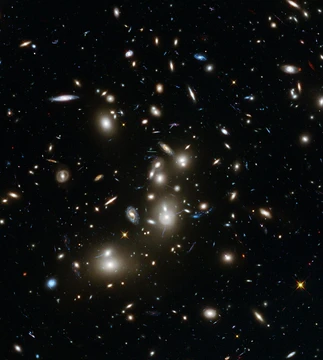
Galaxy cluster
Largest gravitationally bound structures, composed of galaxies, gas, and dark matter.

A galaxy cluster is a massive, gravity-bound system containing hundreds to thousands of galaxies. Its total mass typically falls between 10¹⁴ and 10¹⁵ times the mass of the Sun. These structures are made up of galaxies, extremely hot gas, and dark matter, and they represent the largest gravitationally bound objects known. Until the 1980s, they were thought to be the biggest structures in the universe, but that title now belongs to superclusters. Smaller collections of galaxies are called groups rather than clusters, and both groups and clusters combine to form superclusters.
A typical galaxy cluster contains 100 to 1,000 galaxies, along with hot gas that emits X-rays and a large amount of dark matter. Its total mass is in the range of 10¹⁴ to 10¹⁵ solar masses, and its diameter is usually between 1 and 5 megaparsecs. The individual galaxies within a cluster move at speeds of about 800 to 1,000 kilometers per second relative to one another.
The cluster has three main components. Galaxies themselves make up only a small fraction of the cluster’s mass, though they are the only part visible in ordinary light. The intracluster medium is a hot gas with peak temperatures between 30 and 100 million degrees Celsius. Dark matter accounts for most of the cluster’s mass, but it cannot be seen directly.
When galaxy clusters form, enormous amounts of energy are released through shock waves, gas heating, and interactions between galaxies. Colliding gas generates shock waves that heat it to tens of millions of degrees, producing X-ray emissions. The evolution of galaxies within a cluster is shaped by mergers and by gas being stripped away.
Clusters are classified in several ways, such as by their shape, X-ray brightness, or the type of galaxy that dominates. The Bautz-Morgan system sorts them into types I, II, and III based on how much brighter the brightest galaxy is compared to the others—type I has the greatest contrast, type III the least.
Galaxy clusters have been used to test general relativity. Radek Wojtak at the Niels Bohr Institute studied gravitational redshift using data from 8,000 clusters. Photons from the center of a cluster lose more energy climbing out of the stronger gravity there, so their wavelength is longer than light from the edge.
- Number of galaxies
- 100 to 1,000
- Total mass range
- 10^14 to 10^15 solar masses
- Typical diameter
- 1 to 5 Mpc
- Velocity spread of galaxies
- 800–1000 km/s
- Icm temperature peak
- 30 to 100 million degrees Celsius
Lore & Background
Galaxy clusters have three main components: galaxies (a small fraction, detectable in visible spectrum), heated gas of the intracluster medium (ICM) with peak temperatures between 30 and 100 million degrees Celsius, and dark matter, which makes up the majority of the mass but cannot be detected optically. Small aggregates of galaxies are referred to as galaxy groups rather than clusters; together, groups and clusters form superclusters.
As galaxy clusters form, massive amounts of energy are released due to shock waves, heating of gas, and galaxy interactions. Gas collides with existing material, generating shock waves that heat it to tens of millions of degrees and produce X-ray emissions. Galaxy evolution within clusters is governed by interactions such as galaxy mergers and gas stripping.
Classification systems for galaxy clusters are based on characteristics such as shape symmetry, X-ray luminosity, and dominant galaxy type. The Bautz-Morgan classification sorts clusters into types I, II, and III based on the relative brightness of their galaxies—type I with greatest contrast and type III with the least. Notable nearby clusters include the Virgo Cluster, Fornax Cluster, Hercules Cluster, and Coma Cluster. The Great Attractor, dominated by the Norma Cluster, is massive enough to affect the local expansion of the Universe.
Reader's Guide
Galaxy clusters have been used as measuring instruments to test predictions of general relativity. Radek Wojtak from the Niels Bohr Institute used data from 8,000 galaxy clusters to study gravitational redshift: photons emitted from the center of a cluster lose more energy than those from the edge, producing a longer wavelength. The results matched predictions of general relativity and strongly supported the Lambda-Cold Dark Matter model, according to which most of the cosmos is made up of dark matter that does not interact with matter.
Galaxy clusters are also used as gravitational lenses to boost the reach of telescopes. Their strong gravitational potential bends the path of photons, creating a cosmic magnifying glass that allows observation of distant galaxies in their early stages that would otherwise be undetectable. This works for photons of any wavelength from optical to X-ray, though X-ray detection is more difficult because clusters emit many X-rays. One example is the use of the Phoenix galaxy cluster to observe a dwarf galaxy in its early high-energy stages of star formation.
In the last few decades, clusters have been found to be relevant sites of particle acceleration, discovered through non-thermal diffuse radio emissions such as radio halos and radio relics. Using the Chandra X-ray Observatory, structures like cold fronts and shock waves have been found in many galaxy clusters.
Did You Know?
- Galaxy clusters were believed to be the largest known structures until the 1980s, when superclusters were discovered.
- The heated gas in the intracluster medium has a peak temperature between 30 and 100 million degrees Celsius.
- Radek Wojtak used data from 8,000 galaxy clusters to confirm gravitational redshift as predicted by general relativity.
- Galaxy clusters can act as gravitational lenses, magnifying distant galaxies that would otherwise be undetectable.
Scale and Cosmic Assembly
Galaxy groups and clusters sit at the very top of the gravitationally bound hierarchy in the observable universe. Under the cold dark matter picture of structure formation, the smallest objects collapse first and progressively assemble into ever-larger systems, with clusters representing the final, most massive stage. This places their assembly in a relatively narrow cosmic window, roughly between ten billion years ago and the present. A single cluster can host anywhere from ten to several thousand galaxies, and these clusters frequently nest inside even larger, non-gravitationally bound superclusters. At the lower end, groups are the smallest galaxy aggregates, typically holding no more than fifty members across one to two megaparsecs, with a mass near 10^13 solar masses and internal velocity spreads around 150 km/s. Groups are the most prevalent galaxy structure in the local universe, encompassing at least half of all nearby galaxies. Our own Milky Way belongs to the Local Group, which contains more than fifty galaxies. In 2017, Paul, John, and colleagues proposed sharper mass-based criteria, classifying any aggregation below 8 × 10^13 solar masses as a group rather than a cluster.
The Missing Mass Puzzle
Early velocity measurements of galaxies inside clusters revealed a deep inconsistency: the orbital speeds were far too high for the visible matter's mutual gravity to keep the system bound. Something else had to be providing the extra pull. X-ray surveys later uncovered enormous reservoirs of intergalactic gas, the intracluster medium, blazing at temperatures between ten million and a hundred million kelvin. This hot gas outmasses the galaxies by roughly a factor of two, yet the combined total still falls short of what the velocities demand. Because the gas sits in approximate hydrostatic equilibrium with the cluster's gravitational field, its pressure profile can be used to infer the full mass distribution. The result is striking: the true mass is about six times greater than the galaxies plus hot gas together. In a typical cluster, galaxies contribute only around five percent of the total mass, the X-ray-emitting gas perhaps ten percent, and the overwhelming remainder is dark matter. The Bullet Cluster collision stands as some of the strongest evidence for dark matter, though Brownstein and Moffat have argued that a modified gravity framework can reproduce the observed X-ray properties without requiring it.
A Multi-Wavelength Toolkit for Detection
No single instrument can fully characterize a galaxy cluster, so astronomers rely on a diverse suite of techniques. Optical and infrared telescopes locate clusters by searching for overdensities of galaxies and confirming them through redshift measurements, with infrared surveys proving especially useful for catching more distant, higher-redshift systems. X-ray telescopes detect the thermal bremsstrahlung and atomic line emission from the hot intracluster plasma, making clusters among the brightest extragalactic X-ray sources alongside active galactic nuclei. Radio observations reveal diffuse structures and groups of radio sources that trace cluster locations, while imaging around individual active galactic nuclei at high redshift can expose protoclusters still in the process of forming. The Sunyaev-Zel'dovich effect offers yet another window: hot electrons in the intracluster medium scatter cosmic microwave background photons via inverse Compton scattering, imprinting a characteristic shadow at certain radio frequencies. Finally, gravitational lensing lets researchers map the distribution of dark matter by measuring how a cluster's total mass distorts the apparent shapes of background galaxies. Together, these methods paint a richly layered portrait of each cluster.
Thermal Memory of the Intracluster Gas
The intracluster medium is far more than a passive backdrop; it is a living record of everything that has happened to a cluster since its birth. Because clusters are massive enough to retain energetic gas ejected by their member galaxies, and because the thermal energy of that gas falls squarely within the X-ray band, the gas's present state encodes the full thermal history of cluster formation. That history is shaped by a complex interplay of shock heating during accretion, radiative cooling, and thermal feedback triggered when cooling proceeds too far. The density, temperature, and substructure of the X-ray-emitting gas therefore serve as a fossil archive of the cluster's entire evolutionary journey. To decode this archive, researchers focus on entropy, the thermodynamic quantity most directly altered when thermal energy is added to or removed from the intracluster gas. Studying entropy profiles allows astronomers to distinguish between different heating and cooling episodes, offering a window into how clusters assembled their mass over billions of years. In this sense, the hot gas is both the cluster's most abundant baryonic component and its most informative historical record.
Frequently Asked Questions
What exactly is a galaxy cluster?
A galaxy cluster is a colossal, gravity-held collection of anywhere from a hundred to a thousand galaxies. It also contains scorching-hot gas and dark matter, making it the largest gravitationally bound object we currently know of.
How massive is a typical galaxy cluster?
Total mass usually lands between 10¹⁴ and 10¹⁵ solar masses. The whole structure spans roughly 1 to 5 megaparsecs in diameter, with member galaxies showing velocity spreads of 800 to 1,000 km/s.
What's the difference between a galaxy cluster and a galaxy group?
A group is a smaller gathering of galaxies, while a cluster contains hundreds to thousands. Both types can combine together to build even larger structures called superclusters.
Are galaxy clusters the biggest structures in the universe?
Not anymore. Until the 1980s they held that title, but superclusters—formed by merging groups and clusters—now claim the top spot.
How hot is the gas inside a galaxy cluster?
The intracluster medium peaks at temperatures between 30 and 100 million degrees Celsius. This extreme heat is a key signature astronomers use to identify and study these massive systems.
More in Galaxy Clusters and Groups 1-24
Spotted an error? Know more?
Reader corrections go straight into our review queue. Suggest an edit · How this site is sourced