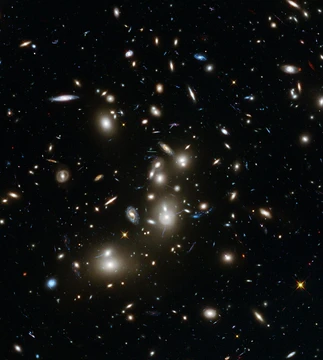
Abell 222
Galaxy cluster linked to Abell 223 by dark matter filament.

Abell 222 is a galaxy cluster in the constellation of Cetus, located at a distance of 2.4 billion light-years from Earth. It holds thousands of galaxies together. The cluster is notable for being connected to Abell 223 by a filament of dark matter, which was detected through gravitational lensing using images from the Japanese Subaru telescope.
Quick Facts
- Epoch
- J2000
- Constellation
- Cetus
- Ra
- 01 · 37 · 27.4
- Dec
- -12 · 58 · 45
- Brightest Member
- LEDA 944643
- Richness
- 3
- Bmtype
- II-III
- Velocity Dispersion
- 1,014 km/s
- Redshift
- 0.2110
- Distance
- 2.4 Gly
- Temperature
- 3.77 ± 0.15 keV
- Other Names
- RXC J0137.4-1259
Facts from the source article.
Lore & Background
Astronomers noticed an invisible string of matter warping spacetime between Abell 222 and Abell 223. Using images from the Japanese Subaru telescope, they discovered that this invisible matter is dark matter, detected via gravitational lensing. The cluster is connected to Abell 223 by a filament of dark matter that is permeated by hot X-ray emitting gas. Research shows this filament contains only about 20 percent normal matter, with the rest assumed to be dark matter, in good agreement with the cosmological standard model. The two bodies form the Abell 222/Abell 223 Supercluster as defined by the IAU. Abell 222 is located in Supercluster 13 (SCL 13), together with seven other members: Abell 205, Abell 206, Abell 212, Abell 230, Abell 232, Abell 233, and Abell 235, using estimated redshifts.
Reader's Guide
Abell 222's significance lies in its role in revealing the nature of dark matter and missing baryonic matter. The detection of a dark matter filament connecting it to Abell 223, using gravitational lensing from the Subaru telescope, provided direct evidence for dark matter structures predicted by the cosmological standard model. Additionally, the hot X-ray emitting gas bridging the two clusters helped astronomers locate a significant portion of the universe's missing baryonic matter, which had been difficult to detect due to its low density. Abell 222's location within Earth's line of sight allowed scientists to observe this gas with high-power infrared and X-ray telescopes. This discovery supports the standard model's estimate that about 5% of the universe is baryonic matter, with much of it residing in low-density gas between clusters. The cluster's membership in the Abell 222/Abell 223 Supercluster and Supercluster 13 further contextualizes its place in large-scale cosmic structure.
Did You Know?
- Abell 222 is located in the constellation Cetus, 2.4 billion light-years from Earth.
- It is connected to Abell 223 by a filament of dark matter detected via gravitational lensing using the Japanese Subaru telescope.
- The filament connecting the two clusters contains only about 20 percent normal matter; the rest is dark matter.
- Abell 222 is part of the Abell 222/Abell 223 Supercluster and also belongs to Supercluster 13 (SCL 13) with seven other Abell clusters.
Cosmic Position and Scale
The Norma Cluster, catalogued as ACO 3627 or Abell 3627, stands as one of the richer assemblies of galaxies known to astronomers. What makes its position particularly striking is its proximity to the center of the Great Attractor, the vast gravitational concentration that draws in surrounding structures across hundreds of millions of light-years. At a distance of roughly 68 megaparsecs, approximately 222 million light-years, it sits well within the local cosmic neighborhood by the standards of deep-universe objects. This combination of relative closeness and intrinsic brightness means the cluster should, in principle, be one of the easier targets for observation. Yet its placement near the heart of the Great Attractor also embeds it within a region of extraordinary gravitational complexity, where the interplay of mass distributions shapes the motion of countless galaxies. The cluster's richness, meaning its high count of member galaxies, further cements its importance as a benchmark for understanding how large-scale structure assembles in the universe.
The Zone of Avoidance Problem
Despite being both relatively close and intrinsically luminous, the Norma Cluster presents a stubborn observational challenge that has frustrated astronomers for decades. The root of the difficulty lies in its sky position: it falls squarely within the Zone of Avoidance, the band of the celestial sphere that runs along the plane of the Milky Way. In this region, dense clouds of interstellar dust and gas belonging to our own galaxy lie between the observer and the target, absorbing and scattering light at optical wavelengths. The result is that the cluster appears severely dimmed and smeared, making it far harder to resolve individual member galaxies or measure their properties with standard optical techniques. This paradox, a bright nearby object that is effectively hidden from visible-light telescopes, has pushed researchers toward alternative observational strategies, particularly in the X-ray band, where interstellar dust is far less obstructive. The cluster thus serves as a vivid reminder that distance and brightness alone do not guarantee ease of study, and that the geometry of our own galaxy can mask even the most prominent extragalactic structures.
Mass and Exotic Members
The total mass of the Norma Cluster is estimated to be on the order of ten to the fifteenth power solar masses, a figure that places it firmly among the most massive galaxy clusters in the local universe. Such a mass budget implies a vast halo of dark matter enveloping the visible galaxies, providing the gravitational scaffolding that holds the rich population of members together. Among the cluster's inhabitants, one object has drawn particular attention: ESO 137-001, a striking example of what astronomers call a jellyfish galaxy. These unusual systems are thought to form when a galaxy plows through the hot intracluster medium, stripping off streams of stars and ionized gas that trail behind like the tentacles of a jellyfish. The presence of such a dramatic object within Abell 3627 highlights the dynamic and often violent environment that cluster members experience, where interactions with the surrounding plasma and with neighboring galaxies can reshape a galaxy's appearance over cosmic timescales. The cluster's richness further ensures that a wide variety of morphological types and evolutionary states are represented among its members.
Connections and Multi-Wavelength Study
The Norma Cluster does not exist in isolation; it is one node in a broader web of rich galaxy clusters that includes the Coma, Eridanus, Fornax, and Virgo clusters, each serving as a reference point for comparative studies of cluster evolution. Its association with the Great Attractor links it to the largest known gravitational structure in the nearby universe, giving it a special role in models of cosmic large-scale structure. Because optical observations are hampered by the Zone of Avoidance, much of the detailed study of Abell 3627 has relied on X-ray astronomy, where the hot gas filling the cluster interior emits strongly and dust interference is minimal. Multi-wavelength surveys spanning infrared, ultraviolet, hydrogen-alpha, and X-ray bands have been compiled to build a more complete picture of the cluster's contents. One particularly notable feature highlighted in public outreach is the cluster's two tails, a striking morphological detail that underscores the complex dynamics at work. Together, these varied observational approaches compensate for the limitations of any single wavelength and paint a richer portrait of this obscured but extraordinary assembly.
Frequently Asked Questions
What is Abell 222?
Abell 222 is a massive galaxy cluster in the constellation Cetus that binds together thousands of individual galaxies through their collective gravity. It sits roughly 2.4 billion light-years from Earth.
Where is Abell 222 located and how far away is it?
The cluster occupies a region of the sky within Cetus and lies approximately 2.4 billion light-years from our vantage point on Earth.
What makes Abell 222 stand out among other galaxy clusters?
Its headline feature is a dark matter filament that physically links it to the neighboring cluster Abell 223. This invisible bridge of mass was revealed through gravitational-lensing analysis of Subaru telescope imagery.
Which supercluster does Abell 222 belong to?
Under the IAU naming scheme it is a member of the Abell 222/Abell 223 Supercluster, and it is also counted among the seven clusters that make up Supercluster 13 (SCL 13).
How was the dark matter filament connecting Abell 222 to Abell 223 discovered?
Astronomers mapped the subtle warping of background light—gravitational lensing—using images captured by Japan's Subaru telescope, which exposed the otherwise invisible thread of dark matter stretching between the two clusters.
More in Galaxy Clusters and Groups 1-24
Spotted an error? Know more?
Reader corrections go straight into our review queue. Suggest an edit · How this site is sourced