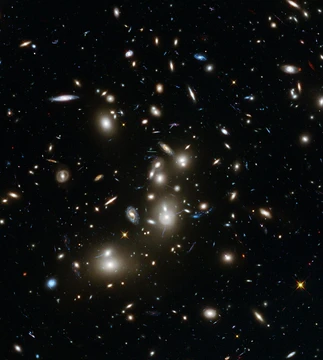
Galaxy groups and clusters
Largest gravitationally bound objects in cosmic structure formation.

Galaxy groups and clusters are the biggest structures in the universe held together by gravity, forming the densest parts of the cosmic web. In the leading model of structure formation—cold dark matter—the smallest clumps collapse first, and over time they merge to build larger ones, eventually creating galaxy clusters. These clusters formed relatively recently, between about 10 billion years ago and today. A group or cluster can contain anywhere from ten to thousands of galaxies. Clusters themselves are often part of even larger, but not gravitationally bound, collections called superclusters.
Groups are the smallest galaxy aggregates, typically with no more than 50 galaxies spread across 1 to 2 megaparsecs. Their mass is around 10¹³ solar masses, and individual galaxies within them move at speeds of about 150 km/s. These numbers are rough guidelines, since larger systems are sometimes also called groups. Groups are the most common galaxy structures, making up at least half of all galaxies in the local universe. Their masses fall between those of giant elliptical galaxies and full clusters. The Milky Way belongs to the Local Group, which contains more than 54 galaxies. In July 2017, S. Paul, R. S. John, and colleagues proposed clear criteria based on scaling laws: any galaxy aggregation with a mass below 8 × 10¹³ solar masses should be classified as a group.
Clusters are bigger than groups, though there’s no sharp dividing line. Visually, they look like collections of galaxies held together by gravity, but the galaxies move too fast to stay bound by their visible mass alone—implying extra invisible mass or an additional force. X-ray observations reveal large amounts of hot intergalactic gas, called the intracluster medium, at temperatures between 10⁷ K and 10⁸ K, which emits X-rays via bremsstrahlung and atomic lines. This gas has about twice the mass of all the galaxies in the cluster, but even that isn’t enough to hold the cluster together. Because the gas is roughly in hydrostatic equilibrium with the cluster’s gravity, the total mass distribution can be calculated. That total turns out to be about six times greater than the mass of galaxies and hot gas combined. The missing component is called dark matter, and its nature is unknown. In a typical cluster, only about 5% of the mass is in galaxies, maybe 10% in hot gas, and the rest is dark matter.
- Group size
- typically no more than 50 galaxies in a diameter of 1 to 2 megaparsecs (Mpc)
- Group mass
- approximately 10^13 solar masses
- Group velocity spread
- about 150 km/s
- Cluster gas temperature
- between 10^7 K and 10^8 K
- Cluster dark matter fraction
- perhaps only 5% of total mass in galaxies, maybe 10% in hot gas, remainder is dark matter
- Local group galaxies
- more than 54 galaxies
- Classification threshold
- galaxy aggregations less massive than 8 × 10^13 solar masses are classified as galaxy groups
Lore & Background
Groups of galaxies are the smallest aggregates, typically containing no more than 50 galaxies within a diameter of 1 to 2 megaparsecs, with a mass of approximately 10^13 solar masses and velocity spreads of about 150 km/s. They are the most common structures in the universe, comprising at least 50% of galaxies in the local universe. Our own Milky Way is contained in the Local Group of more than 54 galaxies. In July 2017, S. Paul, R. S. John et al. defined clear distinguishing parameters for classifying galaxy aggregations as 'galaxy groups' and 'clusters' based on scaling laws, with aggregations less massive than 8 × 10^13 solar masses classified as groups.
Clusters are larger than groups, with no sharp dividing line. Their observed velocities are too large for them to remain gravitationally bound by mutual attractions, implying an additional invisible mass component or an additional attractive force. X-ray studies reveal large amounts of hot intergalactic gas (intracluster medium) at temperatures between 10^7 K and 10^8 K, emitting X-rays via bremsstrahlung and atomic line emission. The total mass of this gas is roughly twice that of the galaxies, but still insufficient to bind the cluster. Hydrostatic equilibrium measurements indicate the total mass is about six times larger than the mass of galaxies or hot gas, with the missing component known as dark matter. In a typical cluster, perhaps only 5% of total mass is in galaxies, maybe 10% in hot gas, and the remainder is dark matter. Brownstein and Moffat use a theory of modified gravity to explain X-ray cluster masses without dark matter; observations of the Bullet Cluster are the strongest evidence for dark matter, though Brownstein and Moffat have shown their modified gravity theory can also account for the cluster's properties.
Reader's Guide
Galaxy groups and clusters are significant as the most recent and most massive objects to have arisen in hierarchical structure formation, and their study reveals how galaxies form and evolve. Clusters have two important properties: their masses are large enough to retain energetic gas ejected from member galaxies, and the thermal energy of the gas is observable in the X-ray bandpass. The observed state of gas within a cluster is determined by a combination of shock heating during accretion, radiative cooling, and thermal feedback triggered by that cooling. The density, temperature, and substructure of the intracluster X-ray gas represent the entire thermal history of cluster formation. Understanding this thermal history requires studying the entropy of the gas, as entropy is the quantity most directly changed by increasing or decreasing the thermal energy of intracluster gas. Observational methods include optical or infrared searches for overdensities and redshift confirmation; X-ray detection of hot plasma; radio observations of diffuse structures and AGN tracers; the Sunyaev-Zel'dovich effect, where hot electrons scatter cosmic microwave background radiation; and gravitational lensing, which uses distortions of background galaxies to model dark matter distribution. Clusters are prominent in X-ray surveys and, along with AGN, are the brightest X-ray emitting extragalactic objects.
Hierarchical Assembly in the Cosmic Web
Galaxy groups and clusters sit at the apex of gravitational structure formation, representing the largest objects in the universe that remain bound by their own mutual gravity. In the prevailing cold dark matter framework, structure builds from the bottom up: the smallest density perturbations collapse first, and over cosmic time they merge and accrete to produce ever-larger systems, culminating in clusters of galaxies. This assembly is not ancient; clusters are thought to have taken their current shape within roughly the last ten billion years, making them among the most recent major structures to emerge. Groups, the smallest aggregates, typically hold no more than fifty galaxies within a diameter of one to two megaparsecs and carry a mass on the order of ten to the thirteenth solar masses. They are extraordinarily common, accounting for at least half of all galaxies in the local universe. Our own Milky Way sits within the Local Group, a collection of more than fifty-four galaxies. In 2017, Paul, John, and colleagues proposed a clean mass threshold of eight times ten to the thirteenth solar masses to distinguish groups from clusters, a boundary that had previously remained fuzzy.
The Missing Mass and the Dark Matter Debate
When astronomers first measured the velocities of galaxies within clusters, a troubling discrepancy emerged: the speeds were far too high for the visible matter alone to hold the system together gravitationally. Something invisible must be providing the extra pull. X-ray observations later revealed vast reservoirs of intergalactic gas, the intracluster medium, blazing at temperatures between ten million and a hundred million kelvin, radiating through bremsstrahlung and atomic line emission. This hot gas carries roughly twice the mass of all the galaxies combined, yet even that falls short of explaining the dynamics. By assuming the gas sits in hydrostatic equilibrium with the cluster's gravitational field, researchers can infer the total mass, which turns out to be about six times greater than the mass in stars plus hot gas. In a typical cluster, galaxies contribute only around five percent of the total mass, the X-ray gas about ten percent, and the remainder is attributed to dark matter. The Bullet Cluster collision provides the strongest observational support for this invisible component, though Brownstein and Moffat have argued a modified-gravity theory can reproduce the same cluster properties without invoking it.
A Toolkit for Finding the Invisible
Because clusters span enormous distances and their constituent galaxies are often too faint to spot individually, astronomers have developed a diverse suite of detection techniques. Optical and infrared surveys search for overdensities, patches where more galaxies appear than expected, and confirm a cluster by verifying that several members share a similar redshift; infrared methods extend this reach to higher-redshift, more distant systems. X-ray telescopes exploit the fact that the hot intracluster plasma ranks among the brightest extragalactic X-ray sources, second only to active galactic nuclei. Radio observations reveal diffuse emission structures and groups of radio sources that trace cluster locations, while at high redshift, imaging around individual active galactic nuclei has helped identify protoclusters still in the process of assembling. The Sunyaev-Zel'dovich effect offers yet another window: hot electrons in the intracluster medium scatter cosmic microwave background photons via inverse Compton scattering, leaving a characteristic spectral shadow at certain radio frequencies. Finally, gravitational lensing lets researchers map the dark matter distribution by measuring how a cluster's total mass warps the apparent shapes of galaxies lying behind it.
Reading the Thermal Fossil Record
The intracluster medium is not merely a passive backdrop; it is a living archive of a cluster's entire thermal history. Because clusters are massive enough to retain energetic gas expelled by their member galaxies, and because that gas radiates in the X-ray band, astronomers can directly observe its temperature, density, and substructure. The present state of this gas is sculpted by a balance of competing processes: shock heating during the accretion of infalling material, radiative cooling that drains energy, and thermal feedback triggered when that cooling becomes too efficient. Entropy, the thermodynamic quantity most directly altered when thermal energy is added or removed, serves as the key diagnostic for reconstructing this history. Clusters occupy a unique niche in the hierarchical formation of the universe; they are the most recent and most massive objects to have assembled, so studying them offers a direct window into how galaxies form, merge, and evolve. Their masses are large enough to confine the energetic outflows that smaller systems would lose, making the intracluster gas a sealed record of every heating and cooling event since the cluster first coalesced.
Frequently Asked Questions
Who are Galaxy groups and clusters?
They are the largest objects in the universe that remain gravitationally bound, sitting at the very top of the cosmic hierarchy. A group typically holds up to about 50 galaxies within 1–2 megaparsecs, while a full cluster can pack in thousands of galaxies and weigh roughly 10¹³ solar masses.
What are Galaxy groups and clusters's powers or role in the story?
In the cold-dark-matter model they serve as the final act of assembly: the smallest clumps collapse first and keep merging upward until they become groups and clusters. They form the densest knots of the cosmic web and represent the endpoint of gravitational structure formation.
Why are Galaxy groups and clusters important to the overall narrative?
As the biggest gravitationally bound structures we know of, they are the ultimate 'characters' in the cosmic-structure story. Their intra-cluster gas reaches temperatures of 10⁷–10⁸ K, and their dark-matter halos dominate the mass budget, with galaxies contributing only about 5% and hot gas perhaps 10%.
What's the 'roster' of Galaxy groups and clusters?
A typical group contains no more than ~50 galaxies with a velocity spread of about 150 km/s, while the Local Group alone already lists over 54 members. Full clusters scale up to thousands of galaxies, all embedded in a dark-matter halo that accounts for the vast majority of the total mass.
More in Galaxy Clusters and Groups 1-24
Spotted an error? Know more?
Reader corrections go straight into our review queue. Suggest an edit · How this site is sourced