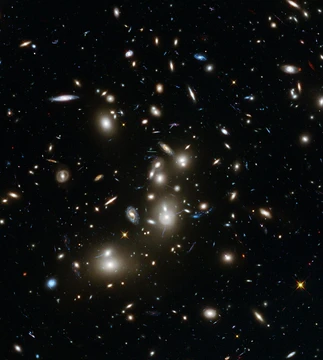
Abell 68
Massive galaxy cluster known for strong gravitational lensing.

Abell 68 is a massive and rich galaxy cluster located in the constellation of Pisces, with a projected co-moving distance of approximately 1124.6 Mpc or 3.668 billion light-years from Earth. It is especially notable for its strong gravitational lensing, which has enabled the detection of distant background galaxies, including one twisted into a shape resembling a 1970s video game alien from Space Invaders. The cluster was first discovered by George O. Abell in 1958 and is one of the original 2,712 clusters compiled in the Abell Catalogue.
Quick Facts
- Constellation
- Pisces
- Ra
- 00h 37m 05.300s
- Brightest Member
- Abell 68 BCG (PGC 1360619)
- Epoch
- J2000.0
- Dec
- +09d 09m 11.00s
- Distance
- 3.668 Gly (1124.6 Mpc)
- Redshift
- 0.254600
- Names
- NSCS J003706+090916, ZwCl 0034.4+0851, PSZ2 G116.95-53.55
- Luminosity
- Between 6 × 1042 and 11 × 1044 erg s / −1
- Richness
- 1
- Bmtype
- Type I
Facts from the source article.
Lore & Background
Abell 68 was first discovered by George O. Abell in 1958, using data from the National Geographic Society - Palomar Observatory Sky Survey, and is one of the original 2,712 galaxy clusters in the Abell Catalogue. The cluster is dynamically relaxed but shows evidence of disturbed structures suggesting a merger. It is an accreting cluster with a splashback feature at a clustercentric radius of rsp/r200,m = 1.291 ± 0.062, and gas entropy indicates total feedback energy per particle declining from ~10 keV to zero at ~0.35r200, implying an upper limit of feedback efficiency of ~0.02 for the supermassive black hole in the central brightest cluster galaxy (BCG). Several galaxies in Abell 68 are infalling and experience ram pressure stripping, becoming jellyfish galaxies whose star formation is extinguished when the AGN of the BCG is switched on. Dwarf galaxy members show a flat luminosity function slope (α ~ -1.2 to -1.4) near the cluster center and steeper slopes away from it.
Reader's Guide
Abell 68's significance lies in its role as a gravitational lens, which has allowed astronomers to study distant background galaxies otherwise too faint to observe. The Hubble Space Telescope captured a background galaxy, ERO J003707 at redshift 1.6, lensed into a shape resembling a Space Invaders alien; this galaxy is an L* early-type disk galaxy with properties shared by about 10 percent of galaxies, and researchers theorize that cooling gas in hierarchical galaxy formation models could develop it into a luminous spiral galaxy. Additionally, Spitzer and IRAC surveys of H-faint sources in 101 lensing cluster fields, including Abell 68, revealed more distant background galaxies at redshifts 3.9 ± 0.4, with median stellar masses of 10^10.3±0.3 M⊙ and star formation rates of 100+60−40 M⊙ yr⁻¹, obscured by dust. These H-faint galaxies make up at least 16+13−7% of galaxies in the stellar-mass range 10^10–10^11.2 M⊙ at z = 3–5, contributing 8+8−4% of the cosmic star formation rate density in that epoch, shedding light on the early formation of massive galaxies. The BCG, Abell 68 BCG (PGC 1360619), is a type-cD elliptical galaxy with a de Vaucouleurs surface brightness profile, a strong radio source, and a low-excitation radio galaxy with 1.4 GHz luminosity between 2 × 10^23 and 3 × 10^25 W Hz⁻¹, likely formed from galaxy mergers.
Did You Know?
- Abell 68 is located in the constellation of Pisces at a distance of about 3.668 billion light-years.
- The cluster's gravitational lens twisted a background galaxy into a shape resembling a 1970s Space Invaders alien.
- Abell 68 contains jellyfish galaxies that lose gas through ram pressure stripping as they infall.
- The brightest cluster galaxy, Abell 68 BCG, is a low-excitation radio galaxy with a powerful core component.
Origins in the Palomar Survey
Abell 68 sits in the constellation Pisces, roughly 3.668 billion light-years from Earth in projected co-moving distance (about 1124.6 megaparsecs). This massive, rich assembly of galaxies first entered the astronomical record in 1958, when George O. Abell identified it as part of his landmark catalogue. That catalogue ultimately compiled 2,712 distinct galaxy clusters, and every entry was drawn from photographic plates produced by the National Geographic Society–Palomar Observatory Sky Survey. In other words, Abell 68's place in the sky was first carefully measured not by a single telescope session but by a systematic, wide-field photographic campaign that mapped the southern sky in detail. Abell's method turned those plates into a structured, reproducible list of rich clusters, and Abell 68 became one of the original members of that list. Decades later, the cluster's reputation grew well beyond its catalogue number, largely because of its extraordinary gravitational lensing and its role as a natural laboratory for studying how galaxies evolve inside a dense, merging environment.
A Merging, Accreting Machine
Abell 68 is a heavyweight: its M500 mass is estimated at no less than 2 × 10¹⁴ solar masses, and its intracluster gas spans a temperature range of roughly 1 to 10 keV, producing X-ray luminosities between 6 × 10⁴² and 11 × 10⁴⁴ erg per second. Despite being dynamically relaxed overall, the cluster carries clear signatures of recent disturbance, pointing to an ongoing or recent merger event. Galaxies on the outskirts are actively infalling through the hot intergalactic medium; as they plow through that gas, ram pressure strips their own gas clouds and heats them, creating the so-called jellyfish galaxies. In some cases the supermassive black hole at the cluster's core powers up its active galactic nucleus, which can shut off star formation in those stripped systems. The cluster is also classified as accreting, with a splashback radius measured at 1.291 ± 0.062 times r200,m. Gas entropy drops from about 10 keV to near zero at roughly 0.35 r200, implying the central black hole's feedback efficiency is capped at around two percent. Dwarf galaxy members show a flat luminosity-function slope near the cluster core but steeper profiles farther out.
A Cosmic Magnifying Glass
One of Abell 68's most celebrated roles is that of a powerful gravitational lens. Hubble Space Telescope imaging revealed a background galaxy, ERO J003707, at redshift 1.6, whose light was bent so dramatically by the cluster's mass that it took on the unmistakable silhouette of a 1970s Space Invaders sprite. That background object is an L*-class early-type disk galaxy with a (R−K) color of at least 5.3 and a K-band magnitude no brighter than 21, properties shared by roughly ten percent of galaxies in its class. Researchers suggest that, under the cooling scenarios predicted by hierarchical formation models, ERO J003707 could eventually evolve into a luminous spiral. Beyond that single striking image, Spitzer and IRAC surveys targeting H-faint sources across 101 lensing cluster fields uncovered a population of very distant, dust-obscured background galaxies at redshifts around 3.9 ± 0.4. These objects carry median stellar masses near 10¹⁰·³ solar masses, star-formation rates of about 100 solar masses per year, and visual extinction of 2.6 ± 0.3 magnitudes. They account for at least 16 percent of galaxies in the 10¹⁰ to 10¹¹·² solar-mass range at z ≈ 3–5 and contribute roughly 8 percent of the cosmic star-formation rate density in that epoch, offering a window into the early assembly of massive galaxies.
The Dominant Elliptical at the Core
At the heart of Abell 68 sits PGC 1360619, the cluster's brightest member, a type-cD elliptical galaxy with a redshift of 0.24. Its surface brightness follows the de Vaucouleurs r¹/⁴ law over a large radial range, and it presents an apparently inactive optical appearance with a velocity dispersion exceeding 160 km/s. Yet radio observations from the Australia Telescope Compact Array, the Jansky Very Large Array, and the Very Long Baseline Array reveal a strong, low-excitation radio source with a powerful core component tied to [O III] 5007 Å emission. At 1.4 GHz its luminosity falls between 2 × 10²³ and 3 × 10²⁵ W/Hz, driven by cooling gas accreted from the surrounding hot atmosphere that feeds the active galactic nucleus. Its near-infrared luminosity exceeds 5 × 10⁴⁴ erg/s. The galaxy's formation story is written in its shape: researchers believe it assembled through the collision and coalescence of smaller ellipticals or spiral galaxies. During those mergers, dynamical friction and mutual tidal forces redistributed orbital kinetic energy into random motion, leaving behind an unstructured, triaxial system that settled into the smooth elliptical profile we observe today.
Frequently Asked Questions
What is Abell 68?
Abell 68 is a large, rich galaxy cluster sitting in the Pisces constellation. It earned its number as one of the original 2,712 entries in George O. Abell's landmark 1958 catalogue of galaxy clusters.
How far away is Abell 68?
Its projected co-moving distance works out to roughly 1,124.6 megaparsecs, which translates to about 3.67 billion light-years from Earth.
Who discovered Abell 68?
George O. Abell identified the cluster back in 1958 while compiling his now-classic catalogue. It has carried the designation 'Abell 68' ever since that original survey.
Why is Abell 68 famous among astronomers and fans?
Its powerful gravitational lensing warps the light of much more distant background galaxies into striking, stretched shapes. One particularly viral example looks like a 1970s Space Invaders alien, which made the cluster a crowd-pleaser in popular astronomy.
What is the X-ray temperature range of Abell 68?
The hot intracluster gas spanning the system shows temperatures between 1 and 10 keV. This spread reflects the varying density and energy of the plasma filling the space between its member galaxies.
More in Galaxy Clusters and Groups 1-24
Spotted an error? Know more?
Reader corrections go straight into our review queue. Suggest an edit · How this site is sourced