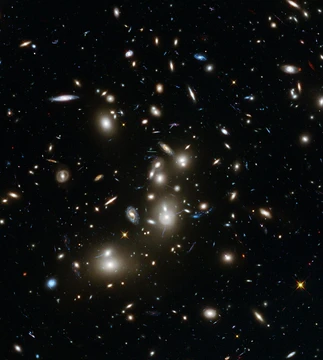
Abell 520
A merging galaxy cluster with a disputed dark core.

Abell 520 (A520) is a galaxy cluster in the constellation Orion. It lies at a co-moving radial distance of 811 Mpc (2,645 Mly) and spans 25 arcminutes across the sky. The cluster’s chaotic structure, the result of a major merger, has earned it the nickname the Train Wreck Cluster. It is classified as a Bautz–Morgan type III cluster.
The cluster’s unusual substructure first drew attention in 2007, when a weak gravitational lensing study using Canada-France-Hawaii-Telescope (CFHT) imaging data revealed a “dark core”—a region with significant mass but no concentration of bright cluster galaxies. This finding was surprising because no conventional understanding of dark matter could explain such a peculiar concentration. At the time, some researchers speculated that the substructure might arise from non-gravitational interactions of dark matter.
Analysis of the motions of 293 galaxies in the cluster field suggested that Abell 520 is forming at the intersection of three filaments of the large-scale structure. In 2012, two international teams published conflicting results. One study, based on the Wide Field Planetary Camera 2 (WFPC2) on the Hubble Space Telescope (HST), confirmed the earlier claim of a dark core. The other, using the Advanced Camera for Surveys (ACS), also found a dark core but detected luminous matter within it—making the core “not so dark,” as it appeared as bright as any other galaxy with dark matter.
In 2014, the original team reanalyzed the ACS images and again reported evidence of a dark core, though at a different location from the first two studies. A subsequent independent analysis of the gravitational shear catalogs from both ACS studies found marginal evidence for the core in both data sets. The authors concluded that they “do not consider A520 as posing a significant challenge to the collisionless dark matter scenario.”
Quick Facts
- Credit
- NASA
- Epoch
- J2000
- Ra
- 04 · 54 · 03.80
- Dec
- +02 · 53 · 33.00
- Constellation
- Orion
- Member No
- 289+
- Richness
- 3
- Bmtype
- III
- Velocity Dispersion
- 1,066 km/s
- Redshift
- 0.2
- Distance
- 811 Mpc 0.705
- Temperature
- 9.8 keV
Facts from the source article.
Lore & Background
Abell 520 is classified as a Bautz–Morgan type III cluster. Analysis of the motions of 293 galaxies in the cluster field suggested that Abell 520 was a cluster forming at the crossing of three filaments of the large scale structure. The surprising substructure of Abell 520 was reported in 2007 from a weak gravitational lensing study based on Canada-France-Hawaii-Telescope (CFHT) imaging data. It was surprising at first, because the study found a 'dark core' with a significant amount of mass in the region, where there is no concentration of bright cluster galaxies. No conventional understanding of dark matter could explain this peculiar concentration of dark matter. At the time, some thought that the substructure may arise from non-gravitational interaction of dark matter.
Reader's Guide
In 2012 two international teams of astronomers published conflicting results on Abell 520. One study based on the Wide Field Planetary Camera 2 (WFPC2) on Hubble Space Telescope (HST) confirmed the previous claim of the dark core, while the other study based on the Advanced Camera for Surveys (ACS) did not support the claim. Although the latter group found the 'dark core', they also found luminous matter, which made the 'dark core' not so dark—in particular, just as bright as any other galaxy with dark matter. In 2014, a study of the ACS images by the original team claimed to again have found evidence of a dark core, but in a different location from the first two studies. A subsequent analysis by an independent third team of the gravitational shear catalogs of the two competing ACS analyses indicates marginal evidence for the core in both data sets and the authors 'do not consider A520 as posing a significant challenge to the collisionless dark matter scenario.' The cluster's significance lies in the ongoing scientific debate about dark matter behavior in merging clusters, with conflicting observations leaving the nature of its substructure unresolved.
Did You Know?
- Abell 520 is popularly nicknamed the Train Wreck Cluster due to its chaotic structure.
- The cluster is located at a co-moving radial distance of 811 Mpc (2,645 Mly) in the Orion constellation.
- A 2007 weak gravitational lensing study based on CFHT imaging data first reported a surprising 'dark core' in the cluster.
- Two international teams published conflicting results on the dark core in 2012, one using HST's WFPC2 and the other using ACS.
Physical Profile and Cosmic Address
Abell 520, often abbreviated A520, is a galaxy cluster situated within the constellation of Orion. It resides at a co-moving radial distance of approximately 811 megaparsecs, which translates to roughly 2,645 million light-years from Earth. From our vantage point, the cluster spans an angular width of 25 arcminutes across the night sky. In terms of structural classification, Abell 520 falls under the Bautz–Morgan type III category, a designation that reflects its irregular, dynamically disturbed architecture rather than the smooth, relaxed profiles seen in more mature clusters. One of the most intriguing aspects of its large-scale environment comes from a kinematic analysis of 293 galaxies within the cluster field. That study indicated Abell 520 is in the process of assembling at the intersection of three distinct filaments of the cosmic web. This triple-filament crossing geometry helps explain why the cluster appears so structurally complex and far from equilibrium, setting the stage for the remarkable phenomena that would later draw intense scrutiny from the astronomical community.
The Train Wreck: A Cluster in Chaos
The popular nickname Train Wreck Cluster captures the visual and dynamical character of Abell 520 with striking aptness. Unlike the orderly, centrally concentrated profiles of relaxed Abell clusters, this system displays a pronounced substructure that astronomers attribute to a major merger event still in progress. The chaotic arrangement of its member galaxies and the irregular distribution of mass give the cluster the appearance of a collision scene frozen in time. Its Bautz–Morgan type III classification further underscores this lack of dynamical relaxation, placing it among the most structurally disturbed systems in the Abell catalogue. The triple-filament crossing geometry identified through the motion analysis of 293 galaxies provides a natural framework for understanding this disorder: three streams of galaxies and dark matter are converging simultaneously, producing the tangled, multi-component structure observed today. Rather than a single coherent gravitational potential well, Abell 520 presents a patchwork of overlapping substructures, each retaining memory of its separate filamentary origin. This ongoing assembly makes it a natural laboratory for studying how clusters grow and how their internal architecture evolves over cosmic time.
The 2007 Dark Core Surprise
In 2007, a weak gravitational lensing analysis built on imaging data from the Canada-France-Hawaii Telescope produced a result that caught the community off guard. The researchers identified a region within Abell 520 containing a substantial concentration of mass, what they termed a dark core, yet this region showed no corresponding overdensity of bright cluster galaxies. In a typical cluster, the most luminous ellipticals and the peak of the dark matter halo are expected to sit in the same place. Here, the mass was clearly present but the light was conspicuously absent. The finding struck at the heart of the standard collisionless dark matter paradigm, because no straightforward gravitational interaction within that framework could naturally produce such a separation. Some researchers at the time speculated that the substructure might instead point to non-gravitational self-interactions among dark matter particles, a possibility that, if confirmed, would have demanded a revision of the dominant cold dark matter model. The announcement immediately elevated Abell 520 from a structurally curious cluster to a potential test case for fundamental particle physics.
Conflicting Verdicts and a Tentative Resolution
The dark core controversy intensified in 2012 when two international teams published competing analyses of Hubble Space Telescope data. One group, working with the Wide Field Planetary Camera 2, reaffirmed the existence of a genuine mass concentration devoid of significant luminous matter. The other group, using the Advanced Camera for Surveys, detected a similar mass peak but also identified a corresponding concentration of stars, effectively rendering the core no darker than any ordinary galaxy hosting dark matter. The original team returned in 2014 with a re-examination of the ACS data, claiming to locate a dark core once more, though at a different position from either of the two 2012 analyses. The dispute was partially settled by an independent third team that compared the gravitational shear catalogs from both ACS-based studies. They reported only marginal evidence for a core in each data set and concluded that Abell 520 does not constitute a significant challenge to the collisionless dark matter picture. The episode stands as a reminder that even the most carefully measured gravitational signals can yield ambiguous interpretations when the underlying astrophysics is as complex as a triple-filament merger.
Frequently Asked Questions
What is Abell 520?
Abell 520 is a galaxy cluster in the constellation Orion, sitting roughly 811 megaparsecs (about 2,645 million light-years) away from us. It spans 25 arcminutes on the sky and contains at least 293 catalogued member galaxies.
Why is Abell 520 nicknamed the Train Wreck Cluster?
The name reflects the cluster's visibly chaotic internal layout, which is the aftermath of a major collision between subclusters. Instead of a smooth, relaxed distribution of galaxies, A520 shows the kind of disordered substructure you would expect mid-merger.
What is the 'dark core' in Abell 520?
A 2007 weak gravitational-lensing survey using CFHT imaging revealed a region inside the cluster that carries a strong mass signature yet lacks any corresponding clump of bright member galaxies. Whether that mass-without-light core is a genuine dark-matter concentration or an artefact of the analysis is still debated.
How is Abell 520 classified, and what does that tell us?
It is listed as a Bautz–Morgan type III cluster, meaning it displays clear substructure rather than a single, well-mixed galaxy population. That designation is consistent with the cluster still being in an active merging phase rather than a relaxed, evolved state.
Why does Abell 520 matter to people studying dark matter?
The disputed dark core suggests a concentration of mass—most likely dominated by dark matter—that is not traced by visible light from galaxies. If confirmed, it gives researchers a natural laboratory for probing how dark matter behaves during violent cluster-scale collisions.
More in Galaxy Clusters and Groups 1-24
Spotted an error? Know more?
Reader corrections go straight into our review queue. Suggest an edit · How this site is sourced