Butcher–Oemler Effect
Hypothesis that distant cluster cores have more blue galaxies.

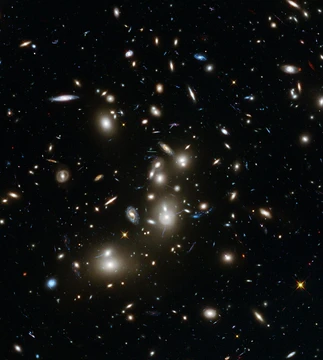
The Butcher–Oemler Effect is the hypothesis that the central regions of galaxy clusters at an intermediate redshift (around z ~ 0.3) hold a higher proportion of blue galaxies than the cores of clusters at low redshift. Harvey Butcher and Augustus Oemler introduced this idea in a 1978 paper in the Astrophysical Journal. Their original study presented photometry for two clusters, Cl 0024+1654 at z = 0.39 and 3C 295 at z = 0.46, both rich and centrally concentrated like the nearby Coma Cluster. In these distant clusters’ cores, they observed more blue galaxies than are seen in the cores of similar nearby clusters.
Blue color in cluster galaxies can, under some conditions, indicate ongoing star formation. Astronomers have sorted these blue cluster members into three spectral classes: objects with very blue colors and emission-filled H-delta lines, indicating vigorous star formation; post-starburst galaxies with similarly blue colors but moderate to strong H-delta absorption; and galaxies with broad or high-excitation line spectra, often linked to active galactic nuclei. The Butcher–Oemler observations suggest that at intermediate redshift, a higher rate of star formation occurs in a fraction of galaxies within rich cluster cores compared to rich cluster cores at low redshift.
The 1978 paper sparked significant debate. A series of Butcher–Oemler papers followed over six years, culminating in "The Evolution of Galaxies in Clusters. V. A Study of Populations since z ~ 0.5." That study presented photometry of 33 clusters with redshifts from 0.003 (the Virgo Cluster) to 0.54 (Cl 0016+16), reinforcing the original conclusion of "strong, recent evolution of galaxies in clusters."
This conclusion prompted many investigations of rich cluster cores at intermediate redshifts (0.3 ≤ z ≤ 0.9). Couch and Newell (1984) obtained broadband photometry of such environments. Other teams imaged clusters between z = 0.5 and z = 0.9 in optical and infrared bands: Couch et al. (1983), Ellis et al. (1985), MacLaren, Ellis and Couch (1988), Aragon-Salamanca, Ellis and Sharples (1991), and Aragon-Salamanca et al. (1993). Spectroscopic observations were carried out by Dressler and Gunn (1982), Lavery and Henry (1985), and Couch and Sharples (1987). Morphological studies using the Hubble Space Telescope were done by Couch et al. (1994) and Dressler et al. (1994).
- First proposed
- 1978
- Original authors
- Harvey Butcher and Augustus Oemler
- Original clusters studied
- Cl 0024+1654 at z = 0.39 and 3C 295 at z = 0.46
- Later study redshift range
- 0.003 (Virgo Cluster) to 0.54 (Cl 0016+16)
- Later study number of clusters
- 33
- Effect confined to
- rich clusters at least as rich or richer than the Virgo cluster
Lore & Background
The original Butcher–Oemler paper presented photometry of two clusters, Cl 0024+1654 at z = 0.39 and 3C 295 at z = 0.46, both typical in morphology and richness, similar to the nearby Coma Cluster. Butcher and Oemler found that in the cores of these distant clusters, more blue galaxies were observed than in the cores of nearby clusters of similar richness and morphology. Cluster galaxy 'blueness' may, under certain circumstances, be used as an indicator of ongoing star formation. Astronomers have identified three spectral classes of blue cluster members: objects undergoing vigorous star formation with emission-filled H-delta lines; post-starburst galaxies with moderate to strong H-delta absorption; and cluster members showing broad and/or high excitation line spectra often found in active galactic nuclei.
The 1978 paper sparked considerable debate, and the ensuing series of Butcher–Oemler papers spanned six years, concluding with a study of 33 clusters with redshifts from 0.003 to 0.54. This later study bolstered the conclusion of 'strong, recent evolution of galaxies in clusters'. Numerous investigations followed, including broadband photometry by Couch and Newell (1984), optical and infrared imaging by several groups, spectroscopic observations by Dressler and Gunn (1982) and others, and Hubble Space Telescope morphological studies by Couch et al. (1994) and Dressler et al. (1994). The outcome of these investigations is that the Butcher–Oemler effect is widespread in rich clusters at z > 0.2 and is due to vigorous episodes of star formation in a subset of cluster members.
Reader's Guide
The Butcher–Oemler effect is significant because it provided early evidence that galaxy populations in rich cluster cores have evolved substantially since intermediate redshifts. The original 1978 paper's claim that a larger fraction of blue galaxies exists in distant cluster cores than in nearby ones challenged the then-prevailing view of passive cluster evolution and sparked a vigorous observational program. Subsequent studies confirmed that the effect is widespread in rich clusters at redshifts greater than 0.2 and is due to vigorous star formation in a subset of cluster members. The effect appears confined to rich clusters at least as rich as the Virgo cluster; observations of small groups out to redshift 0.5 found no relation between blue fraction and group richness. Hubble Space Telescope observations of mergers between blue cluster members showed spectroscopic signatures of starburst or post-starburst objects, suggesting that galaxy–galaxy mergers may partially cause the Butcher–Oemler effect. The legacy of the Butcher–Oemler effect is that it established a key observational benchmark for understanding galaxy evolution in dense environments, driving a generation of multi-wavelength and spectroscopic surveys of distant clusters.
The 1978 Revelation
In 1978, astronomers Harvey Butcher and Augustus Oemler published a paper in the Astrophysical Journal that would reshape how the community understood galaxy evolution in dense environments. Their work centered on broadband photometry of two rich, centrally concentrated clusters—Cl 0024+1654 at a redshift of 0.39 and 3C 295 at 0.46—both of which shared the morphological and richness characteristics of the well-known nearby Coma Cluster. What struck Butcher and Oemler was a striking contrast: the cores of these more distant clusters hosted a noticeably larger population of blue-hued galaxies than the cores of comparable nearby clusters. From this observation they proposed a hypothesis that would bear their names. The Butcher–Oemler Effect posits that at intermediate redshifts, roughly around z = 0.3, the central regions of galaxy clusters contain a greater fraction of blue galaxies than their low-redshift counterparts. This simple yet profound claim immediately placed the question of how cluster galaxies evolve over cosmic time at the forefront of extragalactic astronomy.
Reading the Blue: Three Faces of Star Formation
Under appropriate conditions, the blue coloration of a cluster galaxy serves as a proxy for active or recent star formation, and researchers have sorted the blue members into three distinct spectral categories. The first group comprises objects in the throes of vigorous star formation, displaying extremely blue colors alongside spectra dominated by emission-filled H-delta lines. The second category consists of post-starburst galaxies—cluster members that retain the same blue hues as their starburst counterparts but instead show moderate to strong H-delta absorption, signaling that the burst has recently subsided. The third class includes galaxies exhibiting broad or high-excitation emission-line spectra, a hallmark often associated with active galactic nuclei. Taken together, these three populations imply that at intermediate redshifts, a meaningful fraction of galaxies residing in the cores of rich clusters are undergoing elevated rates of star formation compared with their counterparts in low-redshift cluster cores. The Butcher–Oemler observations thus point to a period of heightened stellar activity in the densest regions of the universe's largest bound structures.
Six Years of Debate and Confirmation
The 1978 paper did not go unchallenged; it ignited a vigorous and sustained debate within the extragalactic community. Butcher and Oemler responded by launching a multi-year program of follow-up observations that stretched over six years and culminated in a landmark study titled The Evolution of Galaxies in Clusters. V. A Study of Populations since z ~ 0.5. In that concluding paper they presented photometric data for an impressive sample of thirty-three galaxy clusters, spanning redshifts from a mere 0.003—the Virgo Cluster in our local neighborhood—to 0.54, represented by the cluster Cl 0016+16. The breadth of this sample allowed them to trace the blue-fraction trend across a wide swath of cosmic time and to reinforce the central claim of their original work. Their conclusion was unambiguous: the evidence supported strong, recent evolution of galaxies in clusters. By systematically expanding the dataset from two clusters to thirty-three, Butcher and Oemler transformed a provocative hypothesis into a well-supported observational result, setting the stage for the wave of independent confirmations that would follow in the 1980s and 1990s.
Widespread, Rich-Cluster Bound, and Possibly Merger-Driven
The Butcher–Oemler Effect quickly became the target of a broad campaign of independent investigations. Researchers including Couch and Newell, Ellis and colleagues, MacLaren, Ellis and Couch, and Aragon-Salamanca and co-workers carried out optical and infrared imaging of clusters between redshifts 0.5 and 0.9, while Dressler and Gunn, Lavery and Henry, and Couch and Sharples contributed spectroscopic surveys. Hubble Space Telescope morphology studies by Couch et al. and Dressler et al. in 1994 added a structural dimension. The consensus that emerged was that the effect is widespread in rich clusters at redshifts above 0.2 and is driven by vigorous star-formation episodes in a subset of cluster members. Crucially, the phenomenon appears confined to rich environments—at least as rich as the Virgo Cluster—since Allington-Smith and colleagues found no richness dependence in small galaxy groups. Furthermore, HST observations of clusters such as CL 0930+4713, AC 114, and Abell 370 revealed that every observed merger between two blue cluster members carried the spectroscopic signature of a starburst or post-starburst object, suggesting that galaxy–galaxy mergers may be a partial driver of the effect.
Frequently Asked Questions
Who is Butcher–Oemler Effect?
It is a hypothesis introduced in 1978 by astronomers Harvey Butcher and Augustus Oemler in a paper published in the Astrophysical Journal. The idea proposes that the central regions of galaxy clusters at intermediate redshifts contain a noticeably larger fraction of blue, star-forming galaxies than the cores of similar nearby clusters.
What are Butcher–Oemler Effect's powers/role?
Its 'power' is to describe a shift in galaxy color populations: at redshifts around 0.3–0.5, cluster cores host more blue galaxies than the cores of rich, nearby clusters like Coma. The effect is specifically confined to rich clusters—those at least as massive as the Virgo Cluster—and does not show up in poorer groups.
Why is Butcher–Oemler Effect important?
It provided early evidence that galaxy populations in cluster environments evolve over cosmic time, suggesting that the processes quenching star formation operate on timescales of hundreds of millions of years. This helped shape modern models of how cluster cores transform blue, star-forming galaxies into the red, passive systems observed today.
Where does Butcher–Oemler Effect first appear?
The original 1978 study presented photometric data for two rich, centrally concentrated clusters: Cl 0024+1654 at z = 0.39 and 3C 295 at z = 0.46. Both were chosen because their structure resembles the nearby Coma Cluster, making them ideal comparison targets for spotting excess blue galaxies in the cores.
More in Galaxy Clusters and Groups 1-24
Spotted an error? Know more?
Reader corrections go straight into our review queue. Suggest an edit · How this site is sourced