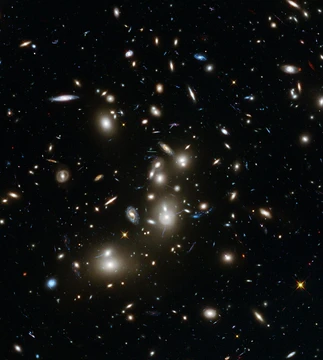
Abell 370
A distant galaxy cluster known for gravitational lensing and the Dragon Arc.

Abell 370 is a galaxy cluster located nearly 5 billion light-years from Earth, in the constellation Cetus. It is the most distant of the clusters catalogued by George Abell, with a core made up of several hundred galaxies. The cluster is notable for its gravitational lensing effects, which have allowed astronomers to observe distant galaxies otherwise hidden from view.
Quick Facts
- Epoch
- J2000
- Constellation
- Cetus
- Ra
- 02 · 39 · 50.5
- Dec
- -01 · 35 · 08
- Richness
- 0
- Bmtype
- II-III
- Redshift
- 0.375
- Distance
- 1.464 Gpc 0.705
Facts from the source article.
Lore & Background
In the 1980s, astronomers from Toulouse Observatory discovered a gravitational lens in space between Earth and Abell 370 using the Canada-France-Hawaii Telescope. A curious arc had been observed earlier near the cluster, but the astronomers recognized it as this phenomenon. Abell 370 appears to include several arcs of light, including the largest ever discovered at 30 arcseconds long, originally called the Giant Arc but later renamed the Dragon Arc. These arcs are mirages caused by gravitational lensing of distant galaxies by the massive cluster.
Reader's Guide
The significance of Abell 370 lies in its role as a gravitational lens, which has enabled the discovery of extremely distant galaxies. In 2002, astronomers used this lensing effect to find HCM-6A, a galaxy 12.8 billion light-years away, which at the time was the furthest known galaxy. In 2009, an HST study revealed the 30-arcsecond-long arc in greater detail, with the appearance of a dragon, leading NASA scientists to rebrand it as The Dragon. Its head is composed of a spiral galaxy, with another image of the spiral forming the tail, and several other images overlapping to form the body. These galaxies all lie approximately 5 billion light-years away. The cluster's gravitational lensing continues to be a tool for studying the early universe.
Did You Know?
- The Dragon Arc is the largest gravitational lens arc ever discovered, at 30 arcseconds long.
- In 2002, the lensing effect of Abell 370 helped discover HCM-6A, then the furthest known galaxy at 12.8 billion light-years away.
- The Dragon Arc's head is a spiral galaxy, with another image of the same spiral forming its tail.
Origins of the Catalogue
The Abell catalogue, within which Abell 370 holds its place as entry number 370, traces its roots to 1958 when American astronomer George O. Abell undertook the monumental task of compiling a systematic inventory of galaxy clusters. Working from photographic plates produced by the Palomar Observatory Sky Survey, Abell identified and catalogued approximately 4,000 clusters, each containing at least 30 member galaxies. The catalogue achieved near-completeness out to a redshift of z = 0.2, meaning it captured essentially all qualifying clusters within that relatively nearby cosmic distance. This foundational work established a reference framework that astronomers have relied upon for decades, and Abell 370 sits comfortably within the first major range of entries (1 through 1999) that Abell assembled from those northern-sky plates.
Southern Hemisphere Extension
The original 1958 catalogue was limited in its sky coverage, but that gap was addressed nearly three decades later. In 1987, Abell joined forces with colleagues Corwin and Olowin to extend the catalogue's reach into the southern hemisphere. This collaborative effort produced the Southern catalogue, designated with entries running from S1 through S1174, adding a substantial number of additional galaxy clusters to the overall inventory. The 1989 paper by Abell, Corwin, and Olowin formalized this extension, and together with the original 1958 publication, these two works form the complete Abell catalogue as it is known today. Abell 370, as part of the original northern-sky sequence, thus exists alongside this much larger southern complement, and the combined resource gives researchers a near-global view of rich galaxy clusters.
Nomenclature and the Dual Abell Legacy
One of the most common sources of confusion in astronomy involves the name Abell itself, which actually serves two distinct cataloguing purposes. George O. Abell not only compiled the galaxy cluster catalogue but also produced a separate catalogue of 86 planetary nebulae in 1966. The proper designation for galaxy clusters is the three-letter code ACO, as in ACO 13, while the planetary-nebula entries carry the single letter A, as in A 39. Despite this clear distinction in formal nomenclature, colloquial usage in the astronomical community often simply says Abell for either type of object, leading to potential ambiguity. Abell 370, therefore, belongs to the galaxy cluster family (ACO 370 in strict notation), and its identity as a rich cluster of at least 30 galaxies distinguishes it entirely from any planetary nebula that might share a similar numerical label in the other catalogue.
Structure, Scope, and Accessibility
The Abell catalogue is organized into three principal ranges that reflect its layered history. The first range, encompassing entries 1 through 1999, represents Abell's original 1958 compilation from the Palomar Observatory Sky Survey plates. The second range, running from 2000 to 4076, extends the inventory further within the northern sky. The third and final range, the Southern catalogue spanning S1 to S1174, was contributed by Abell, Corwin, and Olowin in their 1987 extension. Together these three sections account for the approximately 4,000 clusters in the full catalogue, each meeting the threshold of at least 30 member galaxies. The catalogue has been made available in electronic form, ensuring that researchers worldwide can access the data behind entries like Abell 370 without needing to consult the original photographic plates or the 1958 and 1989 printed papers. This digital accessibility has kept the catalogue a living tool in modern extragalactic astronomy.
Frequently Asked Questions
What is Abell 370?
Abell 370 is a rich galaxy cluster sitting roughly 5 billion light-years away in the constellation Cetus. Its core packs in several hundred galaxies held together by mutual gravity.
Why is Abell 370 so famous among astronomers?
The cluster's immense mass warps spacetime enough to act as a gravitational lens, stretching background galaxies into long, dramatic arcs. The most celebrated example is the 'Dragon Arc,' a warped image of a far-off galaxy magnified by the cluster's pull.
Who put Abell 370 in the catalogue, and what makes it stand out there?
George Abell included it in his systematic survey of rich galaxy clusters. It holds the record as the most distant cluster in his original list, with a redshift of z = 0.375.
Can I see Abell 370 with a backyard telescope?
No—its apparent magnitude of about +22 makes it far too faint for amateur equipment. It is studied with large research telescopes and space-based observatories.
Why does Abell 370 matter for understanding the early universe?
Its gravitational lensing works like a natural magnifying glass, boosting the light of galaxies that are otherwise far too dim to detect. This lets astronomers study structures from the universe's youth that would be invisible without the cluster's help.
More in Galaxy Clusters and Groups 1-24
Spotted an error? Know more?
Reader corrections go straight into our review queue. Suggest an edit · How this site is sourced