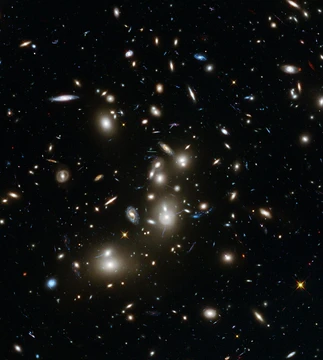
Cooling flow
Predicted rapid cooling of intracluster medium in galaxy clusters.

A cooling flow is a phenomenon predicted to occur in the centers of galaxy clusters, where the intracluster medium (ICM) should rapidly cool at rates of tens to thousands of solar masses per year. This cooling is expected because the ICM, a hot plasma, loses energy through X-ray emission, with the X-ray brightness proportional to the square of the gas density, which rises steeply toward cluster centers. The predicted cooling timescale is less than a billion years, and the resulting pressure drop should cause overlying material to flow inward, sustaining the cooling flow.
- Cooling rate range
- tens to thousands of solar masses per year
- Predicted cooling timescale
- less than a billion years
- Temperature fall ratio
- a third or a half of the temperature in the outskirts
- Mass deposition rate formula
- Ṁ = (2/5) * (Lμm) / (kT)
Lore & Background
The cooling flow model arises from the observation that the intracluster medium (ICM) in the centers of many galaxy clusters is dense and emits strongly in X-rays. The X-ray brightness is proportional to the square of the density, and the temperature in the core falls to typically a third or a half of the temperature in the cluster outskirts. The predicted timescale for the ICM to cool is relatively short, less than a billion years, leading to the expectation that material should cool and flow inward at rates of tens to thousands of solar masses per year.
However, observations have found little evidence for the large amounts of cool X-ray emitting gas that such cooling would produce, creating the 'cooling flow problem.' Several explanations have been proposed to resolve this discrepancy, including heating by the central active galactic nucleus (AGN), thermal conduction from outer cluster regions, cosmic ray heating, hiding of cool gas by absorbing material, and mixing of cool gas with hotter material. Heating by AGN is the most popular explanation, as AGN emit a lot of energy over their lifetimes, while some alternatives have theoretical problems.
Reader's Guide
The cooling flow concept is significant because it highlights a major discrepancy between theoretical predictions and observational evidence in galaxy cluster astrophysics. The predicted mass deposition rates, derived from the formula Ṁ = (2/5)(Lμm)/(kT), where L is the bolometric luminosity and T is the temperature, are not matched by observations, which show little cool X-ray emitting gas. This 'cooling flow problem' has driven research into heating mechanisms, with AGN heating via sound waves (observed in the Perseus and Virgo clusters) emerging as the leading explanation. The problem underscores the complexity of feedback processes in clusters and has shaped understanding of how supermassive black holes interact with their environments. The legacy of the cooling flow problem is that it has refocused attention on non-gravitational heating sources, particularly AGN, as key regulators of gas cooling and star formation in the centers of galaxy clusters.
Did You Know?
- The predicted cooling rate in a cooling flow ranges from tens to thousands of solar masses per year.
- The X-ray brightness of the intracluster medium is proportional to the square of its density.
- The cooling flow problem arises because there is little evidence for cool X-ray emitting gas in many clusters.
- Heating by the central active galactic nucleus is the most popular explanation for the cooling flow problem.
Architecture of a Heterogeneous Assembly
The Virgo Cluster is not a uniform blob of galaxies but a layered, heterogeneous structure. Its roughly 1,300 to 2,000 member galaxies span about eight degrees of sky in the constellation Virgo, situated 53.8 million light-years from Earth. Within that expanse, the two major galaxy families occupy different geometries: spiral galaxies trace an oblong prolate filament roughly four times longer than it is wide, aligned along our line of sight, while elliptical galaxies cluster more tightly toward the center. The assembly breaks down into at least three principal subclumps. Virgo A, anchored by the giant elliptical M87, dominates with a mass around 10^14 solar masses—roughly ten times the combined mass of the other two. A second subclump orbits around M86, and Virgo B centers on M49, the cluster's brightest member. Some researchers also identify a Virgo C subcluster around M60 and a Low Velocity Cloud subclump around the large spiral NGC 4216. In 1984, the first ultra-diffuse galaxy was spotted in the cluster's core, and M87's supermassive black hole had its event horizon imaged by the Event Horizon Telescope Collaboration in 2019.
A Cluster Still in the Making
The Virgo Cluster is far from a settled, static structure. Evidence strongly indicates it is a dynamically young system still in the process of assembling itself. Its three principal subclumps are actively merging toward a single, larger cluster, while surrounding smaller galaxy clouds—designated N Cloud, S Cloud, and Virgo E—are currently infalling under the cluster's gravitational pull. Even more distant isolated galaxies and groups, such as the Coma I cloud, are being drawn inward and expected to join the cluster in the future. The sheer mass of the system, estimated at 1.2 × 10^15 solar masses within a radius of about 2.2 megaparsecs, produces extreme peculiar velocities; some member galaxies move at speeds as high as 1,600 km/s relative to the cluster's center. This gravitational dominance also affects our own Local Group, slowing its recession from Virgo by roughly ten percent—a phenomenon astronomers call the Virgocentric flow. Meanwhile, nearby groupings like M Cloud, W Cloud, and W' Cloud appear to be unrelated background systems passing behind the cluster rather than true members.
The Hot Plasma and Its Devastating Effects
Between the galaxies of the Virgo Cluster lies an environment far more hostile than empty space. The intracluster medium is a vast bath of hot, rarefied plasma reaching temperatures around 30 million kelvins, radiating energy in the X-ray band. This medium is not merely a passive backdrop; it actively reshapes the galaxies it surrounds. As cluster members plow through the dense intracluster gas, ram pressure stripping efficiently tears molecular gas from their disks. Over time, this gas loss can quench star formation entirely, transforming once-active spirals into quiescent systems. The plasma also harbors a surprising population of intergalactic stars—potentially up to ten percent of all stars in the cluster—along with some planetary nebulae, likely ejected from their parent galaxies through gravitational interactions. Stripped globular clusters, possibly ripped from dwarf galaxies, and at least one active star-formation region have also been identified within the medium. Fainter dwarf galaxies, numerous throughout the cluster, are typically catalogued by their numbers in the Virgo Cluster Catalog rather than by proper names.
From Fuzzy Patches to a Cosmic Neighborhood
For nearly two centuries, the brighter galaxies of the Virgo Cluster were catalogued as mere nebulae without stars. Charles Messier included several of them in his famous list of non-cometary fuzzy objects during the late 1770s and early 1780s, but their true identity as distant galaxies remained unknown until the 1920s. Today, the cluster's remarkable accessibility makes it a favorite target for amateur astronomers. Its most prominent members can be glimpsed with nothing more than binoculars or a small telescope, and on a clear night a modest six-inch instrument will reveal approximately 160 of the cluster's galaxies. The brightest of all is the elliptical galaxy M49. Fainter members, particularly the numerous dwarf galaxies, are typically identified by their designations in the Virgo Cluster Catalog. The cluster's position roughly 53.8 million light-years away, centered in the constellation Virgo, places it within the larger Virgo Supercluster, of which our own Local Group and the Milky Way are part. This proximity, combined with its rich population, has made the Virgo Cluster one of the most thoroughly studied galaxy groups in the sky.
Frequently Asked Questions
What is a cooling flow in a galaxy cluster?
A cooling flow is a predicted process in the dense cores of galaxy clusters where the hot intracluster plasma radiates away its thermal energy so quickly that it should collapse inward. As the gas loses heat through X-ray emission, the local pressure drops and surrounding material rushes in to replace it, sustaining a continuous inward flow.
How much mass is deposited in a cooling flow?
The predicted mass deposition rate spans from tens to thousands of solar masses per year, depending on the specific cluster. The rate is derived from the X-ray luminosity, the mean molecular weight of the plasma, and the gas temperature.
Why does the gas cool faster in the cluster center than the outskirts?
X-ray radiative losses scale with the square of the gas density, and density climbs steeply toward the cluster core. The outskirts, where temperatures are already a third to a half of the peak central values, radiate far less efficiently, so the cooling is concentrated in the innermost regions.
How long does a cooling flow last before the gas is gone?
The predicted cooling timescale in the densest regions is less than a billion years, meaning the gas loses its thermal support on a relatively short cosmic clock. Once that pressure is gone, the overlying material is pulled inward by gravity, perpetuating the flow.
Why do astronomers care about cooling flows?
Cooling flows were long viewed as a natural engine for feeding supermassive black holes and seeding new star formation in cluster cores. Their predicted cycle of rapid radiative losses followed by gravitational infall makes them a critical test of how hot plasma behaves in the densest gravitational environments in the universe.
More in Galaxy Clusters and Groups 1-24
Spotted an error? Know more?
Reader corrections go straight into our review queue. Suggest an edit · How this site is sourced