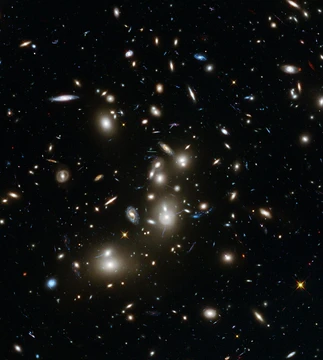
Hickson 40
A compact merging galaxy group in Hydra.

Hickson 40 is a compact galaxy group located in the constellation Hydra, about 300 million light-years away. It contains five galaxies—three spirals, one elliptical, and one lenticular—that are currently merging. The group is so tightly packed that it could fit within an area roughly the size of the Milky Way's galactic disk. Its member galaxies began interacting early in their formation, resulting in a dense and varied collection of galactic types.
Though Hickson 40 is relatively isolated, most similar galaxy clusters are usually part of larger structures. It can be found in the Hydra constellation.
Astronomers have studied Hickson 40 across multiple wavelengths, including visible light, radio, infrared, and X-ray. Most of its galaxies contain bright radio sources at their cores, suggesting supermassive black holes. X-ray observations show large amounts of hot gas, indicating the galaxies are drawing closer together. Infrared data reveal high rates of star formation. As one of the most compact galaxy clusters known, Hickson 40 is a valuable subject for research, particularly for NASA. Studies suggest that such dense groups were more common in the early universe and may have contributed to the formation of quasars, whose intense light from heated infalling material spread across space. By examining close groups like Hickson 40, astronomers can better understand when and how galaxies assemble and what they are made of.
Two supernovae have been recorded in Hickson 40. SN 2003D, a Type Ia supernova with a magnitude of 17.5, was discovered by Tim Puckett and Alex Langoussis on January 6, 2003, located 1.6 arcseconds east and 10.2 arcseconds south of the nucleus of MCG -1-25-8. SN 2026dwm, a Type IIb supernova with a magnitude of 19.97, was discovered by the GOTO survey on February 21, 2026.
Quick Facts
- Epoch
- J2000
- Ra
- 09h 38m 54s
- Dec
- −04° 51.1′
- Member No
- 6
- Names
- MCG-01-25-008, MCG-01-25-009, MCG-01-25-010, MCG-01-25-011, MCG-01-25-012, LEDA 27517
Facts from the source article.
Lore & Background
Researchers have observed Hickson 40 in many wavelengths, including visible light, radio, infrared, and X-ray. The majority of the galaxies within the cluster have a dense radio source in the cores, which could be proof for the existence of supermassive black holes. X-ray surveys have revealed that the galaxies are pushing closer together because of the amount of hot gas present. Infrared observations reveal fast rates of star formation. Hickson 40 is one of the most compact galaxy clusters ever observed, making it a valuable research point for NASA. Research shows that galaxy clusters were more prevalent in the early universe, and helped the formation of quasars, whose luminosity from heated infalling material spread across the universe. Studying the formation of galaxies in other close groups like Hickson 40 has given astronomers a chance to sort out when and where galaxies assemble themselves, and what material they are made of.
Reader's Guide
Hickson 40 is notable as one of the most compact galaxy clusters ever observed, providing a valuable research point for NASA. Its extreme density—so compact that it could fit within a region close to the diameter of the Milky Way's galactic disk—makes it an important laboratory for studying galaxy interactions and mergers. Observations across multiple wavelengths have revealed dense radio sources in most galactic cores, suggesting supermassive black holes, while X-ray data show hot gas driving the galaxies closer together. Infrared observations indicate rapid star formation. Although Hickson 40 is remarkably self-sustained, the vast majority of galaxy clusters that resemble it are typically part of a larger cluster. Two supernovae have been observed in the group: SN 2003D (Type Ia, mag. 17.5) discovered by Tim Puckett and Alex Langoussis on 6 January 2003, and SN 2026dwm (Type IIb, mag. 19.97) discovered by GOTO on 21 February 2026. Studying groups like Hickson 40 helps astronomers understand when and where galaxies assemble and what material they are made of, as well as the role of compact groups in the early universe and quasar formation.
Did You Know?
- Hickson 40 consists of five member galaxies: three spirals, one elliptical, and one lenticular.
- Two supernovae have been observed in Hickson 40: SN 2003D (Type Ia) and SN 2026dwm (Type IIb).
- X-ray surveys show the galaxies are pushing closer together due to hot gas.
More in Galaxy Clusters and Groups 1-24
Spotted an error? Know more?
Reader corrections go straight into our review queue. Suggest an edit · How this site is sourced