HCG 3
A compact group of four galaxies in Cetus.

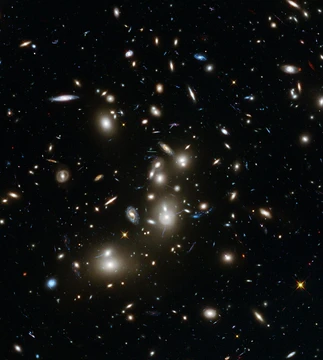
HCG 3 is a compact group of galaxies from the Hickson Compact Group catalog, located in the constellation Cetus less than 1 degree north of NGC 157. It is notable for being one of 100 such groups identified by Paul Hickson in 1982, and for containing four member galaxies with distinct infrared and color properties.
Quick Facts
- Epoch
- J2000
- Ra
- 00 · 34 · 28.8000
- Dec
- -07 · 34 · 58.800
- Constellation
- Cetus
- Member No
- 4
- Redshift
- 0.026321
- Distance
- 111.43 Mpc
- Other Names
- [DZ2015] 471
- Velocity Dispersion
- 251.2 km/s
Facts from the source article.
Lore & Background
HCG 3 was identified by Paul Hickson in 1982 as part of a catalog of 100 compact galaxy groups. It lies in the constellation Cetus, less than 1 degree north of NGC 157, at a distance of 111.43 ± 7.81 Mpc. The group has a radial velocity dispersion of 251 km/s and a crossing time of H₀tc = 0.023.
Far-infrared studies using the Infrared Astronomical Satellite (IRAS) show that only HCG 3C emits a strong infrared signal, indicating a high amount of star formation and stellar nurseries. Its far-infrared luminosity is 10.433 L☉, while the other three members (HCG 3A, 3B, and 3D) have weak or undetected emission. HCG 3C also has the lowest B-R value, indicating a large amount of molecular cloud formation, whereas HCG 3B has the highest B-R, representing a high amount of old stellar population. HCG 3A is the brightest of the four in blue-filter total brightness (B_T), and HCG 3C is the dimmest.
Reader's Guide
HCG 3 is significant as one of the 100 compact groups cataloged by Paul Hickson in 1982, providing a sample for studying galaxy interactions and evolution in dense environments. Its four member galaxies show a clear dichotomy in star formation activity: only HCG 3C exhibits strong far-infrared emission and a low B-R color, both indicative of active star formation and molecular clouds, while the other members show weak or undetected infrared emission and higher B-R values, suggesting older stellar populations. This contrast within a single compact group offers insight into how environmental factors may trigger or suppress star formation. The group's measured radial velocity dispersion and crossing time provide dynamical context for understanding the timescales of galaxy interactions. The use of IRAS data highlights the role of far-infrared astronomy in detecting thermal radiation from interstellar dust, which is a reliable tracer of massive star formation. HCG 3 thus serves as a case study in the varied star formation histories that can coexist in a compact group.
Did You Know?
- HCG 3 is located less than 1 degree north of NGC 157 in the constellation Cetus.
- Only HCG 3C emits a strong infrared signal, with a far-infrared luminosity of 10.433 L☉.
- HCG 3A is the brightest of the four members in blue-filter total brightness, while HCG 3C is the dimmest.
- HCG 3B has the highest B-R value, indicating a high amount of old stellar population.
More in Galaxy Clusters and Groups 1-24
Spotted an error? Know more?
Reader corrections go straight into our review queue. Suggest an edit · How this site is sourced