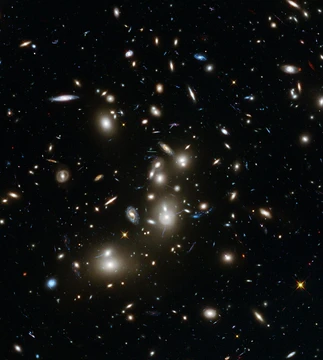
Gioiello (galaxy cluster)
Most distant massive galaxy cluster known.

Gioiello (officially XDCP J0044.0-2033) is a massive galaxy cluster discovered in the archive of the XMM-Newton mission as part of the XMM-Newton Distant Cluster Project (XDCP) and first published by Santos et al. 2011. It is notable as the most distant massive galaxy cluster that has been found and studied, located 9.6 billion light years away from Earth and containing 400 trillion times the mass of the Sun.
- Redshift
- z=1.579
- Mass
- 400 trillion solar masses
- Distance
- 9.6 billion light years
- Discovery year
- 2011
- Discovery paper
- Santos et al. 2011
- Coordinates
- RA 00h 44m 05.20s | Dec −20° 33’ 59.70"
- Constellation
- Cetus
Lore & Background
Gioiello (lit. 'Jewel' in Italian) was first detected by astronomers in 2011 (Santos et al 2011). Follow-up research using dedicated X-ray imaging from the Chandra observatory was discussed at the Italian village sharing its namesake, Villi il Gioiello. At this research meeting the unique properties of Gioiello were discussed at length, including that it emits purple light and is incredibly massive. The results of research surrounding Gioiello and other massive galaxy clusters were published in The Astrophysical Journal, with its main author being Paolo Tozzi of the National Institute for Astrophysics (INAF) in Florence, Italy, and co-author Joana Santos, also from INAF.
The cluster image is a composite of X-rays (purple); optical (red, green, blue); and far-infrared (red). Gioiello is unique compared to other clusters in that it still has many stars forming within its galaxies. Although several clusters have been confirmed at this size, it is the only cluster with redshifts capable of diffusing X-ray emission, which creates different limitations on the temperature and on the mass of the galaxy. The cluster was spotted six times between 8 September and 24 November in 2013.
Galaxy clusters are the largest structures in the Universe held together by gravity. NASA observed this cluster over a period of four days, allowing researchers to identify the accurate mass of the cluster. Previous to the discovery of Gioiello, researchers found another very large galaxy cluster named 'El Gordo,' located 7 billion light years away. A distance estimate scale provided by NASA shows the location of Gioiello stretching to the early universe category. Astronomers have discovered several smaller galaxy clusters close to the distance of Gioiello, more than 9.5 billion light-years away, though some appeared to be proto-clusters. Researchers detected hints of uneven structure in the hot gas, possibly caused by collisions with smaller galaxy clusters, providing clues to how the cluster became so massive very early on.
Reader's Guide
Gioiello's significance lies in its status as the most distant massive galaxy cluster discovered and studied, offering a unique window into the early universe. Its high redshift (z=1.579) and enormous mass (400 trillion solar masses) make it a critical object for understanding how galaxy clusters evolved over cosmic time. The cluster's ongoing star formation provides astronomers with a new perspective on the state of younger galaxy clusters and their behavior. The detection of uneven structure in its hot gas suggests it may still be undergoing interactions and collisions with smaller clusters, which could explain how it became so massive early on. However, the article notes that further research needs to be done to better understand these galaxies, and the outlook for further studies is low following the basis of currently planned missions. The discovery and study of Gioiello, published in The Astrophysical Journal by Paolo Tozzi and Joana Santos, underscores the importance of high-redshift cluster observations for testing models of structure formation, even as observational challenges remain.
Did You Know?
- Gioiello means 'jewel' in Italian, named for the pink, purple, and red sparkling colors in its X-ray image.
- It was discovered in the XMM-Newton archive as part of the XMM-Newton Distant Cluster Project (XDCP).
- The cluster contains 400 trillion times the mass of the Sun and is located 9.6 billion light years away.
More in Galaxy Clusters and Groups 1-24
Spotted an error? Know more?
Reader corrections go straight into our review queue. Suggest an edit · How this site is sourced