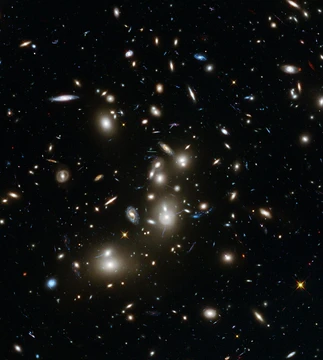
Abell 754
A massive, merging galaxy cluster in Hydra.

Abell 754 is a large, bright galaxy cluster in the constellation Hydra, known for its strong X-ray emissions. It formed when two smaller clusters collided, a process that started around 500 million years ago and is still happening. The cluster remains unsettled and will likely take a few billion more years to reach a stable state. It belongs to Supercluster 78 (SCL 78) alongside two other clusters, Abell 780 and Abell 838.
The cluster’s central dominant galaxy, LEDA 25714, is a luminous, slightly stretched elliptical with an effective radius of 47.72 kiloparsecs and an absolute magnitude of M_V = -23.99. Abell 754 contains over 100 confirmed member galaxies and has been cited in more than 560 scientific papers. It has been observed by the Very Large Array, Chandra X-ray Observatory, BeppoSAX, ROSAT, and the Giant Metrewave Radio Telescope.
In terms of radio properties, low-frequency studies have identified four diffuse radio sources and one new source within the cluster. The "west relic" appears only at very low frequencies (74 MHz) and has a steep spectrum (α > 2), suggesting it is an ancient relic. The fourth diffuse feature likely comes from a "cocoon of a radio galaxy" or a remnant of a radio galaxy that shut down about 90 million years ago. ASCA X-ray observations show the intracluster medium has a temperature of 9.0 ± 0.3 keV, indicating the cluster is both massive and hot.
A subcluster has moved through Abell 754 from east to west, causing the diffuse radio emission. The four diffuse blobs lie along this east-west axis. The eastern shock is near the X-ray peak and close to two of the diffuse radio blobs, suggesting the shock is accelerating particles and producing the radio emission. Numerical simulations indicate the cluster formed from a major merger with a mass ratio of 2.5:1. The X-ray bar is off-center from the galaxies, the X-ray surface brightness is stretched, and extreme temperature variations exist, with some gas reaching 19 keV—clear signs of a merger. The remnant gas is still settling, and the cluster is taking longer than expected to stabilize. This suggests many pre- or post-merger clusters should be observable and supports a low-density universe dominated by dark matter and dark energy.
Another radio study describes the emission as complex, with two extended features.
Quick Facts
- Epoch
- J2000
- Constellation
- Hydra
- Ra
- 09 · 08 · 50.1
- Dec
- -09 · 38 · 12
- Brightest Member
- LEDA 25714
- Richness
- 2
- Bmtype
- I-II
- Redshift
- 0.5420 (16 249 km/s)
- Distance
- 233 Mpc 0.705
- Temperature
- 9.0 ± 0.3 keV
- Flux
- 4.35-11 erg s / −1 / cm / −2 / (0.5–2 keV)
- Other Names
- Abell 0754; ABELL 0754; SCL 078 NED01; RXC J0909.1-0939; MAXI J0909-097
Facts from the source article.
Lore & Background
Abell 754 is the result of a major merger of two clusters with a mass ratio of 2.5:1, as suggested by numerical simulations. The collision began about 500 million years ago and is still ongoing, with the system remaining disturbed. The cluster is expected to reach equilibrium in a few billion years. It is located in Supercluster 78 (SCL 78) together with Abell 780 and Abell 838.
The cluster's intracluster medium (ICM) has a temperature of 9.0 ± 0.3 keV, indicating it is massive and hot, with extreme temperature inhomogeneities reaching up to 19 keV. A bar of X-ray emission is not centered on the galaxies, and the X-ray surface brightness is elongated. A subcluster has moved through Abell 754 from east to west, causing diffuse radio emission. Four diffuse radio blobs exist along the east-west axis, with an eastern shock near the X-ray peak close to two of the blobs, suggesting the shock is accelerating particles.
Low-frequency radio studies have found four diffuse radio sources and one new source. The 'west relic' is visible only at very low frequencies (74 MHz) with a steep spectrum (α > 2), suggesting it is very old. The fourth diffuse feature's spectrum indicates it is likely a 'cocoon of a radio galaxy' or a remnant shut down about 90 million years ago. The radio emission is complex, with a western halo coincident with the hottest gas and shock front, and an eastern halo possibly produced by secondary protons from proton-proton collisions.
Reader's Guide
Abell 754 is significant as a well-studied example of a major cluster merger, referenced in over 560 scientific papers. Its ongoing collision, beginning about 500 million years ago, provides insights into the dynamics of cluster mergers and the timescales for reaching equilibrium. The cluster's disturbed state, with extreme temperature inhomogeneities up to 19 keV and a bar of X-ray emission offset from the galaxies, is a clear sign of merger activity. Numerical simulations suggest the merger takes longer than expected to settle, indicating that many post- or pre-merging clusters should be observable and supporting a low-density universe dominated by dark matter and dark energy. The cluster's complex radio emission, including a very old relic and a possible radio galaxy remnant shut down 90 million years ago, offers clues about particle acceleration and shock processes. X-ray observations reveal a cool component of gas separated from the hot ICM, likely from embedded groups falling into the cluster. Abell 754 has been studied by multiple observatories, including the Very Large Array, Chandra X-ray Observatory, BeppoSAX, ROSAT, and the Giant Metrewave Radio Telescope.
Did You Know?
- Abell 754 was formed from the collision of two smaller clusters with a mass ratio of 2.5:1.
- The cluster's intracluster medium reaches temperatures up to 19 keV.
- A 'west relic' in Abell 754 is only visible at 74 MHz and has a very steep spectrum (α > 2).
Frequently Asked Questions
What is Abell 754?
Abell 754 is a large, luminous galaxy cluster located in the constellation Hydra, hosting more than 100 confirmed member galaxies. It stands out for its intense X-ray glow, powered by an intracluster medium at roughly 9.0 keV.
What is the central dominant galaxy of Abell 754?
The cluster's cD galaxy is LEDA 25714, a bright, slightly elongated elliptical with an effective radius of about 47.72 kiloparsecs. Its absolute visual magnitude of −23.99 makes it an exceptionally luminous anchor for the whole system.
Is Abell 754 a stable, relaxed cluster?
No — it is still in the throes of a major merger that kicked off roughly 500 million years ago when two smaller clusters collided. Astronomers expect several more billion years before the system fully settles into a stable configuration.
Which supercluster does Abell 754 belong to?
It is part of Supercluster 78 (SCL 78), sharing that extended grouping with two other clusters, Abell 780 and Abell 838.
Why is Abell 754 a popular target for X-ray and merger studies?
Its hot intracluster medium at 9.0 ± 0.3 keV produces a strong, easily detectable X-ray signal, while its ongoing collision between two former sub-clusters gives researchers a live laboratory for studying how galaxy clusters evolve. The combination of high brightness and unsettled structure makes it a standout case in the Hydra field.
More in Galaxy Clusters and Groups 1-24
Spotted an error? Know more?
Reader corrections go straight into our review queue. Suggest an edit · How this site is sourced