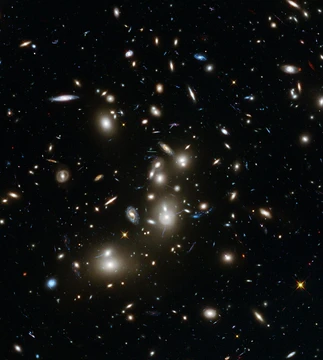
El Gordo (galaxy cluster)
A massive distant galaxy cluster composed of two colliding subclusters.

El Gordo (lit. The Fat One), also known as ACT-CL J0102-4915 or SPT-CL J0102-4915, is a distant galaxy cluster located more than 7 billion light-years from Earth. As of 2011, it was the largest distant galaxy cluster observed at its distance or beyond, and as of 2014 it held the record for being the largest distant galaxy cluster discovered, with a mass initially estimated at slightly less than three quadrillion solar masses, later reduced to about 2.1×10^15 (2.1 quadrillion) solar masses with a 10% uncertainty.
- Official name
- ACT-CL J0102-4915
- Nickname
- El Gordo (Spanish for 'the Fat One')
- Distance from earth
- more than 7 billion light-years
- Mass
- about 2.1×10^15 (2.1 quadrillion) solar masses with a 10% uncertainty (later estimate)
- Discovery telescopes
- NASA's Chandra X-ray Observatory, the Atacama Cosmology Telescope, and the European Southern Observatory's Very Large Telescope
- Announcement
- 219th meeting of the American Astronomical Society in Austin, Texas
Lore & Background
El Gordo was discovered using NASA's Chandra X-ray Observatory, the Atacama Cosmology Telescope (funded by the National Science Foundation), and the European Southern Observatory's Very Large Telescope. Researchers gave it the nickname 'El Gordo' as an homage to the telescopes used for its discovery in the Atacama Desert in Northern Chile (ACT, VLT and SOAR). Findings and results on El Gordo were announced at the 219th meeting of the American Astronomical Society in Austin, Texas.
Observations from the European Southern Observatory's Very Large Telescope and the Chandra X-ray Observatory show that El Gordo is composed of two separate galaxy subclusters, colliding at several million kilometers per hour. These observations suggest that El Gordo most probably formed in the same manner as the Bullet Cluster (which is located 4 billion light-years from Earth).
It was claimed that this interacting cluster presents problems for the conventional Lambda-CDM model of cosmology because it is hard to reconcile ΛCDM's model of galaxy formation with the combination of how early El Gordo is observed in cosmic history, its large mass, and its high collision velocity. It was argued that later more accurate measurements have rejected this claim and led to a smaller mass estimate fully consistent with the ΛCDM cosmology. However, the claims of consistency with ΛCDM were shown to be due to the assumption of a very low collision velocity that is not supported by any hydrodynamical simulations, not because of the slightly reduced mass estimate, which by itself does not solve the problem. According to Cristóbal Sifón from Pontifical Catholic University of Chile, 'this is the first time we've found a system like the Bullet Cluster at such a large distance.'
Reader's Guide
El Gordo's significance lies in its status as the largest distant galaxy cluster observed at its distance or beyond as of 2011, and as of 2014 it held the record for being the largest distant galaxy cluster discovered. Its mass, initially estimated at slightly less than three quadrillion solar masses, was later reduced to about 2.1 quadrillion solar masses with a 10% uncertainty. The cluster is notable for being composed of two separate subclusters colliding at several million kilometers per hour, forming in a manner similar to the Bullet Cluster. Its discovery and subsequent analysis have sparked debate regarding the Lambda-CDM model of cosmology. Some claimed that the cluster's early cosmic appearance, large mass, and high collision velocity are hard to reconcile with ΛCDM, while others argued that later more accurate measurements resolved the issue. However, the claims of consistency with ΛCDM were shown to rely on an assumption of a very low collision velocity not supported by hydrodynamical simulations, and the reduced mass estimate alone does not solve the problem. This makes El Gordo an important object for testing cosmological models and understanding galaxy cluster formation and collisions at large distances.
More in Galaxy Clusters and Groups 1-24
Spotted an error? Know more?
Reader corrections go straight into our review queue. Suggest an edit · How this site is sourced