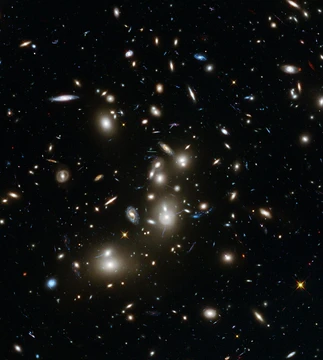
Copeland Septet
A compact group of eight interacting galaxies in Leo.

Copeland's Septet sits about 430 million light-years off in Leo, a tight knot of galaxies pulling on each other gravitationally. The name "septet" comes from the seven galaxies spotted through 19th-century telescopes, but modern catalogs actually list eight physical members, labeled HCG 57a through 57h. Its brightest galaxy, NGC 3753, has a redshift that ties the whole group to the Coma Supercluster.
The biggest and brightest member is NGC 3753 (HCG 57a), a magnitude 14.5 spiral. Right next to it sits NGC 3754 (HCG 57d), a smaller spiral, and the two form a close pair. Occupying the core's center is NGC 3750 (HCG 57c), an elliptical galaxy. On the western side, NGC 3746 (HCG 57b) is a barred spiral that has produced two known supernovae, SN 2002ar and SN 2005ba. Nearby, NGC 3748 (HCG 57e) is an edge-on lenticular galaxy marked by a dust lane. The remaining cataloged components include NGC 3751 (HCG 57f), an elliptical on the core's southern edge; NGC 3745 (HCG 57g), a faint lenticular; and PGC 36010 (HCG 57h), a dwarf spiral of 17th magnitude.
Gravitational encounters among the group members have left clear signs of tidal disruption. The interaction between NGC 3753 and NGC 3754, for instance, has stretched long streams of neutral hydrogen gas and stars into the space between galaxies. Spectroscopic work reveals that these tidal forces have warped galaxy disks and stripped away gas throughout the cluster, sparking star formation in the spiral members.
British astronomer Ralph Copeland found the cluster on February 9, 1874, using the 72-inch reflector at Birr Castle in Ireland. He logged seven visual members and published the find as "The Septet." In 1982, Paul Hickson added the system to his catalogue of compact galaxy groups as entry 57, including the faint dwarf PGC 36010 as HCG 57h.
Quick Facts
- Epoch
- J2000
- Constellation
- Leo
- Ra
- 11 · 37 · 50.5
- Dec
- +21 · 59 · 06
- Brightest Member
- NGC 3753
- Member No
- 8
- Redshift
- 0.0304
- Distance
- 132 Mpc 67.3
- Other Names
- HCG 57, Arp 320
Facts from the source article.
Lore & Background
British astronomer Ralph Copeland discovered the cluster on February 9, 1874, while observing from Birr Castle in Ireland using the 72-inch reflecting telescope. Copeland recorded seven visual members in the field and published the group under the title 'The Septet.' In 1982, Paul Hickson included the system as entry 57 in his catalogue of compact galaxy groups, adding the faint dwarf galaxy PGC 36010 to the group designation as HCG 57h.
The group is dominated by NGC 3753 (HCG 57a), a magnitude 14.5 spiral galaxy and the largest component. NGC 3753 forms a close physical pair with NGC 3754 (HCG 57d), a smaller spiral galaxy located immediately adjacent to it. Directly next to this pair is NGC 3750 (HCG 57c), an elliptical galaxy occupying the central region of the group core. The western portion contains NGC 3746 (HCG 57b), a barred spiral galaxy that has hosted two documented supernovae (SN 2002ar and SN 2005ba), and NGC 3748 (HCG 57e), an edge-on lenticular galaxy with a dust lane. The remaining cataloged components are NGC 3751 (HCG 57f), an elliptical galaxy on the southern edge of the core, NGC 3745 (HCG 57g), a faint lenticular galaxy, and PGC 36010 (HCG 57h), a 17th-magnitude dwarf spiral galaxy.
The members show evidence of strong tidal disruption caused by mutual gravitational encounters. Tidal interaction between NGC 3753 and NGC 3754 has drawn out long filaments of neutral hydrogen gas and stars into the intergalactic medium. Spectroscopic studies show that tidal forces have distorted galaxy disks and driven gas stripping throughout the cluster, triggering star formation within the spiral members.
Reader's Guide
Copeland's Septet is significant as a compact group of interacting galaxies that illustrates the effects of gravitational encounters on galaxy evolution. The group's eight members, originally thought to be seven, show clear evidence of tidal disruption, including drawn-out filaments of neutral hydrogen gas and stars, distorted galaxy disks, and gas stripping that triggers star formation. Its inclusion in the Hickson Compact Group catalog in 1982 as HCG 57 formalized its status as a key example of a compact galaxy group. The group's location in the Coma Supercluster places it within a larger cosmic structure. The presence of two documented supernovae in NGC 3746 (SN 2002ar and SN 2005ba) adds to its observational interest. The group's legacy lies in its role as a laboratory for studying galaxy interactions and the processes that shape galaxy morphology and star formation in dense environments.
Did You Know?
- Copeland's Septet is located approximately 430 million light-years away in the constellation Leo.
- The group was discovered by British astronomer Ralph Copeland on February 9, 1874, using the 72-inch reflecting telescope at Birr Castle in Ireland.
- Modern catalogs identify eight physical members, designated HCG 57a through HCG 57h, though it was historically named a septet.
- The barred spiral galaxy NGC 3746 (HCG 57b) has hosted two documented supernovae: SN 2002ar and SN 2005ba.
More in Galaxy Clusters and Groups 1-24
Spotted an error? Know more?
Reader corrections go straight into our review queue. Suggest an edit · How this site is sourced