Coma I
A spiral-rich galaxy group infalling into the Virgo Cluster.

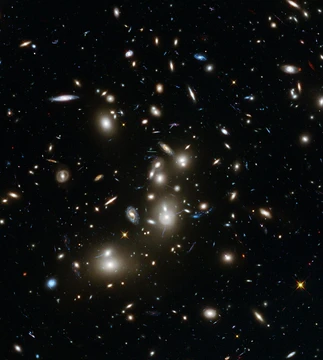
The Coma I Group sits about 14.5 Mpc (47.3 Mly) away in the constellation Coma Berenices. It stands out because it contains many spiral galaxies but very few elliptical or lenticular ones. This group lies in front of the more distant Coma and Leo clusters, and it belongs to the Virgo Supercluster. It is currently falling into the Virgo Cluster and will eventually merge with it.
The group’s structure is debated. Some studies suggest it splits into two subgroups: a denser one around NGC 4274 and NGC 4278, and a looser one around NGC 4565. However, other work finds no clear evidence for two distinct subgroups, noting only a slight density increase near NGC 4274, with the rest of the members spread uniformly to the southeast. That same study describes a central bar-like shape with a minor axis of 0.9 Mpc (2.9 Mly) and a major axis of 2.3 Mpc (7.5 Mly). Later catalogs still list two subgroups centered on NGC 4274 and NGC 4565. There is also evidence that the Coma II Group, centered on NGC 4725, is associated with Coma I. In 2000, Coma II was defined as containing five galaxies: NGC 4494, NGC 4562, NGC 4565, NGC 4725, and NGC 4747. These five have radial velocities between 1190 and 1395 km/s, a narrower and higher range than the 600 to 1000 km/s seen in Coma I. The nearby NGC 4631 Group is sometimes included in Coma I in some catalogs, but listed separately in others.
A table of consistently identified members draws from the Nearby Galaxies Catalog, the Fouque et al. survey, the Lyons Groups of Galaxies (LGG) Catalog, and three group lists from the Nearby Optical Galaxy sample by Giuricin et al. Possible additional members—listed in only one or two of those sources—include IC 3215, IC 3247, IC 3571, MCG 5-29-66, NGC 4080, NGC 4150, NGC 4308, NGC 4455, NGC 4509, NGC 4534, NGC 4627, NGC 4631, NGC 4656, NGC 4670, UGC 6900, UGC 7007, UGC 7300, UGC 7428, UGC 7438, UGC 7673, UGC 7916, and UGCA 294.
The center of the Virgo Cluster (M87) lies about 3.6 Mpc (11.7 Mly) from the Coma I Group.
- Distance
- 14.5 Mpc (47.3 Mly)
- Constellation
- Coma Berenices
- Brightest member
- NGC 4725
- Distance to virgo cluster center
- 3.6 Mpc (11.7 Mly)
- Subgroups mentioned
- NGC 4274, NGC 4278, NGC 4565
Lore & Background
The structure of the Coma I Group is debated. De Vaucouleurs suggested it consists of two main subgroups: a denser one centered on NGC 4274 and NGC 4278, and a looser one surrounding NGC 4565. However, Gregory and Thompson (1977) found no clear evidence for two distinct subgroups, noting only a slight density enhancement around NGC 4274 with the rest of the members uniformly distributed to the southeast. They also observed a central bar-like structure with a minor axis of 0.9 Mpc and a major axis of 2.3 Mpc. P. Fouque et al. and A. M. Garcia et al. both list the group as consisting of two subgroups centered on NGC 4274 and NGC 4565.
Gibson et al. suggested that another association, the Coma II Group centered on NGC 4725, is associated with the Coma I Group. In 2000, Ferrarese et al. defined the Coma II Group as containing five galaxies: NGC 4494, NGC 4562, NGC 4565, NGC 4725, and NGC 4747. These five galaxies have radial velocities in the narrow range of 1190 to 1395 km/s, which is larger than the range of galaxies in the Coma I group (600 to 1000 km/s). The nearby NGC 4631 Group is sometimes listed as part of the Coma I Group in some catalogs, while other catalogs list it as separate.
Reader's Guide
The Coma I Group is significant as a nearby, spiral-rich galaxy group within the Virgo Supercluster, providing a contrast to the more elliptical-rich environments of larger clusters. Its ongoing infall into the Virgo Cluster makes it a valuable laboratory for studying galaxy interactions and the process of cluster assembly. The group's structure remains a subject of investigation, with different studies either supporting or questioning the existence of distinct subgroups. The association of the Coma II Group with Coma I, based on radial velocity differences, adds complexity to its membership. The group's proximity—its center lies only 3.6 Mpc from the Virgo Cluster's center—underscores its role in the dynamics of the local supercluster. The consistent identification of certain member galaxies across multiple catalogs provides a stable core for study, while the list of possible members highlights ongoing uncertainties in group delineation.
Did You Know?
- The brightest member of the group is NGC 4725.
- The Coma I Group is currently infalling into the Virgo Cluster and will eventually merge with it.
More in Galaxy Clusters and Groups 1-24
Spotted an error? Know more?
Reader corrections go straight into our review queue. Suggest an edit · How this site is sourced