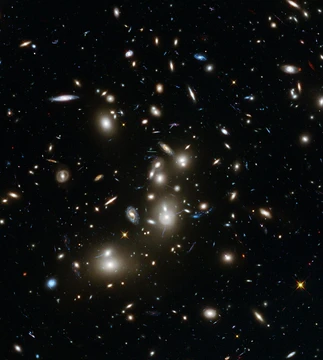
Coma Cluster
A rich galaxy cluster with over 1,000 members and abundant dark matter.

The Coma Cluster, also cataloged as Abell 1656, is a massive galaxy cluster home to more than 1,000 known galaxies. It forms one half of the Coma Supercluster, sharing that distinction with the Leo Cluster (Abell 1367). The cluster lies in the constellation Coma Berenices, from which it gets its name, and holds a place in astronomical history as one of the first galaxy clusters noted in scientific literature—William Herschel observed it visually in 1785, and Max Wolf conducted a photographic survey in 1901.
On average, the Coma Cluster sits about 99 megaparsecs (321 million light-years) from Earth. Its ten brightest spiral galaxies shine with apparent magnitudes between 12 and 14, making them visible through amateur telescopes with apertures larger than 20 centimeters. At the cluster’s core, two supergiant elliptical galaxies—NGC 4874 and NGC 4889—dominate the scene. The cluster lies just a few degrees from the north galactic pole on the sky, and its central region is populated mostly by elliptical galaxies, including both dwarf and giant varieties.
The cluster’s members are overwhelmingly elliptical and S0 galaxies, with only a few younger spiral galaxies, many of which likely reside near the cluster’s outskirts. Some galaxies within the Coma Cluster have also been identified as ultra diffuse galaxies. Although many individual galaxies in the cluster had been spotted earlier, astronomers at Mount Palomar Observatory only fully grasped the cluster’s extent during more thorough studies in the 1950s.
The Coma Cluster is famous as one of the first places where gravitational anomalies hinted at unseen mass. In 1933, Fritz Zwicky observed that the cluster’s galaxies moved too fast for the visible matter alone to hold the cluster together. Though the concept of dark matter wouldn’t gain acceptance for another fifty years, Zwicky wrote that the galaxies must be bound by “dunkle Materie” (dark matter). Today, about 90% of the Coma Cluster’s mass is thought to be dark matter.
An extended X-ray source centered near 1300+28 in the direction of the Coma Cluster was reported before August 1966, detected by balloon, though a sounding rocket flight on November 25, 1964, had not found it. The Uhuru X-ray observatory later spotted a strong X-ray source close to the cluster’s center, suggested to be called Coma X-1.
- Number of identified galaxies
- over 1,000
- Mean distance from earth
- 99 Mpc (321 million light years)
- Apparent magnitudes of ten brightest spi
- 12–14
- Central supergiant elliptical galaxies
- NGC 4874 and NGC 4889
- Percentage of mass believed to be dark m
- about 90%
- X-ray luminosity of source near center
- 2.6 × 10^44 ergs/s
- Size of x-ray source
- about 45 arc-minutes
Lore & Background
The Coma Cluster is one of the first galaxy clusters noted in astronomy literature, visually observed by William Herschel in 1785 and photographically surveyed by Max Wolf in 1901. Its full extent was not understood until the 1950s when astronomers at Mount Palomar Observatory studied it more thoroughly, though many individual galaxies had been identified earlier. The cluster's central region is dominated by two supergiant elliptical galaxies, NGC 4874 and NGC 4889, and most galaxies in the central portion are ellipticals, including both dwarf and giant ellipticals. The cluster is within a few degrees of the north galactic pole on the sky.
In 1933, Fritz Zwicky showed that the galaxies of the Coma Cluster were moving too fast for the cluster to be bound together by visible matter alone, leading him to write that the galaxies must be held together by 'dunkle Materie' (dark matter). About 90% of the cluster's mass is believed to be in the form of dark matter. An extended X-ray source centered near the cluster was reported before August 1966, observed by balloon, though not detected in a 1964 sounding rocket flight. The Uhuru satellite later observed a strong X-ray source near the center, designated Coma X-1, with a luminosity of 2.6 × 10^44 ergs/s and an extended size of about 45 arc-minutes, arguing against a single galaxy being responsible.
Reader's Guide
The Coma Cluster holds a significant place in astronomy as one of the first clusters where gravitational anomalies indicated the presence of unobserved mass. Fritz Zwicky's 1933 work on the cluster's galaxy velocities provided early evidence for dark matter, though the concept was not accepted for another fifty years. The cluster's X-ray emission, first detected by balloon and later confirmed by the Uhuru satellite, revealed an extended source that could not be attributed to a single galaxy, highlighting the cluster's diffuse hot gas. The cluster's richness—over 1,000 identified galaxies, mostly elliptical and S0 types—and its role as one of two major clusters in the Coma Supercluster make it a key object for studying galaxy evolution and large-scale structure. The discovery of ultra diffuse galaxies within the cluster further adds to its importance. Discrepancies in early X-ray observations, such as differing source strengths at 25 keV between balloon and Uhuru measurements, remain unresolved in the source article.
Did You Know?
- The Coma Cluster was visually noted by William Herschel in 1785.
- Fritz Zwicky coined the term 'dunkle Materie' (dark matter) based on the cluster's galaxy motions in 1933.
- The cluster contains about 800 galaxies within a 100 × 100 arc-min area of the celestial sphere.
- The X-ray source Coma X-1 has an extended size of about 45 arc-minutes.
More in Galaxy Clusters and Groups 1-24
Spotted an error? Know more?
Reader corrections go straight into our review queue. Suggest an edit · How this site is sourced