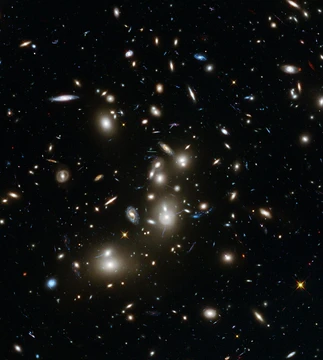
CL0024+17
A galaxy cluster revealing dark matter through gravitational lensing.

CL0024+17, also known as CL0024+1654, is a galaxy cluster in the constellation Pisces, approximately 4 billion light years distant. It is notable for its large mass, which gravitationally lenses a background galaxy into eight well-resolved images, and for providing strong evidence of dark matter through the discovery of a dark-matter ring near its center, though this ring is disputed by other independent studies.
- Distance
- 4 billion light years
- Constellation
- Pisces
- Radius
- 0.54 mpc
- Mass
- 8.1x10^14 solar masses
- Dark matter percentage
- more than 98% of remaining mass (excluding visible galaxies)
- Lensed images
- eight well-resolved images of a background galaxy
Lore & Background
CL0024+17 appears as a concentration of yellow elliptical and spiral type galaxies. Its large mass gravitationally lenses a background galaxy, creating eight well-resolved images of that galaxy. Blue streaks near the cluster's center are smeared images of very distant galaxies not part of the cluster, distorted because their light is bent and magnified by the cluster's powerful gravity.
Because dark matter does not shine or reflect light, astronomers detect its influence only through gravity's effect on light. By mapping the distorted light from gravitational lensing, astronomers trace how dark matter is distributed in the cluster. This mapping revealed a dark-matter ring near the cluster's center, though this discovery is disputed by other independent studies. The ring's discovery is among the strongest evidence that dark matter exists.
Excluding mass concentrations centered on visible galaxies, more than 98% of the remaining mass in the cluster is dark matter, centered near the brightest galaxies. The distribution of this dark matter is far smoother and more symmetrical than predicted in CDM cosmologies such as Omega-1 and Omega-0.3.
Reader's Guide
CL0024+17 is significant primarily as a laboratory for studying dark matter. Its large mass creates gravitational lensing, allowing astronomers to map the distribution of dark matter by analyzing the distorted light from background galaxies. The discovery of a dark-matter ring near the cluster's center, though disputed by other independent studies, is cited as among the strongest evidence that dark matter exists. The cluster's dark matter distribution is far smoother and more symmetrical than predictions from CDM cosmologies such as Omega-1 and Omega-0.3, challenging those models. With more than 98% of its mass (excluding visible galaxies) in the form of dark matter, CL0024+17 exemplifies how dark matter dominates galaxy clusters. The eight well-resolved lensed images of a single background galaxy provide a rare and detailed probe of the cluster's gravitational field, enabling precise dark matter mapping. Its legacy lies in advancing the observational case for dark matter and testing cosmological simulations.
Did You Know?
- CL0024+17 is about 4 billion light years away in the constellation Pisces.
- Its mass is 8.1x10^14 solar masses, and it has a radius of 0.54 mpc.
- More than 98% of the cluster's mass (excluding visible galaxies) is dark matter.
- A dark-matter ring near the cluster's center was discovered, but this finding is disputed by other independent studies.
More in Galaxy Clusters and Groups 1-24
Spotted an error? Know more?
Reader corrections go straight into our review queue. Suggest an edit · How this site is sourced