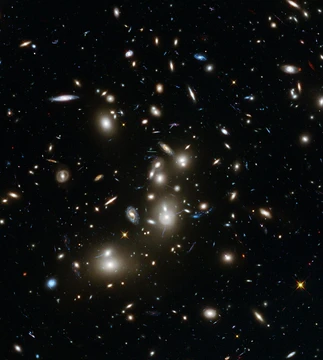
CL J1001+0220
Most distant known galaxy cluster, caught in transformation.

CL J1001+0220 is the most distant known galaxy cluster as of 2026, with a redshift of z=2.506, placing it 11.1 billion light-years from Earth. Discovered in 2016 by the Chandra X-ray Observatory, the ESO's UltraVISTA telescope, and the Atacama Large Millimeter Array, it is notable for being the first observed cluster caught in the transition from a proto-cluster to a mature cluster.
- Redshift
- z=2.506
- Distance
- 11.1 billion light-years
- Discovery year
- 2016
- Discovery telescopes
- Chandra X-ray Observatory, ESO's UltraVISTA telescope, Atacama Large Millimeter Array
- Number of galaxies
- 17
- Star formation rate near core
- 3,400 solar masses per year
- Starburst galaxies near core
- 9 of the 11 massive galaxies
Lore & Background
CL J1001+0220 was discovered in 2016 through a combination of X-ray, infrared, and millimeter observations. It appears to be undergoing the transformation from a still-forming proto-cluster to a mature galaxy cluster, and it is the first such cluster observed in this stage of its evolution. The cluster consists of seventeen galaxies, and nine of the eleven massive galaxies closest to its center are starburst galaxies. These starburst galaxies together are forming new stars at the rate of about 3,400 solar masses per year. In contrast, the Milky Way produces only the equivalent of one solar mass per year, so these galaxies at the core are producing stars at a rate three thousand times greater than the Milky Way on average. Other galaxy clusters at ten billion light years and closer have far less star formation, suggesting that star formation slows down in large galaxies within clusters after the galaxies have already come together during the development of a galaxy cluster.
Reader's Guide
The significance of CL J1001+0220 lies in its unique evolutionary stage and extreme star formation. As the most distant known galaxy cluster as of 2026, it provides a direct view of cluster assembly when the universe was much younger. The cluster is the first observed in the transition from a proto-cluster to a mature cluster, offering a rare snapshot of how galaxies and clusters evolve. The intense star formation at its core—3,400 solar masses per year, compared to the Milky Way's one solar mass per year—indicates that starburst activity is common in the dense core of a forming cluster. The article notes that other clusters at ten billion light-years and closer have far less star formation, which suggests that star formation slows down in large galaxies after they have come together during cluster development. This makes CL J1001+0220 a key object for understanding the processes that govern galaxy evolution in dense environments.
More in Galaxy Clusters and Groups 1-24
Spotted an error? Know more?
Reader corrections go straight into our review queue. Suggest an edit · How this site is sourced