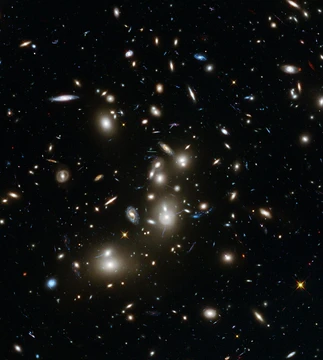
Bullet Group
A merging galaxy group showing dark matter–baryon separation.

The Bullet Group (SL2S J08544-0121) is a newly merging group of galaxies, resulting from a high-speed collision between two galaxy groups. It is notable for exhibiting a separation between its dark matter and baryonic matter components, making it one of the few galaxy clusters known to show such a separation as of 2014, and the smallest mass object to do so.
Quick Facts
- Epoch
- J2000.0
- Constellation
- Hydra
- Ra
- 08 · 54 · 46.5480
- Dec
- -01 · 21 · 37.262
- Redshift
- 0.351
- Names
- Bullet Group, SL2S J08544-0121
Facts from the source article.
Lore & Background
The Bullet Group was discovered in 2008, revealing a bimodal distribution of galaxies. The group is named after the Bullet Cluster, a similar merging cluster, but on a smaller scale—groups instead of clusters. The group's galaxies occur in two clumps, while the gas has expanded into a billowing cloud encompassing all three clumps. The group is dominated by one elliptical galaxy in one concentration, while the other node has two large bright galaxies that do not dominate the group. The group is a gravitational lens, strongly lensing a more distant galaxy at z=~1.2.
Reader's Guide
The Bullet Group's significance lies in its demonstration of the separation between dark matter and baryonic matter during a high-speed merger, a phenomenon previously observed only in larger clusters. As of 2014, it is the smallest mass object known to exhibit this separation, providing a unique laboratory for studying dark matter behavior on a smaller scale. Its gravitational lensing of a distant galaxy further aids in mapping the mass distribution. The group's naming after the Bullet Cluster underscores its role as a smaller analog, helping to extend the understanding of merger dynamics and dark matter properties to galaxy groups.
Did You Know?
- It is the smallest mass object known to exhibit separation between dark matter and baryonic matter as of 2014.
- The group strongly lenses a more distant galaxy at redshift ~1.2.
- The group's galaxies are distributed in two clumps, while the gas forms a billowing cloud encompassing all three clumps.
More in Galaxy Clusters and Groups 1-24
Spotted an error? Know more?
Reader corrections go straight into our review queue. Suggest an edit · How this site is sourced