Bullet Cluster
Colliding galaxy cluster pair providing evidence for dark matter.

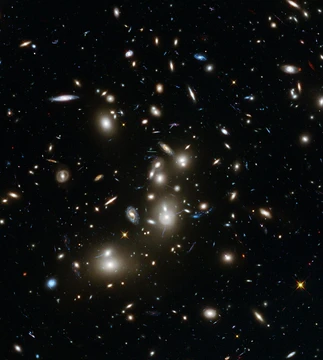
The Bullet Cluster (1E 0657-56) is actually a pair of colliding galaxy clusters, though the name strictly applies to the smaller subcluster, which is moving away from the larger one. Located about 3.72 billion light-years away (a comoving radial distance of 1.141 Gpc), it was first noted in a 1992 paper called "The Einstein Slew Survey." Astrophysicists find it especially important because gravitational lensing observations of this system are often cited as strong evidence for dark matter.
During the collision, the cluster pair's main components—stars, hot gas, and the inferred dark matter—behaved differently, allowing scientists to study them separately. The stars, visible in ordinary light, mostly passed through each other, only slowed by gravity. The hot gas, seen in X-rays, makes up most of the ordinary (baryonic) matter in the pair. Because this gas interacts electromagnetically, it slowed down much more than the stars. The dark matter was detected indirectly through gravitational lensing of background objects, using general relativity. This suggests that most of the gravity in the system comes from two regions of collisionless dark matter that moved past the gas during the crash.
The Bullet Cluster is one of the hottest known galaxy clusters, offering a test for cosmological models that may differ at temperatures above a certain critical threshold. From Earth, we see that the subcluster passed through the main cluster's center about 150 million years ago, creating a bow-shaped shock wave. This formed as 70-million-kelvin gas from the subcluster plowed through 100-million-kelvin gas in the main cluster at nearly 10 million km/h (6 million mph). The shock's radiation output equals the energy of about ten typical quasars.
According to Greg Madejski, Chandra observations by Markevitch et al. (2004) and Clowe et al. (2004) showed that the cluster is undergoing a high-velocity merger (around 4,500 km/s). The hot X-ray gas lags behind the subcluster's galaxies, while the dark matter clump, mapped by weak lensing, aligns with the collisionless galaxies but lies ahead of the collisional gas. This, along with similar observations, places good limits on how strongly dark matter interacts with itself. Eric Hayashi notes that the bullet subcluster's velocity is not unusually high for a cluster substructure and fits within the standard Lambda-CDM model.
Quick Facts
- Epoch
- J2000
- Ra
- 06 · 58 · 37.9
- Dec
- -55 · 57 · 0
- Constellation
- Carina
- Member No
- ~40
- Redshift
- 0.296
- Distance
- 1.141 Gpc (3.7 billion light-years).
- Temperature
- 17.4 ± 2.5 keV
- Luminosity
- 1.4 ± 0.3 × 10 / 39 / h / 50 · −2 / joule/s (bolometric)
- Flux
- 5.6 ± 0.6 × 10 / −19 / watt/cm / 2 / (0.1–2.4 keV)
- Other Names
- 1E 0657-56, 1E 0657-558
Facts from the source article.
Lore & Background
The Bullet Cluster's major components—stars, gas, and putative dark matter—behave differently during collision. Stars, observable in visible light, mostly passed through gravitationally slowed but unaltered. The hot gas of the intracluster medium, seen in X-rays, interacts electromagnetically, slowing much more than the stars. Dark matter was detected indirectly by gravitational lensing of background objects, calculated using general relativity. This supports the idea that most gravitation in the cluster pair is in two regions of collisionless dark matter that bypassed the gas regions during the collision.
The Bullet Cluster is one of the hottest-known clusters of galaxies. Observed from Earth, the subcluster passed through the cluster center 150 million years ago, creating a bow-shaped shock wave as 70 million kelvin gas plowed through 100 million kelvin gas at about nearly 10 million km/h. The bow shock radiation output is equivalent to the energy of 10 typical quasars. According to Greg Madejski, the merger is high-velocity (around 4,500 km/s), with X-ray gas lagging behind subcluster galaxies, and the dark matter clump coincident with collisionless galaxies but ahead of collisional gas. According to Eric Hayashi, the velocity of the bullet subcluster is not exceptionally high and can be accommodated within the Lambda-CDM model. A 2010 study claimed velocities incompatible with LCDM, but subsequent work found consistency, with earlier discrepancy stemming from small simulations and methodology.
Reader's Guide
The Bullet Cluster has been claimed as a significant challenge for modified gravity theories like MOND. Astronomers measured stellar and gas mass using visible and X-ray light, and mapped gravitational potential via gravitational lensing. The X-ray gas is in the center, while galaxies are on the outskirts; the gravitational potential reveals two large concentrations centered on the galaxies, not on the X-ray gas where most normal matter lies. In ΛCDM, dark matter halos would pass through each other during collision, explaining the offset between gravitational potential and X-ray gas detected at 8σ significance. Clowe et al. claimed this as 'A Direct Empirical Proof of the Existence of Dark Matter,' though they made no attempt to analyze the cluster using MOND. Angus et al. demonstrated that MOND does reproduce the offset, as missing mass in MOND centers on regions with accelerations lower than a0, corresponding to galaxy areas. However, MOND still fails to fully explain the cluster due to remaining mass residuals in core regions. Mordehai Milgrom has argued that observed characteristics could be caused by undetected standard matter, such as cold dense hydrogen gas clouds, though such clouds are unlikely due to AGN feedback. Other alternate theories like MOG and Many-body gravity claim to explain the cluster's weak gravitational lensing.
Did You Know?
- The name 'Bullet Cluster' strictly refers to the smaller subcluster moving away from the larger one.
- The bow shock from the collision radiates energy equivalent to 10 typical quasars.
- The offset between gravitational potential and X-ray gas was detected at a statistical significance of 8σ.
- A 2010 study claimed the collision velocities were incompatible with LCDM, but later work found consistency.
More in Galaxy Clusters and Groups 1-24
Spotted an error? Know more?
Reader corrections go straight into our review queue. Suggest an edit · How this site is sourced