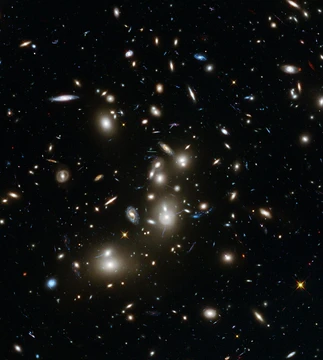
Antlia Cluster
Third-nearest galaxy cluster to the Local Group.

The Antlia Cluster (also known as Abell S0636) is a cluster of galaxies located in the Hydra–Centaurus Supercluster. It is the third-nearest cluster to the Local Group after the Virgo Cluster and Fornax Cluster, with a distance from Earth ranging from 40.5 megaparsecs (132.1 megalight-years) to 40.9 Mpc (133.4 Mly). The cluster can be viewed from Earth in the constellation Antlia and should not be confused with the Antlia Dwarf galaxy.
- Distance range
- 40.5 Mpc (132.1 Mly) to 40.9 Mpc (133.4 Mly)
- Constellation
- Antlia
- Redshift
- z = 0.0087
- Number of galaxies
- about 234
- Bautz morgan type
- III
- Mean x ray temperature
- kT ~ 2.0 keV
- Dominant galaxies
- NGC 3268 and NGC 3258
Lore & Background
The Antlia Cluster is classified as a rare Bautz–Morgan type III cluster, meaning it has no central dominant brightest cluster galaxy. Instead, the cluster is dominated by two massive elliptical galaxies, NGC 3268 and NGC 3258. The cluster contains a total of about 234 galaxies and is very dense compared to other clusters such as Virgo and Fornax, thus containing early-type galaxies and a larger portion of dwarf ellipticals. The cluster is split into two galaxy groups: the Northern subgroup gravitating around NGC 3268, and the Southern subgroup centered on NGC 3258.
Reader's Guide
The Antlia Cluster's significance lies in its status as the third-nearest cluster to the Local Group, after Virgo and Fornax, making it a relatively accessible target for studying galaxy cluster dynamics and evolution. Its classification as a rare Bautz–Morgan type III cluster—lacking a central dominant galaxy—distinguishes it from many other clusters and provides a unique laboratory for understanding how clusters can be structured without a single dominant member. The cluster's high density, compared to Virgo and Fornax, and its composition of early-type galaxies and a large portion of dwarf ellipticals, offer insights into the environmental effects on galaxy formation and evolution. X-ray observations from the now-obsolete satellite ASCA show the cluster is almost isothermal with a mean temperature of kT ~ 2.0 keV, contributing to knowledge of the intracluster medium. The cluster's overall redshift of z = 0.0087 indicates it is receding from the Local Group, consistent with the expansion of the Universe.
More in Galaxy Clusters and Groups 1-24
Spotted an error? Know more?
Reader corrections go straight into our review queue. Suggest an edit · How this site is sourced