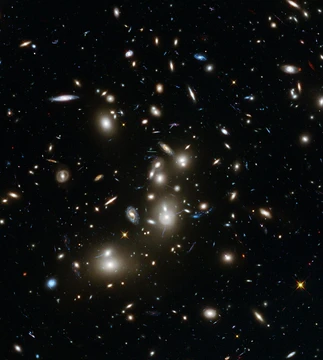
Abell S1063
A gravitational lens revealing faint galaxies from the early universe.

Abell S1063 is a galaxy cluster in the constellation Grus, located 4.5 billion light-years away. Its gravity acts as a lens, bending and magnifying the light of even more distant galaxies behind it. This effect, called gravitational lensing, works like a glass lens to focus and brighten the otherwise faint and distorted images of those far-off galaxies. The cluster was previously studied by the Hubble Space Telescope’s Frontier Fields program, which used it as a natural magnifying glass to explore the early universe. The image of Abell S1063 is a deep field—a long exposure of a single patch of sky, designed to capture as much light as possible from the faintest, most distant galaxies. For the James Webb Space Telescope, this target required nine separate near-infrared snapshots, totaling about 120 hours of observation. Combined with the gravitational lensing effect, this made it Webb’s deepest look at a single object to date, with the potential to reveal some of the very first galaxies that formed.
Quick Facts
- Epoch
- J2000
- Constellation
- Grus
- Ra
- 22 · 48 · 54.3
- Dec
- -44 · 31 · 07
- Redshift
- 0.351
Facts from the source article.
Lore & Background
Abell S1063 was previously observed by the NASA/ESA Hubble Space Telescope’s Frontier Fields program before the James Webb Space Telescope researched the cluster. The galaxy cluster creates a gravitational lens and distorts galaxies behind it as a result of its gravity. Like a glass lens, it focuses the light from these faraway galaxies, producing images that are distorted but bright and magnified enough to be observed and studied. This was the aim of Hubble’s observations, using the galaxy cluster as a magnifying glass to investigate the early universe.
The image of Abell S1063 is what is known as a deep field – a long exposure of a single area of the sky, collecting as much light as possible to draw out the most faint and distant galaxies that do not appear in ordinary images. With 9 separate snapshots of different near-infrared wavelengths of light, totaling around 120 hours of observation time and aided by the magnifying effect of gravitational lensing, this is Webb’s deepest gaze on a single target to date. Focusing such observing power on a massive gravitational lens, like Abell S1063, therefore has the potential to reveal some of the very first galaxies formed in the early universe.
Reader's Guide
Abell S1063 is significant because it serves as a powerful gravitational lens, magnifying and brightening distant galaxies that would otherwise be too faint to observe. The cluster was first studied by Hubble’s Frontier Fields program, which aimed to use such clusters as natural magnifying glasses to investigate the early universe. The James Webb Space Telescope later observed the cluster, producing its deepest gaze on a single target to date. By combining 120 hours of observation across 9 near-infrared snapshots with the lensing effect, Webb has the potential to reveal some of the very first galaxies formed in the early universe. The cluster is surrounded by glowing streaks of light, which are faint galaxies from the beginning of the universe. Its legacy lies in enabling astronomers to study these primordial galaxies, providing a window into cosmic history that ordinary imaging cannot achieve.
Did You Know?
- Abell S1063 is located in the constellation Grus.
- The cluster lies 4.5 billion light-years from Earth.
- Webb’s observation of Abell S1063 is its deepest gaze on a single target to date.
More in Galaxy Clusters and Groups 1-24
Spotted an error? Know more?
Reader corrections go straight into our review queue. Suggest an edit · How this site is sourced