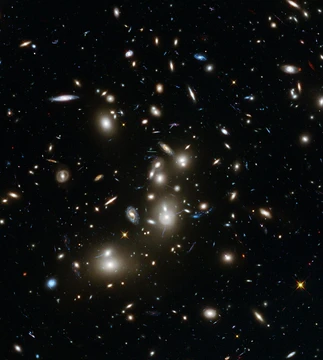
Abell 478
X-ray luminous cluster with one of the largest cooling flows.

Abell 478 is a galaxy cluster from the Abell catalogue that emits strongly in X-rays. It has been extensively observed by a range of X-ray telescopes, including EXOSAT, the Einstein Observatory, ROSAT, the Chandra X-ray Observatory, XMM-Newton, and ASCA, as well as by the Very Long Baseline Array. The cluster is considered one of the largest known cooling flow cores, with a cooling rate of about 1,000 solar masses per year.
The cluster’s center has a temperature of 2.46 keV, while its outer regions reach 4.14 keV, indicating a cool flow core. Its X-ray morphology is nearly circular, with an ellipticity of 0.2, though some analyses using high-resolution ROSAT images have rejected this near-circular shape, finding it significantly elliptical instead. The intracluster medium (ICM) is described as hot, smooth, and dilute, centered on the cD galaxy PGC 14685.
Chandra detected two X-ray cavities within the central 15 megaparsecs of Abell 478. These cavities are thought to result from past activity of the central supermassive black hole (SMBH). The current radio lobes are much smaller than the cavities, and the present radio strength is at least ten times weaker than the minimum needed to create them, suggesting the SMBH was far more active in the past. The jets and cavities are not perfectly aligned, with misalignments of 37.7° and 34.8°, a pattern also seen in clusters like Abell 2390 and Abell 496.
Four hotspots in the ICM have been detected, each about twice as hot as the surrounding gas. The excess energy in these hotspots is roughly ten times the energy required to create the X-ray cavities, implying they were formed by strong shocks from jets of the active galactic nucleus (AGN).
Studies of the cluster’s dark matter have produced conflicting results. One analysis found a cuspy dark matter profile with an inner slope of n = 1, consistent with the cold dark matter (CDM) model. Another study, however, characterized the profile as a soft core with a logarithmic slope of 0.35 ± 0.22, significantly flatter than the NFW profile (slope 1.0). This softer profile is consistent with other clusters hosting a cD galaxy, suggesting the cD galaxy may have modified the dark matter distribution.
There is evidence of extra gas absorbing X-rays from the cluster, with an excess X-ray absorption (N_H) of about 4–5 × 10²¹ cm⁻².
Quick Facts
- Epoch
- J2000
- Constellation
- Taurus
- Ra
- 04 · 13 · 20.7
- Dec
- +10 · 28 · 35
- Richness
- 2
- Redshift
- 0.0881 (26 412 km/s)
- Distance
- 367 Mpc 0.705
- Temperature
- 7.94 keV
- Mass
- 7.6814
- Flux
- (7.9 ± 1.1)-11 erg s / −1 / cm / −2 / (0.1–2.4 keV)
- Other Names
- ZwCl 0410.8+1023; MCXC J0413.4+1028; SWIFT J0413.5+1027; XSS J04127+1029; RX J0413.4+1027; RXGCC 165
Facts from the source article.
Lore & Background
Abell 478 has been observed by a range of X-ray observatories and satellites including EXOSAT, Einstein Observatory, ROSAT, Very Long Baseline Array, Chandra X-ray Observatory, XMM-Newton, and ASCA. The Chandra X-ray Observatory detected two X-ray cavities within the central 15 MPC of the cluster, attributed to past activity of the central supermassive black hole. Current radio lobes are much smaller than the cavities, and the current radio strength is at least 10 times smaller than the minimum needed to create the cavities, indicating the black hole was significantly more active in the past. A dusty quasar was found in the background, detected by the James Clerk Maxwell Telescope. The cluster's center has a temperature of 2.46 keV, while outer regions are 4.14 keV, indicating a cool flow core. Four hotspots in the intracluster medium are twice as hot as surrounding gas, with excess energy about 10 times that needed to create the X-ray cavities, suggesting they are created by strong shocks from jets of the central active galactic nucleus. The jets and cavities are not perfectly aligned, with misalignments of 37.7° and 34.8°, a pattern seen in other clusters such as Abell 2390 and Abell 496.
Reader's Guide
Abell 478 is significant as a dynamically relaxed galaxy cluster with one of the largest cooling flows ever observed, at roughly 1000 solar masses per year. Its X-ray morphology is described as near circular with an ellipticity of 0.2, supporting dynamical relaxation, though a separate analysis using high-resolution ROSAT images rejected this and found it significantly elliptical. The cluster exhibits an excess X-ray absorption of about 4–5 × 10²¹ cm⁻², which one analysis suggests is of Galactic rather than extragalactic origin. Dark matter studies have yielded conflicting results: one found a cuspy profile with inner slope n = 1, consistent with the cold dark matter model, while another found a soft core with logarithmic slope 0.35 ± 0.22, flatter than the NFW profile, attributed to modification by the central cD galaxy (PGC 14685). The presence of two X-ray cavities and misaligned jets indicates past AGN activity that has changed direction over time. A marginal carbon monoxide detection found a modest amount of neutral hydrogen. The cluster's legacy lies in its role as a laboratory for studying cooling flows, AGN feedback, and dark matter distribution in clusters with a central dominant galaxy.
Did You Know?
- Abell 478 has one of the largest cooling flows ever observed, with a cooling rate of ~1000 solar masses per year.
- Two X-ray cavities were detected within the central 15 MPC, caused by past activity of the central supermassive black hole.
- The dark matter profile of Abell 478 is disputed: one study found a cuspy profile (n=1), another found a soft core (slope 0.35 ± 0.22).
More in Galaxy Clusters and Groups 1-24
Spotted an error? Know more?
Reader corrections go straight into our review queue. Suggest an edit · How this site is sourced