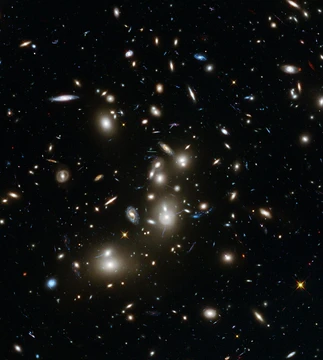
Abell 3266
A large southern galaxy cluster with a fast-moving gas mass.

Abell 3266 is a galaxy cluster located in the southern sky and belongs to the Horologium-Reticulum Supercluster. In the southern hemisphere, only the Shapley Supercluster (with 28 clusters) and the Sculptor Superclusters (with 25 clusters) are larger. The Horologium-Reticulum Supercluster itself contains 35 galaxy clusters and is one of the most massive concentrations of matter in the nearby universe.
A team from the Department of Physics at the University of Maryland, Baltimore County found a vast gas cloud moving through Abell 3266 at 750 km/s (466 miles per second). This gas mass, with a diameter of roughly 3 million light-years and a mass of billions of suns, was the largest object of its kind known as of June 2006.
The cluster’s central dominant galaxy, designated WISEA J043113.14-612712.3, is a large, bright, moderately elongated elliptical. It has an effective radius of 98.44 kpc (about 321,000 light-years) and an absolute magnitude of M_V = -24.51. Abell 3266 has at least 100 confirmed member galaxies and has been cited in more than 1,400 scientific papers.
Quick Facts
- Epoch
- J2000
- Constellation
- Reticulum
- Ra
- 04 · 31 · 12
- Dec
- -61 · 28 · 00
- Richness
- 2
- Bmtype
- I-II
- Velocity Dispersion
- 3.136 km/s
- Redshift
- 0.05890 (17 658 km/s)
- Distance
- 248 Mpc 0.705
- Flux
- 3.5-11 erg s / −1 / cm / −2 / (0.5–2 keV)
Facts from the source article.
Lore & Background
Abell 3266 is a galaxy cluster in the southern sky that belongs to the Horologium-Reticulum Supercluster, which has one of the largest mass concentrations in the nearby universe and contains a total of 35 galaxy clusters. It is one of the largest clusters in the southern sky, after the Shapley Supercluster (28 clusters) and the Sculptor Superclusters (25 clusters).
The Department of Physics at the University of Maryland, Baltimore County discovered that a large mass of gas is hurtling through the cluster at a speed of 750 km/s (466 miles/second). This gas mass is billions of solar masses, approximately 3 million light-years in diameter, and as of June 2006 was the largest of its kind discovered.
The central dominant galaxy of Abell 3266, designated WISEA J043113.14-612712.3, is a large, bright, moderately elongated elliptical galaxy with an effective radius of 98.44 kpc (approximately 321,000 light years) and an absolute magnitude of M_V = -24.51. The cluster has at least 100++ confirmed members and has been referenced in over 1400 scientific papers.
Reader's Guide
Abell 3266 is significant as one of the largest galaxy clusters in the southern sky, part of the Horologium-Reticulum Supercluster, which itself contains one of the largest mass concentrations in the nearby universe. Its discovery of a massive gas cloud—billions of solar masses, 3 million light-years across, moving at 750 km/s—was the largest such structure found as of June 2006, highlighting dynamic processes within clusters. The cluster's central elliptical galaxy, with its large effective radius and bright absolute magnitude, serves as a key reference point. With over 1400 scientific papers citing it, Abell 3266 is a well-studied object that contributes to understanding supercluster-scale structure and intracluster gas dynamics. Its legacy lies in providing a benchmark for studies of cluster mergers and gas motions in the nearby universe.
Did You Know?
- Abell 3266 is part of the Horologium-Reticulum Supercluster, which has 35 galaxy clusters.
- A gas mass billions of solar masses hurtles through the cluster at 750 km/s.
- The central dominant galaxy has an effective radius of approximately 321,000 light years.
More in Galaxy Clusters and Groups 1-24
Spotted an error? Know more?
Reader corrections go straight into our review queue. Suggest an edit · How this site is sourced