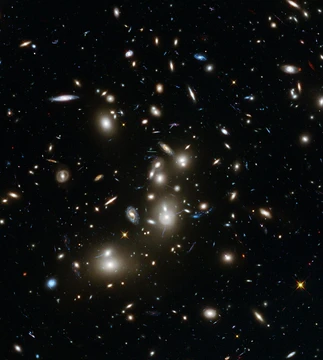
Abell 2744
A giant merging cluster with high dark matter and strong lensing.

Abell 2744, also known as Pandora's Cluster, is a massive galaxy cluster formed when at least four smaller clusters crashed together over 350 million years. It lies about 4 billion light-years from Earth. The cluster's mass is mostly dark matter (roughly 75 percent), with hot gas making up about 20 percent—so hot it only glows in X-rays—and the galaxies themselves accounting for less than 5 percent. The cluster also hosts a radio halo with a strong central component and an extended tail, which might be leftover radiation or part of the main halo. Team member Renato Dupke explained the nickname came from the "many different and strange phenomena" the collision unleashed.
The cluster's structure is unusually dynamic, with gravitational lensing and X-ray data revealing eight massive substructures. The main merger is between a northern and southern subcluster, seen nearly head-on, with the southern part in front. A smaller interloper is falling in from the northwest. This high number of substructures suggests the cluster is undergoing intense change, offering insights into how galaxies assemble into clusters—the final stage in ΛCDM cosmology. A 2025 analysis using polycyclic aromatic hydrocarbons (PAH) to trace star formation found that nearly all star-forming galaxies in Abell 2744 sit in low-density areas at the cluster's edges, implying that as galaxies fall inward, ram pressure strips their gas and shuts down star formation.
Because merging clusters are among the universe's strongest gravitational lenses, Abell 2744 has been used to magnify light from objects up to 12 billion years old, when the first stars and galaxies formed. Deep-field observations include the UNCOVER program on the James Webb Space Telescope, the Hubble Frontier Fields, and X-ray imaging by Chandra. Notable discoveries in this patch of sky include the most distant known quasar, UHZ1, and the distant galaxies UNCOVER-z12 and UNCOVER-z13.
- Distance from earth
- approximately 4 billion light years
- Mass composition
- galaxies less than 5%, gas around 20%, dark matter around 75%
- Number of merging subclusters
- at least four
- Merger timespan
- 350 million years
- Nickname
- Pandora's Cluster
- Number of massive substructures
- eight
Lore & Background
Abell 2744 is a highly dynamic and massive galaxy cluster, with gravitational lensing analyses and X-ray imaging identifying eight massive substructures in an ongoing merger between North and South subclusters, with a minor interloper falling inward from the Northwest. The major North-South merger is seen head-on, mostly out of the plane of the sky, with the southern subcluster in front of the northern subcluster. The number of massive substructures is unusually high for galaxy clusters, and indicates the cluster is undergoing a period of intense change in its formation. Its structure and features could give insights about how galaxies aggregate into clusters, the latest stage in ΛCDM cosmology.
As an example, a 2025 analysis searching for starburst galaxies using the emission spectrum of polycyclic aromatic hydrocarbons (PAH), compounds which are associated with high rates of star formation, found that almost all the star-forming galaxies in the cluster were in low-density areas on the outer edges of the cluster, suggesting star-forming galaxies are quenched as they fall into a cluster and ram pressure strips them of gas and dust. The cluster also shows a radio halo along with several other Abell clusters, with a strong central halo and an extended tail that could either be relic radiation or an extension of the central halo.
Reader's Guide
Abell 2744's significance lies in its role as a natural laboratory for studying galaxy cluster mergers and the behavior of dark matter. As a merging cluster, it is one of the strongest gravitational lenses in the universe, magnifying the light of distant objects from up to 12 billion light years ago, when the first stars and galaxies were forming. Many deep-field images have been taken of Abell 2744, including projects like UNCOVER on the James Webb Space Telescope, Hubble Frontier Fields on the Hubble Space Telescope, and X-ray imaging by the Chandra X-Ray Observatory. Notable discoveries in the cluster's region of the sky include the most distant known quasar, UHZ1, and the distant galaxies UNCOVER-z12 and UNCOVER-z13. The cluster's high number of massive substructures and ongoing merger provide insights into how galaxies aggregate into clusters, the latest stage in ΛCDM cosmology. Its nickname, Pandora's Cluster, was explained by team member Renato Dupke: 'We nicknamed it “Pandora's Cluster” because so many different and strange phenomena were unleashed by the collision.'
Did You Know?
- The cluster's mass is about 75% dark matter, less than 5% galaxies, and around 20% hot gas that shines only in X-rays.
- It is the result of a simultaneous pile-up of at least four smaller galaxy clusters over 350 million years.
- Almost all star-forming galaxies in the cluster are found in low-density areas on its outer edges, suggesting ram pressure quenching.
More in Galaxy Clusters and Groups 1-24
Spotted an error? Know more?
Reader corrections go straight into our review queue. Suggest an edit · How this site is sourced